
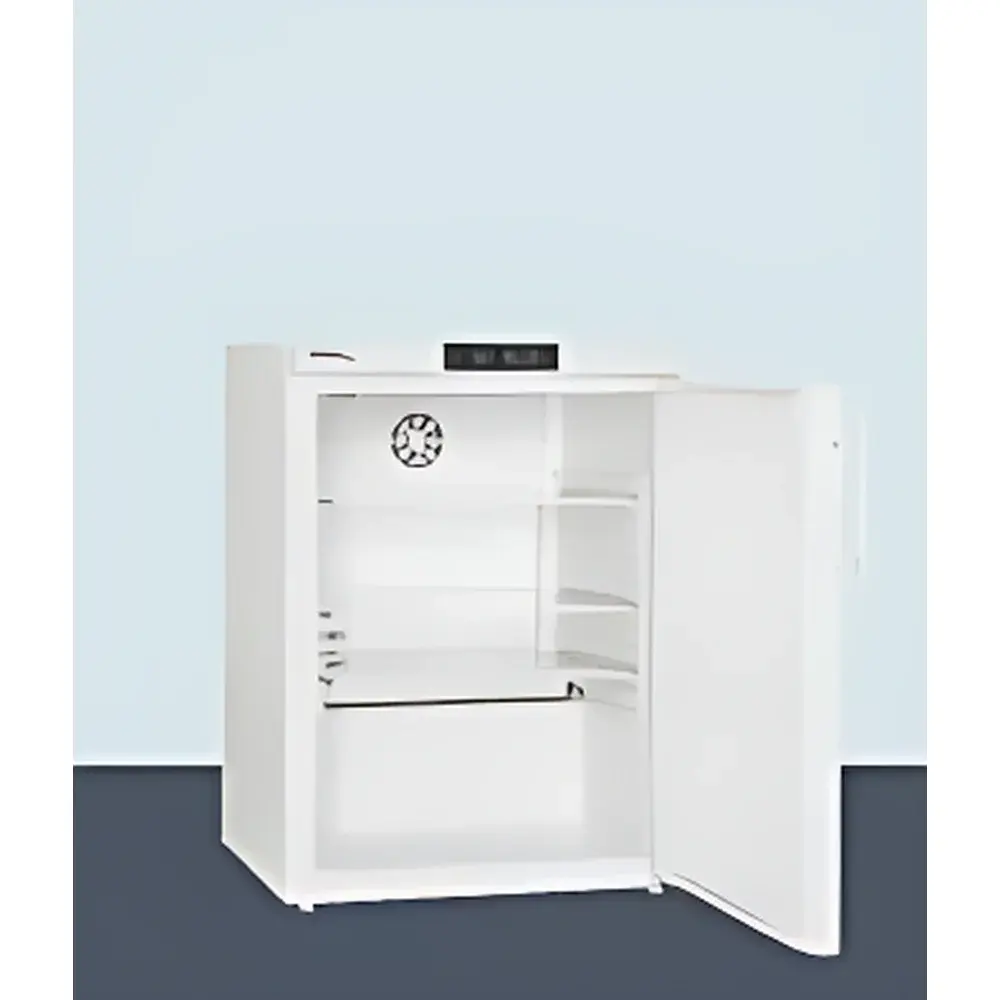
Liebherr LKUexv 1610 Explosion-Proof Laboratory Refrigerator
| Brand | Liebherr |
|---|---|
| Origin | Austria |
| Model | LKUexv 1610 |
| Type | Upright |
| Capacity | 141 L |
| Temperature Range | +3 °C to +16 °C |
| Dimensions (W×D×H) | 600 × 615 × 820 mm |
| Energy Consumption | 0.863 kWh/24h |
| ATEX Certification | Compliant with Directive 2014/34/EU (ATEX 95) |
| Control Precision | ±0.1 °C |
| Alarm Functions | Temperature deviation, door open, sensor fault, power failure |
| Data Interface | RS485 (supports up to 20 units), dry contact output, optional external PT100 probe |
| Defrosting | Automatic, spark-free design |
| Refrigerant | R600a |
| Climate Class | SN-ST (ambient 10–38 °C) |
| Noise Level | ≤42 dB(A) |
| Shelf Load Capacity | Glass shelf up to 40 kg, plastic drawer up to 24 kg |
| Locking | High-security mechanical lock |
| Ergonomic Handle | Stainless steel, slim-profile |
Overview
The Liebherr LKUexv 1610 is a CE-marked, ATEX-certified explosion-proof laboratory refrigerator engineered for the secure, temperature-stable storage of flammable liquids, volatile solvents, combustible powders, and other hazardous substances in regulated research and quality control environments. Designed and manufactured in Austria under strict adherence to EU Directive 2014/34/EU (ATEX 95), this upright unit operates within a precisely controlled range of +3 °C to +16 °C—covering the majority of ICH, USP, and ISO-compliant storage requirements for reagents, standards, reference materials, and biological samples sensitive to thermal drift. Its refrigeration system employs a hermetically sealed, spark-free compressor architecture and R600a hydrocarbon refrigerant—a low-GWP, high-efficiency alternative aligned with F-Gas Regulation (EU) No 517/2014. The cabinet’s thermal uniformity is maintained across all zones via forced-air circulation and multi-point sensor feedback, ensuring spatial temperature deviation remains within ±0.3 °C at setpoint—a critical performance benchmark for GLP and GMP-aligned laboratories.
Key Features
- ATEX-certified explosion protection: Full compliance with Category 2G (gas/vapour) and Category 2D (dust) per EN 60079-0, EN 60079-15, and EN 60079-31; certified by notified body TÜV Rheinland.
- Precision electronic temperature control: Microprocessor-based regulation with 0.1 °C resolution and real-time PID adjustment; maintains setpoint stability within ±0.2 °C under standard load conditions.
- Comprehensive alarm architecture: Four independent monitoring channels (temperature excursion, door status, sensor integrity, mains interruption) with audible/visual alerts and non-volatile memory storing the last three alarm events—including timestamps, duration, and trigger cause.
- Remote monitoring & integration readiness: RS485 Modbus RTU interface enables centralized logging of temperature profiles, alarm history, and operational status for up to 20 units; dry-contact outputs support building management systems (BMS) or PLC-based environmental surveillance.
- Energy-optimized design: Annual energy consumption of ≤315 kWh (based on ISO 15502 test conditions); achieves EU Energy Label class A+ rating with noise emission limited to ≤42 dB(A) at 1 m distance.
- Robust mechanical construction: Stainless steel interior and exterior panels; reinforced glass shelves rated for 40 kg static load; ergonomic slim-profile handle; high-security three-point mechanical lock with dual-key access control.
Sample Compatibility & Compliance
The LKUexv 1610 is validated for long-term storage of Class I (flammable liquid), Class II (combustible dust), and Class III (ignitable fibres/flyings) materials as defined under NFPA 497 and IEC 60079-10-1. Its temperature stability profile supports storage protocols required by USP , ISO 20387:2018 (biobanking), and ASTM E2500-13 (verification of laboratory equipment). The unit complies with electromagnetic compatibility (EMC) per EN 61326-1 and electrical safety per EN 61010-1. All internal surfaces are non-porous and chemically resistant to common laboratory solvents including acetone, ethanol, ethyl acetate, and diethyl ether—facilitating decontamination without compromising structural integrity.
Software & Data Management
While the LKUexv 1610 operates via embedded firmware without proprietary cloud software, its RS485 interface delivers raw, timestamped temperature data at user-configurable intervals (1–60 min), compatible with industry-standard SCADA platforms (e.g., Siemens Desigo, Schneider EcoStruxure), LabVantage LIMS, and custom Python/Node-RED data ingestion pipelines. Audit trail functionality meets FDA 21 CFR Part 11 requirements when integrated with validated third-party data loggers that provide electronic signatures, role-based access control, and immutable record retention. Optional external PT100 probe integration allows independent verification of chamber temperature against primary control sensor—supporting IQ/OQ validation protocols.
Applications
- Storage of organic solvents (e.g., methanol, hexane, toluene) and peroxide-forming compounds in university chemistry and pharmaceutical synthesis labs.
- Secure holding of calibration standards, certified reference materials (CRMs), and QC samples requiring stable ambient-temperature conditioning per ISO/IEC 17025 clause 7.6.
- Pre-analytical sample staging in clinical diagnostics labs handling volatile metabolites or unstable biomarkers.
- Long-term archiving of catalysts, initiators, and reactive monomers in polymer R&D facilities operating under OSHA 1910.106 and DSEAR 2002 regulatory frameworks.
- Backup cold storage for biobanks where −20 °C freezers are unavailable or unsuitable for heat-sensitive intermediates.
FAQ
Does the LKUexv 1610 require special electrical installation?
No—unit operates on standard 230 V AC / 50 Hz single-phase supply with integrated overcurrent and surge protection; no dedicated earth ground beyond standard lab circuit requirements.
Can the temperature setpoint be locked to prevent unauthorized changes?
Yes—password-protected parameter access mode restricts modification of setpoint, alarms, and calibration offsets to authorized personnel only.
Is validation documentation provided with the unit?
Yes—each unit ships with Factory Acceptance Test (FAT) report, ATEX certificate, Declaration of Conformity, and traceable calibration certificate for the primary temperature sensor.
What maintenance intervals are recommended?
Condenser coil cleaning every 6 months; annual verification of door gasket integrity and alarm functionality; biennial recalibration of control sensor against NIST-traceable reference standard.
Is remote firmware update supported?
No—firmware is fixed at time of manufacture to ensure deterministic behavior and regulatory compliance; updates require factory service intervention with full revalidation support.



