
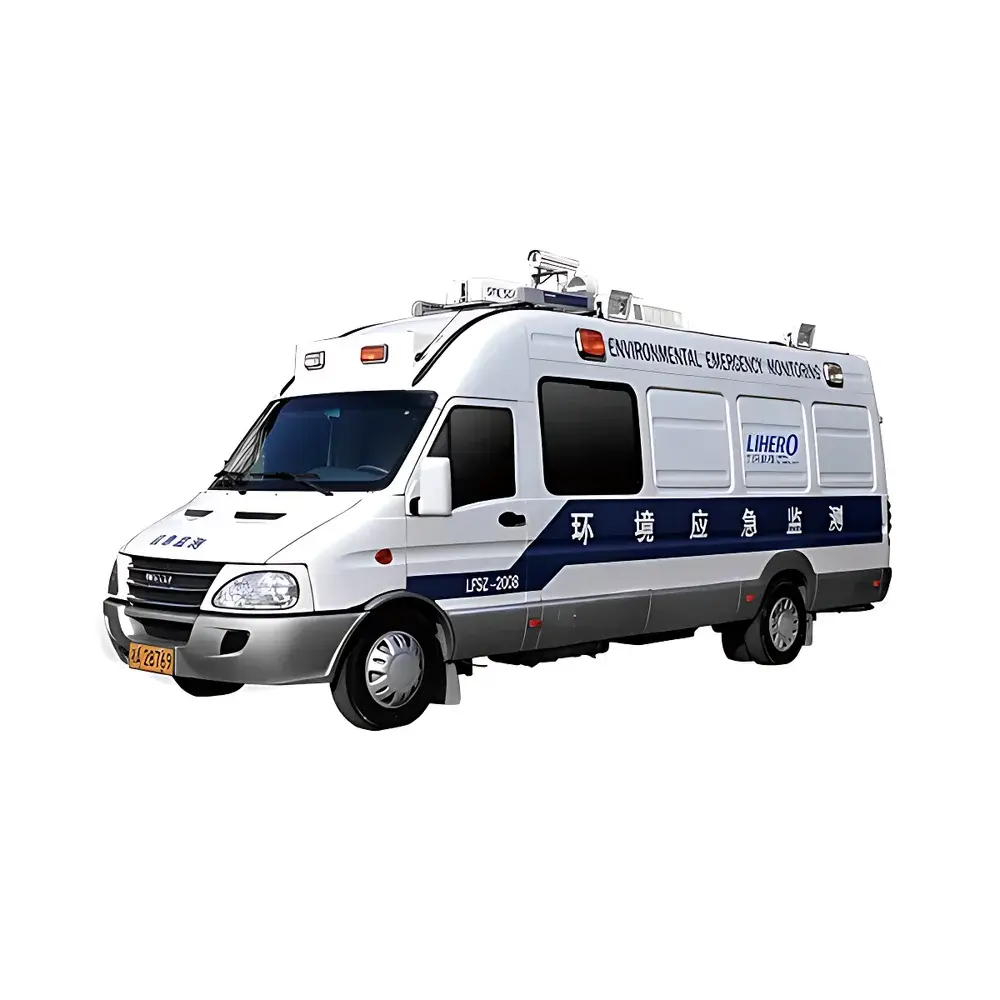
Lihero LFSZ-2008 Mobile Water Quality Monitoring System
| Brand | Lihero |
|---|---|
| Origin | Hunan, China |
| Model | LFSZ-2008 |
| Mounting Platform | Vehicle-integrated mobile laboratory |
| Configuration | Modular, fully automated water analysis system |
| Compliance Framework | Designed for ISO/IEC 17025-aligned operational workflows, supports GLP/GMP traceability requirements (audit trail, sample ID logging, QC event recording) |
| Data Transmission | Real-time secure telemetry to central emergency command platforms via 4G/LTE and optional satellite uplink |
| Analytical Scope | >100 water quality parameters including but not limited to pH, conductivity, turbidity, DO, COD, NH₃-N, TN, TP, heavy metals (As, Cd, Pb, Hg, Cr⁶⁺), organic micropollutants (via onboard GC-MS or UV-Vis spectrophotometric modules), and microbial indicators (ATP-based rapid enumeration) |
Overview
The Lihero LFSZ-2008 Mobile Water Quality Monitoring System is a purpose-engineered, vehicle-mounted environmental analytics platform designed for high-tempo field deployment in emergency response, routine patrol, and regulatory compliance verification scenarios. Built upon a robust chassis-integrated architecture, the system integrates modular analytical instrumentation, programmable liquid handling, and embedded environmental sensor arrays into a single, ISO 14644-classified clean-zone cabin. Its core measurement methodology combines multi-channel electrochemical sensing, flow-injection spectrophotometry (FIA-UV/Vis), membrane-based ion-selective detection, and optional on-board gas chromatography–mass spectrometry (GC-MS) for targeted organic compound identification. Unlike static laboratory instruments or handheld field kits, the LFSZ-2008 implements full analytical workflow automation—from probe-based in-situ pre-screening and peristaltic auto-sampling (depth-controlled, temperature-compensated) through reagent dispensing, reaction incubation, optical/electrochemical signal acquisition, and multivariate calibration correction—enabling continuous, unattended operation for up to 72 hours on auxiliary power.
Key Features
- Vehicle-integrated mobility: Configured on certified Class 3 or 4 chassis with climate-controlled, vibration-damped cabin (operational range: −20 °C to +50 °C), compliant with UN ECE R107 rollover safety standards.
- Modular analytical architecture: Swappable sensor cartridges and analyzer modules support rapid reconfiguration between surface water, wastewater, drinking water, and industrial effluent monitoring protocols.
- End-to-end automation: Integrated PLC-driven control logic manages sampling sequence, reagent inventory tracking, waste containment, and scheduled maintenance alerts; no manual intervention required for routine 24/7 operation.
- Embedded quality assurance framework: Real-time QC includes automatic standard reference material (SRM) injections every 4 hours, parallel duplicate analysis (n=2), spike recovery validation (per EPA Method 500/600 series), and drift-corrected calibration curve regeneration.
- Secure data infrastructure: Dual-mode telemetry (4G/LTE primary, Iridium satellite backup) transmits time-stamped, digitally signed datasets with SHA-256 hashing to cloud-hosted emergency command dashboards; all communications adhere to TLS 1.3 encryption standards.
Sample Compatibility & Compliance
The LFSZ-2008 accommodates raw, filtered, digested, and preserved aqueous matrices—including riverine, lacustrine, estuarine, groundwater, municipal wastewater, and industrial discharge streams—with minimal pretreatment. Sample intake utilizes submersible NEMA 4X-rated pumps with self-cleaning vortex impellers and anti-fouling Teflon-coated tubing. All wetted components comply with USP Class VI biocompatibility and NSF/ANSI Standard 61 for potable water contact. The system’s operational documentation and electronic audit trail meet FDA 21 CFR Part 11 requirements for electronic records and signatures, supporting regulatory submissions under EU Water Framework Directive (WFD) Annex V, China’s HJ/T 91–2019, and ASTM D511/D512/D5257 series methods.
Software & Data Management
The onboard Linux-based control software (v4.2.x) provides ISO/IEC 17025-aligned instrument method management, configurable reporting templates (PDF/CSV/XML), and role-based user access (admin, operator, QA reviewer). Data are stored locally on encrypted SSD with RAID 1 redundancy and synchronized hourly to a FIPS 140-2 validated cloud repository. Integration APIs (RESTful JSON over HTTPS) enable interoperability with third-party GIS platforms (e.g., ArcGIS Enterprise), SCADA systems, and national environmental monitoring networks (e.g., China’s National Surface Water Quality Monitoring Network). Full audit logs capture operator actions, calibration events, error codes, and environmental chamber conditions—retained for ≥10 years per GLP retention policies.
Applications
- Rapid source identification during chemical spills or illegal discharge incidents
- Dynamic baseline mapping of watershed health across seasonal hydrological cycles
- Real-time validation of wastewater treatment plant effluent compliance (e.g., TN < 15 mg/L, TP < 0.5 mg/L)
- Support for drinking water safety plans under WHO Guidelines for Drinking-water Quality (GDWQ)
- Field verification of remediation effectiveness at contaminated sediment sites (e.g., PAHs, PCBs, chlorinated benzenes)
- Mobile accreditation-ready testing for third-party environmental inspection agencies
FAQ
What power sources does the LFSZ-2008 support during extended off-grid deployment?
The system operates on dual-input power: 220 VAC shore supply or integrated 24 VDC vehicle alternator charging, backed by a 10 kWh lithium-iron-phosphate (LiFePO₄) battery bank rated for ≥8 hours continuous operation at full analytical load.
Can the system be configured for heavy metal speciation (e.g., Cr(VI) vs. total Cr)?
Yes—optional hyphenated modules include sequential injection–hydride generation–atomic fluorescence spectroscopy (SI-HG-AFS) and ion chromatography–inductively coupled plasma mass spectrometry (IC-ICP-MS), enabling oxidation-state-resolved quantification per ISO 17294-2 and EPA Method 200.8.
How is calibration traceability maintained across field deployments?
Each analyzer module ships with NIST-traceable calibration certificates; field recalibration uses CRM-certified solutions (e.g., NIST SRM 3198 for nitrate, BAM-100 for turbidity), logged automatically with GPS-tagged metadata and operator digital signature.
Is remote diagnostics and firmware update capability available?
Yes—the embedded gateway supports secure SSH tunneling and Over-The-Air (OTA) firmware updates with rollback capability, verified via cryptographic checksum prior to installation.
Does the system meet cybersecurity requirements for critical infrastructure monitoring?
It complies with IEC 62443-3-3 SL2 controls, including network segmentation, application whitelisting, disabled default accounts, and quarterly vulnerability scanning reports generated per NIST SP 800-53 Rev. 4.







