
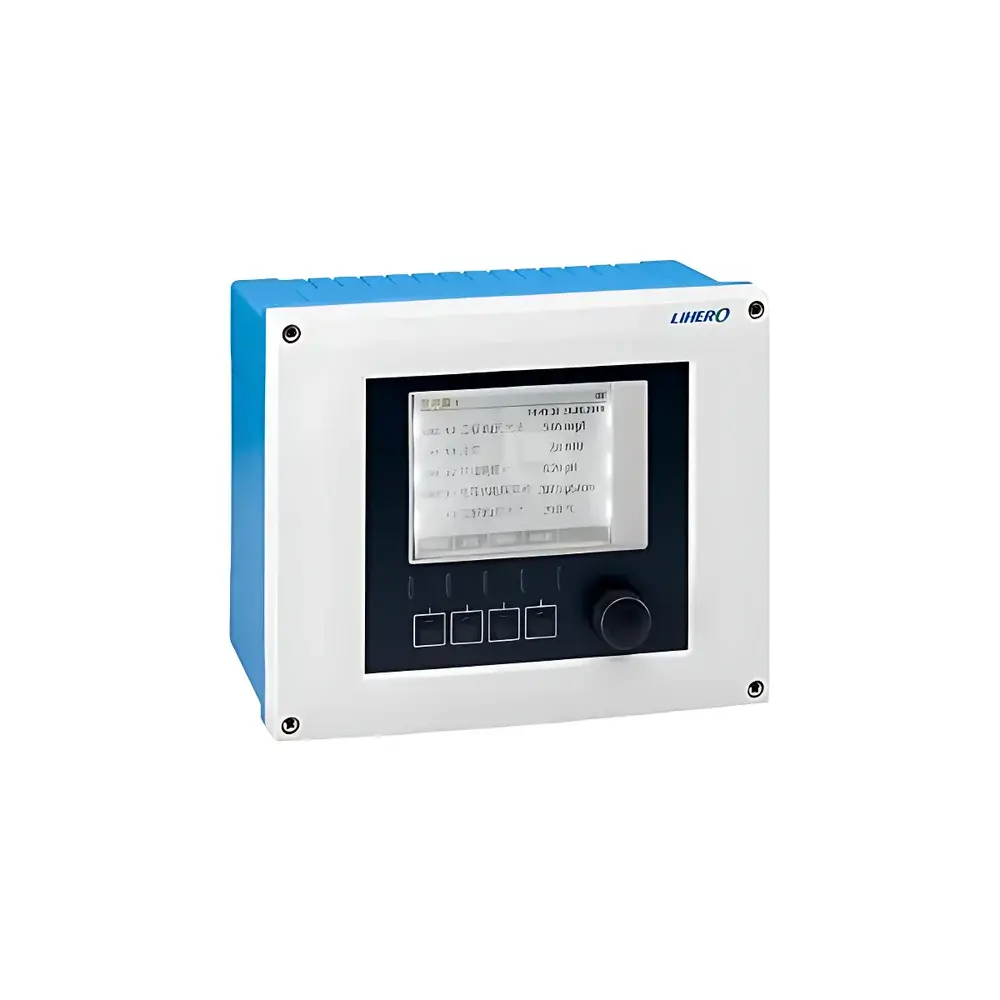
Lihero LFWCS-2008 Conventional Five-Parameter Online Water Quality Monitor
| Brand | Lihero |
|---|---|
| Model | LFWCS-2008 |
| Origin | Hunan, China |
| Instrument Type | Online Monitor |
| Output Signals | 4–20 mA / RS-485 / RS-232 |
| Probe Cleaning | Automatic brush (turbidity), programmable electrode cleaning interface |
| Diagnostic Capabilities | Electrode aging, membrane fouling/rupture/open-circuit detection |
| Insulation Resistance | ≥20 MΩ (power line to chassis) |
| Conductivity Technology | Four-electrode sensor |
| User Interface | Graphical LCD with intuitive calibration workflow |
| Compliance | Designed for continuous environmental monitoring per Chinese HJ/T 96–2003 and ISO 7027 (turbidity), ISO 5814 (DO), ISO 7888 (conductivity), and ASTM D1293 (pH) |
Overview
The Lihero LFWCS-2008 is an industrial-grade, online water quality monitoring system engineered for continuous, unattended measurement of five core physicochemical parameters—pH, dissolved oxygen (DO), electrical conductivity (EC), turbidity, and temperature—in natural waters, wastewater effluents, drinking water distribution networks, and aquaculture systems. Unlike portable or spot-check instruments, the LFWCS-2008 integrates multi-sensor probe assemblies with embedded signal conditioning, real-time diagnostics, and robust environmental hardening for deployment in outdoor cabinets, submersible housings, or fixed station enclosures. Its measurement architecture adheres to internationally recognized electrochemical and optical principles: pH is determined via glass-membrane potentiometry; DO employs polarographic or optical luminescence (configurable); EC utilizes a four-electrode AC-driven sensor to eliminate polarization effects and extend dynamic range; turbidity follows ISO 7027-compliant 90° scattered light detection with integrated mechanical brush cleaning; and temperature is measured via Pt1000 RTD for automatic compensation across all channels. The system operates under ambient temperatures from 0 °C to 50 °C and IP68-rated probe modules ensure long-term stability in submerged or high-humidity environments.
Key Features
- Programmable automatic probe cleaning interface supporting timed or event-triggered actuation of motorized turbidity brushes and optional ultrasonic or chemical cleaning modules.
- Comprehensive electrode health diagnostics—including membrane integrity verification, aging trend analysis, open-circuit detection, and response time monitoring—enabling predictive maintenance scheduling.
- Four-electrode conductivity sensor architecture delivering stable measurements across 0.1 µS/cm to 200 mS/cm without polarization drift or coating-induced hysteresis.
- Isolation-certified electronics with ≥20 MΩ insulation resistance between power input and chassis, meeting IEC 61000-6-2 immunity and IEC 61000-6-4 emission requirements for industrial sites.
- Multi-protocol digital output (Modbus RTU over RS-485, ASCII over RS-232) alongside analog 4–20 mA current loops for seamless integration into SCADA, DCS, or PLC-based supervisory systems.
- Graphical LCD interface with multilingual menu navigation (English default), guided calibration workflows, and on-screen diagnostic logs accessible without external software.
Sample Compatibility & Compliance
The LFWCS-2008 is validated for use in freshwater, estuarine, and secondary-treated wastewater matrices. Its sensor suite meets performance criteria outlined in national and international standards: turbidity measurements conform to ISO 7027 for formazin-based calibration traceability; dissolved oxygen accuracy aligns with ISO 5814 for electrochemical sensors; conductivity resolution satisfies ISO 7888 Class B specifications; and pH response complies with ASTM D1293 for field-deployable electrodes. While not certified to US EPA or EU WFD Annex V requirements out-of-the-box, the system supports configuration and documentation packages necessary for GLP-aligned data acquisition in regulated monitoring programs. All firmware and calibration records retain timestamped audit trails compatible with basic 21 CFR Part 11–aligned data governance practices when deployed with external secure logging infrastructure.
Software & Data Management
The instrument operates autonomously without host PC dependency. Local data storage retains up to 30 days of 1-minute interval readings (pH, DO, EC, turbidity, temp) in non-volatile memory. Configuration, calibration history, and diagnostic events are exportable via USB or serial dump in CSV format. Optional Lihero DataBridge™ gateway firmware enables MQTT/HTTP(S) transmission to cloud platforms (e.g., AWS IoT Core, Azure IoT Hub) with TLS 1.2 encryption and configurable payload compression. No proprietary desktop software is required; configuration is performed via terminal emulation (e.g., PuTTY) or web-based interface when equipped with Ethernet module (LFWCS-2008-E variant).
Applications
- Real-time compliance monitoring at municipal wastewater treatment plant discharge points per local environmental regulations (e.g., China’s GB 18918–2002).
- Early-warning detection of algal bloom precursors via correlated DO depletion, pH elevation, and turbidity spikes in reservoirs and intake canals.
- Process control feedback in membrane bioreactors (MBRs) and activated sludge systems where conductivity and temperature trends indicate salinity shifts or thermal stress.
- Long-term ecological assessment in rivers and lakes under national surface water quality surveillance programs (e.g., China’s National Surface Water Monitoring Network).
- Preventive maintenance support for remote pumping stations where probe fouling risk is elevated due to high suspended solids or organic load.
FAQ
Does the LFWCS-2008 support NIST-traceable calibration?
Yes—calibration solutions for pH (NIST SRM 1691, 1692), conductivity (KCl standards per ISO 7888), and turbidity (formazin or AMCO AEPA-1) are fully compatible. Certificate of conformance is provided with each factory calibration kit.
Can the system operate on solar power?
Yes—the standard 12–24 VDC input range and low average power draw (<3.5 W nominal) make it suitable for solar-battery hybrid deployments. An optional DC-DC converter module ensures stable operation during voltage fluctuations.
Is remote firmware update supported?
Firmware updates require physical USB or serial access for security reasons; over-the-air (OTA) updates are not implemented to maintain data integrity and regulatory traceability.
What is the recommended calibration frequency for field deployment?
Initial calibration before installation; subsequent verification every 7–14 days depending on matrix fouling potential. Turbidity and DO sensors benefit from weekly visual inspection and brush cycle validation.
Does the unit meet explosion-proof requirements for hazardous areas?
No—the LFWCS-2008 is rated for general-purpose industrial environments (IP68 probe, IP65 enclosure). For Zone 1/2 applications, it must be installed within an approved explosion-proof barrier housing or used with intrinsically safe signal isolators.
Related Products







