
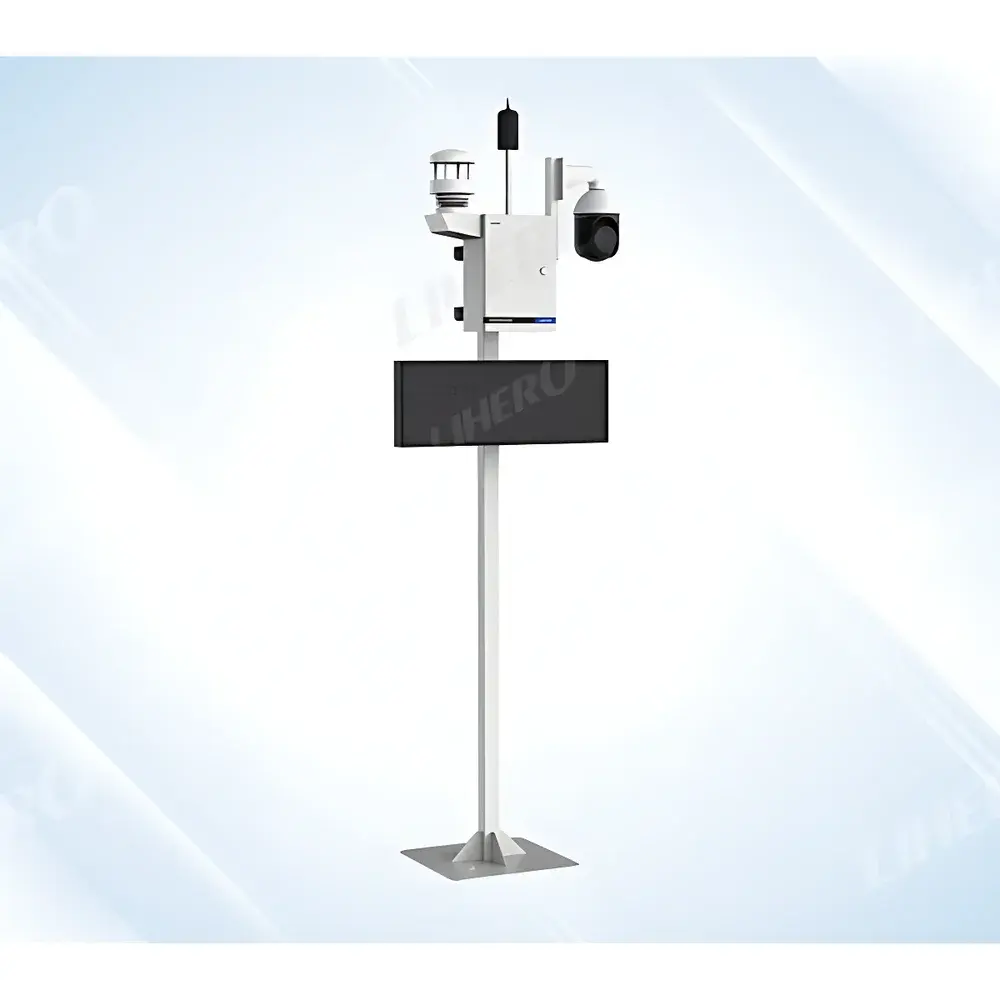
Lihero LHNM-300 Environmental Noise Automatic Monitoring Station
| Brand | Lihero |
|---|---|
| Model | LHNM-300 |
| Compliance | IEC 61672-1:2013 (Class 1), IEC 61252:2017, IEC 61260-1:2014 (1/1 & 1/3-octave), GB/T 3785.1–2010, GB/T 15952–2010, GB/T 3241–2010 |
| Measurement Modes | Simultaneous outdoor monitoring, 1/1-octave band, and 1/3-octave band analysis |
| Data Outputs | L<sub>Aeq</sub>, L<sub>AFmax</sub>, L<sub>AE</sub>, L<sub>An</sub> (e.g., L<sub>10</sub>, L<sub>50</sub>, L<sub>90</sub>), SEL, noise dose |
| Power Supply | Integrated UPS with charge/discharge protection |
| Environmental Rating | IP65 enclosure |
| Communication | RS485 (Modbus RTU), Ethernet, 4G LTE, optional NB-IoT |
| Local Display | Optional high-brightness LED screen (operable at –20 °C to +60 °C) |
| Mounting | Pole-mountable, single-person installation |
Overview
The Lihero LHNM-300 Environmental Noise Automatic Monitoring Station is a Class 1 precision instrument engineered for unattended, long-term acoustic surveillance in ambient and regulatory monitoring networks. It operates on the principle of digital electroacoustic transduction, utilizing a calibrated condenser microphone coupled with a low-noise, temperature-compensated preamplifier and high-resolution 24-bit ADC sampling at ≥48 kHz. The system implements real-time signal processing compliant with IEC 61672-1:2013 for sound level measurement and IEC 61260-1:2014 for fractional-octave spectral analysis. Unlike conventional portable sound level meters, the LHNM-300 is architecturally optimized for continuous outdoor deployment—featuring synchronized concurrent computation across three operational modes: environmental outdoor monitoring (per ISO 1996-2), 1/1-octave band analysis, and 1/3-octave band analysis—eliminating mode-switching latency and ensuring temporal coherence across all derived metrics.
Key Features
- Triple-mode simultaneous acquisition: Outdoor monitoring, 1/1-octave, and 1/3-octave band analysis computed in parallel using shared time-synchronized raw data streams
- Robust outdoor-rated enclosure (IP65) with integrated thermal management, anti-condensation heating element, and UV-stabilized housing for operation from –20 °C to +60 °C
- Comprehensive electrical protection: Built-in surge suppression (IEC 61643-11 compliant), earth leakage circuit interruption (ELCI), and lightning current diversion (10/350 µs waveform, 10 kA nominal)
- Intelligent power architecture: Integrated sealed-lead-acid or LiFePO4 UPS with automatic charge regulation, deep-discharge recovery, and graceful shutdown during extended outages
- Self-diagnostics and resilience: Watchdog-timed automatic reboot on firmware hang; NTP-based auto-time synchronization; internal memory logging with circular buffer (≥30 days at 1-second resolution)
- Optional local interface: High-luminance monochrome LED display supporting real-time LAeq, LAFmax, and statistical percentiles—viewable under direct sunlight
Sample Compatibility & Compliance
The LHNM-300 is validated for measurement of broadband and spectrally structured environmental noise sources—including road traffic, rail, aircraft flyovers, industrial facilities, construction sites, and neighborhood activities. Its microphone sensitivity, frequency response (10 Hz–20 kHz ±0.5 dB), and dynamic range (25–140 dB re 20 µPa) meet Class 1 requirements per IEC 61672-1:2013 and GB/T 3785.1–2010. Spectral analysis adheres strictly to IEC 61260-1:2014 for both 1/1-octave (center frequencies 31.5–8000 Hz) and 1/3-octave (25–10000 Hz) implementations. For occupational and community exposure assessment, it satisfies IEC 61252:2017 for personal sound exposure meter functionality—including dose calculation and peak C-weighted level reporting. All firmware algorithms undergo periodic traceable calibration verification against national metrology institute (NIM)-certified reference systems.
Software & Data Management
- Embedded firmware supports Modbus RTU (RS485), TCP/IP (Ethernet), and LTE-M/4G CAT-1 communication protocols with TLS 1.2 encryption for secure data transmission
- Cloud-ready architecture compatible with MQTT and HTTP(S) POST endpoints; supports configurable reporting intervals (1 s to 1 h) and event-triggered uploads (e.g., LAmax > threshold)
- Web-based remote portal provides real-time waveform visualization, octave spectrograms, historical trend charts, and automated compliance reporting aligned with national noise mapping directives (e.g., EU Directive 2002/49/EC Annex II)
- Audit-trail enabled logging: All configuration changes, calibration events, and system resets are timestamped and digitally signed to support GLP/GMP-aligned environmental data integrity requirements
- Firmware update mechanism includes dual-bank storage and rollback capability—validated via SHA-256 signature verification prior to execution
Applications
The LHNM-300 serves as a foundational node in statutory environmental noise monitoring networks operated by municipal ecological bureaus, transportation authorities, and industrial park environmental departments. It is routinely deployed for: (1) baseline characterization and long-term trend analysis of urban soundscapes per GB 3096–2008; (2) impact assessment of new infrastructure projects (e.g., highway expansions, rail corridors); (3) enforcement-grade monitoring at factory perimeters to verify compliance with GB 12348–2008 industrial noise limits; (4) construction site noise auditing under JGJ/T 121–2018; and (5) social noise complaint investigation where statistical percentile levels (L10, L50, L90) and spectral signatures assist source attribution. Its synchronized multi-mode output enables cross-validation between regulatory metrics (e.g., Lden) and diagnostic spectral features without temporal misalignment.
FAQ
Does the LHNM-300 require annual recalibration? Why?
Yes. Per IEC 61672-1:2013 Clause 8.3, Class 1 instruments used in regulatory monitoring must undergo traceable recalibration at intervals not exceeding 12 months. Field verification using an accredited acoustic calibrator (e.g., Class 1 pistonphone per IEC 60942) is required before each monitoring campaign.
Can the device operate during thunderstorms or heavy rain?
Yes. The unit incorporates Type II surge protection (10/350 µs, 10 kA), galvanic isolation on all signal lines, and IP65-rated ingress protection. However, direct lightning strike mitigation requires proper grounding per IEC 62305-3 and installation of external lightning rods.
Is the data export format compatible with GIS noise mapping platforms?
Yes. Time-stamped CSV and NetCDF4 outputs include geotagged metadata (WGS84 coordinates, elevation, sensor height). Prebuilt connectors exist for ArcGIS NoiseModeller, SoundPLAN, and CadnaA via standardized API endpoints.
What cybersecurity standards does the communication module follow?
The embedded LTE/Ethernet stack complies with IEC 62443-4-2 for secure product development lifecycle and implements TLS 1.2, certificate-based mutual authentication, and firmware signing per NIST SP 800-193 guidelines.
How is microphone wind noise suppressed during outdoor operation?
The system integrates a certified windscreen meeting IEC 61672-3:2013 Annex B specifications (≤0.5 dB insertion loss at 125 Hz, ≤1.5 dB at 1 kHz), combined with adaptive digital wind-noise reduction algorithms that preserve transient fidelity while attenuating low-frequency turbulence artifacts.
Related Products







