
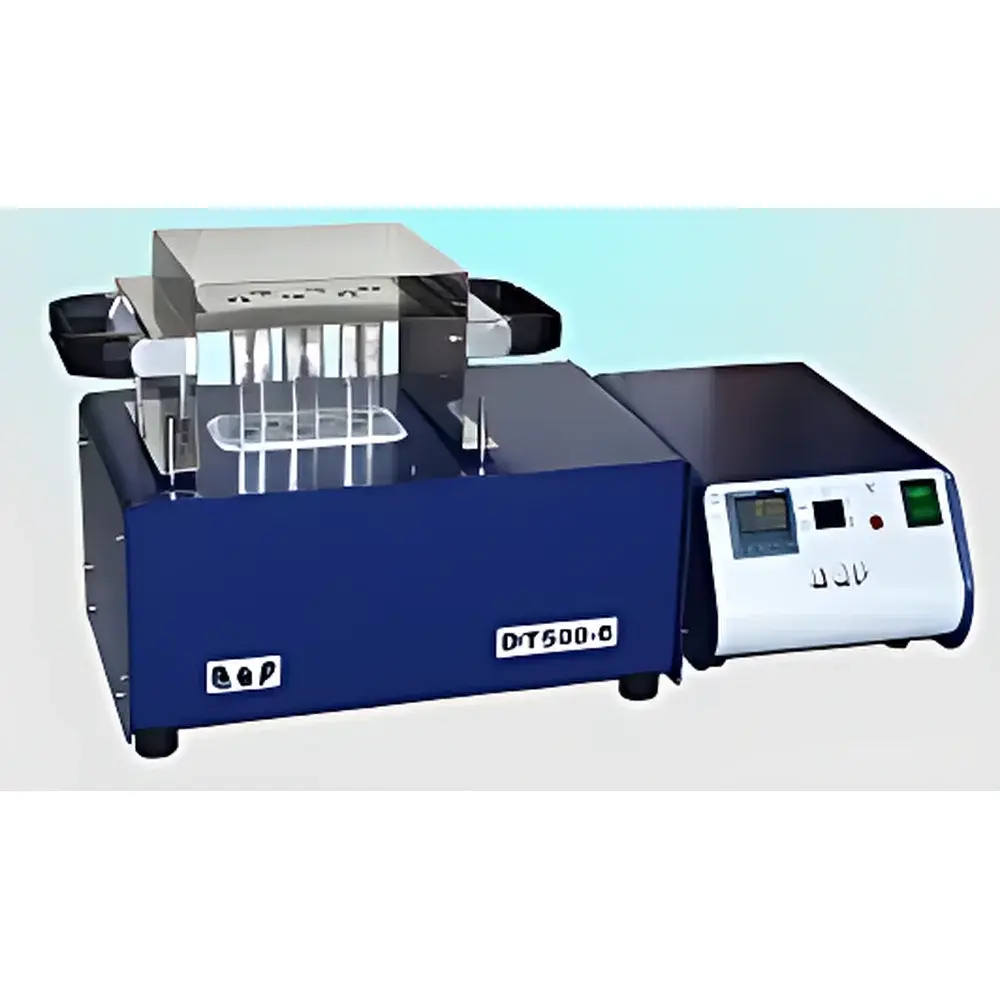
R&P DT400 Explosive Ignition Temperature Tester
| Brand | R&P |
|---|---|
| Origin | Germany |
| Model | DT400 |
| Heating Block Material | Aluminum per DIN 1725 |
| Sample Well Configuration | 3 × Ø16.2 ± 0.1 mm, depth 70 mm (optional 6-well) |
| Temperature Sensor | PT100 probe |
| Max Operating Temperature | 400 °C (optional 500 °C) |
| Heating Rate Range | 5–20 K/min |
| Temperature Control Accuracy | ±0.1 °C |
| Power Consumption | 1600 VA |
| Cooling Block | Integrated for accelerated post-test cooling |
| Sample Tube Dimensions | Ø16 mm × 130 mm (100 pcs included) |
| Controller | PID-based, housed in separate safety-rated control cabinet |
| Display | Digital readout for actual and setpoint temperature |
| Supply Cable Length | ~2 m |
Overview
The R&P DT400 Explosive Ignition Temperature Tester is a precision-engineered thermal analysis instrument designed for the standardized determination of ignition temperature (also referred to as auto-ignition temperature or AIT) of energetic materials—including propellants, pyrotechnic compositions, primary and secondary explosives, and hazardous organic compounds. Based on the principle of controlled, uniform heating under inert or ambient atmospheric conditions, the DT400 implements the test methodology aligned with DIN 1725 (Aluminum heating block specification), ASTM E659 (Standard Test Method for Autoignition Temperature of Liquid Chemicals), and relevant sections of UN ST/SG/AC.10/Rev.6 (Manual of Tests and Criteria, Part III, Section 33.2.1). The system utilizes a high-purity aluminum heating block—machined to strict dimensional tolerances—to ensure thermal homogeneity across sample wells. Ignition is detected visually or via optional optical flame-sensing integration, while the independent PID controller maintains precise ramp rate and endpoint stability critical for regulatory reproducibility.
Key Features
- Three precisely machined sample wells (Ø16.2 ± 0.1 mm, depth 70 mm), compliant with DIN 1725 specifications; optional six-well configuration available for higher throughput screening
- PT100 Class A temperature sensor embedded directly in the heating block for traceable, high-fidelity thermal feedback
- Dedicated external control cabinet housing a programmable PID controller with adjustable heating rates from 5 K/min to 20 K/min—enabling method-specific thermal protocols
- Digital display showing both real-time block temperature and user-defined setpoint, with resolution of 0.1 °C and control accuracy of ±0.1 °C
- Integrated passive cooling block mounted adjacent to the heating unit, significantly reducing cooldown time between sequential tests and improving laboratory workflow efficiency
- Overtemperature protection circuitry with independent thermal cutoff, engineered to meet IEC 61000-6-2 and EN 61010-1 safety requirements for laboratory electrical equipment
- 100 standardized glass sample tubes (Ø16 mm × 130 mm) supplied with each system, ensuring consistent sample geometry and vapor confinement behavior
Sample Compatibility & Compliance
The DT400 supports solid, paste-like, and low-volatility liquid energetic samples in accordance with national and international classification standards. Its design facilitates testing under ambient air or nitrogen purge environments (with optional gas inlet kit). The instrument conforms to DIN 1725 for aluminum block metallurgical and dimensional specifications, and its operational methodology supports data generation suitable for inclusion in Safety Data Sheets (SDS) per CLP Regulation (EC) No. 1272/2008. Test reports generated using the DT400 are routinely accepted by notified bodies for UN transport classification (Class 1), EU REACH registration dossiers, and GHS hazard communication submissions. The system’s mechanical and electrical architecture complies with CE marking directives, including the Low Voltage Directive (2014/35/EU) and EMC Directive (2014/30/EU).
Software & Data Management
While the base DT400 operates via hardware-based PID control without embedded software, it is fully compatible with third-party data acquisition systems via analog 0–10 V or 4–20 mA output signals (available upon request). For laboratories requiring audit-ready documentation, an optional USB-connected digital recorder module provides timestamped temperature logging at 1 Hz resolution, supporting CSV export and 21 CFR Part 11–compliant electronic signatures when deployed with validated LIMS or ELN platforms. All temperature setpoints, ramp profiles, and observed ignition events can be manually logged in accordance with GLP principles, and the system’s thermal stability profile is verifiable through routine calibration using NIST-traceable reference thermometers.
Applications
- Determination of auto-ignition temperature for military propellants (e.g., nitrocellulose-based formulations) and commercial explosives (e.g., ammonium nitrate/fuel oil blends)
- Thermal safety screening of new energetic materials during R&D phase, prior to scale-up or process hazard analysis (PHA)
- Quality control testing of batch-to-batch consistency in pyrotechnic compositions used in aerospace initiators and automotive airbag inflators
- Regulatory submission support for transportation hazard classification under ADR/RID/IMDG Code and IATA Dangerous Goods Regulations
- Root cause analysis of thermal runaway incidents in storage or handling scenarios involving oxidizer–fuel mixtures
FAQ
Is the DT400 certified for use in accredited testing laboratories?
Yes—the DT400 meets the physical and metrological requirements outlined in ISO/IEC 17025:2017 for equipment used in ignition temperature determination, provided that periodic calibration and verification procedures are implemented per the manufacturer’s technical manual.
Can the heating block be upgraded to 500 °C after purchase?
A 500 °C version requires factory modification of the heating element, insulation, and thermal cutoff thresholds; retrofitting is not supported in the field. Specify requirement at time of order.
Does the system include flame detection capability?
The standard DT400 relies on operator visual observation. An optional photodiode-based flame detection module with relay output is available for automated event triggering and synchronized data capture.
What maintenance is required to ensure long-term accuracy?
Annual verification of PT100 probe calibration against a reference thermometer and inspection of heating block surface integrity are recommended. No consumables beyond sample tubes are required.
Related Products





