
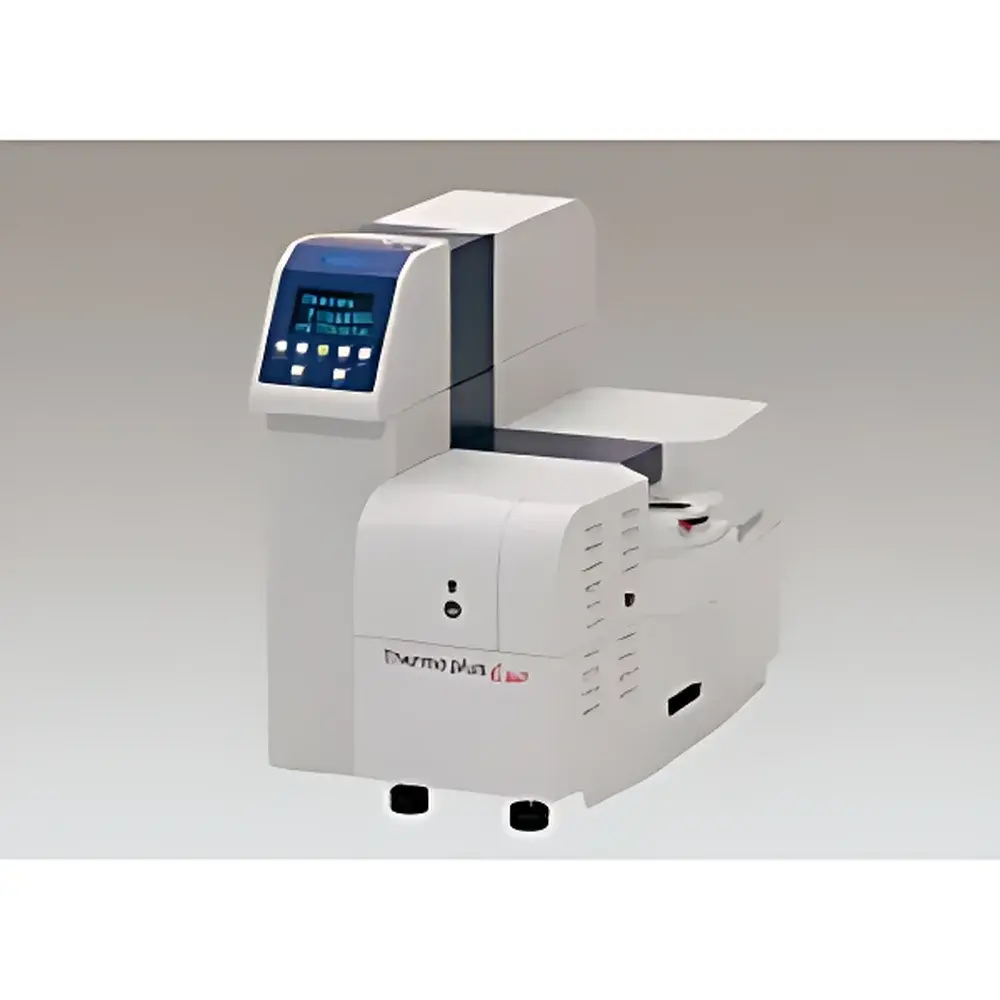
Rigaku Thermo Plus EVO TG-DTA Series Thermogravimetric-Differential Thermal Analyzer
| Brand | Rigaku |
|---|---|
| Origin | Japan |
| Model | TG-DTA |
| Temperature Range | RT–1100°C (standard), RT–1500°C (high-temp) |
| Max Heating Rate | 100°C/min |
| Atmosphere Options | Air, inert gas, flowing gas, vacuum |
| Max Sample Mass | 1 g |
| TG Range | ±0.1–±250 mg |
| TG Sensitivity | 0.1 µg |
| DTA Range | ±1.5–±1000 µV |
| Sample Crucible | φ2 mm × 2.5 mm height |
| Sample Holder Configuration | Horizontal dual-beam differential triple-coil balance (Rigaku patented) |
| Cooling | Forced rapid cooling (1500°C → 50°C in ≤20 min) |
| Optional Accessories | ASC-24 Auto Sampler, IR Heating Furnace, TG-DTA/GC-MS coupling interface |
| Software | Multi-station control (up to 8 units), SIA/DRC/CRC dynamic thermal analysis modes, ECO power-saving mode (30% reduction), real-time instrument status display, automated calibration & diagnostics, dual-data backup, FDA 21 CFR Part 11–compliant audit trail (optional), network-enabled firmware updates |
Overview
The Rigaku Thermo Plus EVO TG-DTA Series is a high-precision, horizontally configured thermogravimetric-differential thermal analyzer engineered for simultaneous, real-time measurement of mass change (TG) and thermal energy flow (DTA) under controlled temperature programs. Based on Rigaku’s proprietary horizontal differential triple-coil balance architecture, the system eliminates mechanical drift by dynamically compensating for thermal expansion, convection, and electromagnetic interference across both sample and reference arms—achieving sub-microgram mass resolution (0.1 µg) and microvolt-level DTA sensitivity (±1.5 µV). Designed for rigorous R&D and QC environments, it operates across a broad thermal range (RT–1100°C standard; RT–1500°C with high-temperature furnace), supports programmable heating rates up to 100°C/min, and enables precise atmosphere control—including air, nitrogen/argon purging, dynamic gas flow, and reduced-pressure operation. Its compact footprint, rotatable control panel, and modular design accommodate integration into space-constrained labs while maintaining full compliance with ISO 11358, ASTM E1131, and USP thermal analysis guidelines.
Key Features
- Horizontal differential triple-coil balance system—Rigaku’s patented drift-compensation technology ensures long-term baseline stability and high reproducibility across extended runs.
- Modular furnace options: standard resistive heater (1100°C) or optional infrared-heated high-temp furnace (1500°C), both enabling rapid heating (≤100°C/min) and forced active cooling (1500°C → 50°C in ≤20 min).
- Plug-and-play sample holder mechanism—no soldering or service engineer required; users replace crucibles (φ2 mm × 2.5 mm) via simple insertion, minimizing downtime and cross-contamination risk.
- Dynamic thermal analysis modes: Stepwise Isothermal Analysis (SIA), Dynamic Rate Control (DRC), and Constant Reaction Rate Control (CRC)—enabling kinetic modeling, decomposition pathway mapping, and reaction mechanism validation.
- ECO power management system reduces standby power consumption by ≥30% via intelligent component deactivation; selectable via front-panel toggle or software interface.
- Scalable automation: ASC-24 automatic sample changer (24-position, user-installable) supports unattended batch analysis; compatible with multi-instrument network control (up to 8 units per workstation).
- Integrated temperature pre-control algorithm eliminates overshoot during isothermal holds—no pre-scan calibration required—and includes built-in NIST-traceable temperature calibration routines.
Sample Compatibility & Compliance
The Thermo Plus EVO accommodates solid powders, granules, thin films, and small-volume liquids (≤1 g max loading) in standardized alumina or platinum crucibles. Its horizontal sample placement mitigates gravitational artifacts and prevents catastrophic failure if sample dislodges—enhancing operational safety and instrument longevity. The system meets GLP and GMP documentation requirements when configured with optional 21 CFR Part 11–compliant software modules, including electronic signatures, audit trails, and role-based access control. All thermal protocols align with ISO/IEC 17025–accredited laboratory practices and support traceability to NIST SRM standards for mass and temperature calibration.
Software & Data Management
Thermo Plus EVO is operated via Rigaku’s TGA-Analysis Suite—a Windows-based platform supporting method development, real-time data visualization, multi-curve overlay, derivative (DTG) calculation, and peak deconvolution. It provides automated fault diagnosis, scheduled self-calibration, and dual-location data redundancy (local SSD + network drive). Remote monitoring and over-the-air firmware updates ensure continuous regulatory alignment. For regulated industries, optional validation packages include IQ/OQ documentation, electronic record integrity verification, and CSV-compliant reporting templates aligned with FDA and EMA expectations.
Applications
This instrument delivers quantitative insight across polymer degradation kinetics, catalyst thermal stability, pharmaceutical polymorph transitions, battery electrode decomposition, ceramic sintering behavior, and inorganic hydrate loss profiling. Its compatibility with GC-MS coupling enables evolved gas analysis (EGA), linking mass-loss events directly to molecular speciation. Academic and industrial users apply it for ASTM D3850-compliant pyrolysis studies, ISO 11358-based activation energy determination (e.g., Kissinger, Ozawa-Flynn-Wall), and USP -mandated residual solvent quantification in drug substances.
FAQ
What is the maximum sample capacity and crucible specification?
Maximum sample mass is 1 g; standard crucibles are cylindrical alumina vessels (φ2 mm × 2.5 mm height), optimized for minimal thermal lag and consistent heat transfer.
Does the system support inert or reducing atmospheres?
Yes—it accepts continuous gas flow (N₂, Ar, He, H₂/N₂ mixtures) at adjustable flow rates (0–200 mL/min) and vacuum operation down to 10 Pa.
Can TG-DTA data be correlated with evolved gas analysis?
Yes—via optional TG-DTA/GC-MS interface, enabling time-resolved identification of volatile species released during thermal events.
Is remote operation and multi-instrument control supported?
Yes—the software supports centralized control of up to eight Thermo Plus EVO units from a single workstation, with synchronized method execution and consolidated data export.
What regulatory compliance features are available?
Optional 21 CFR Part 11 modules provide electronic signatures, immutable audit trails, and permission-based workflow controls—validated for use in FDA-inspected pharmaceutical and medical device QA/QC laboratories.



