
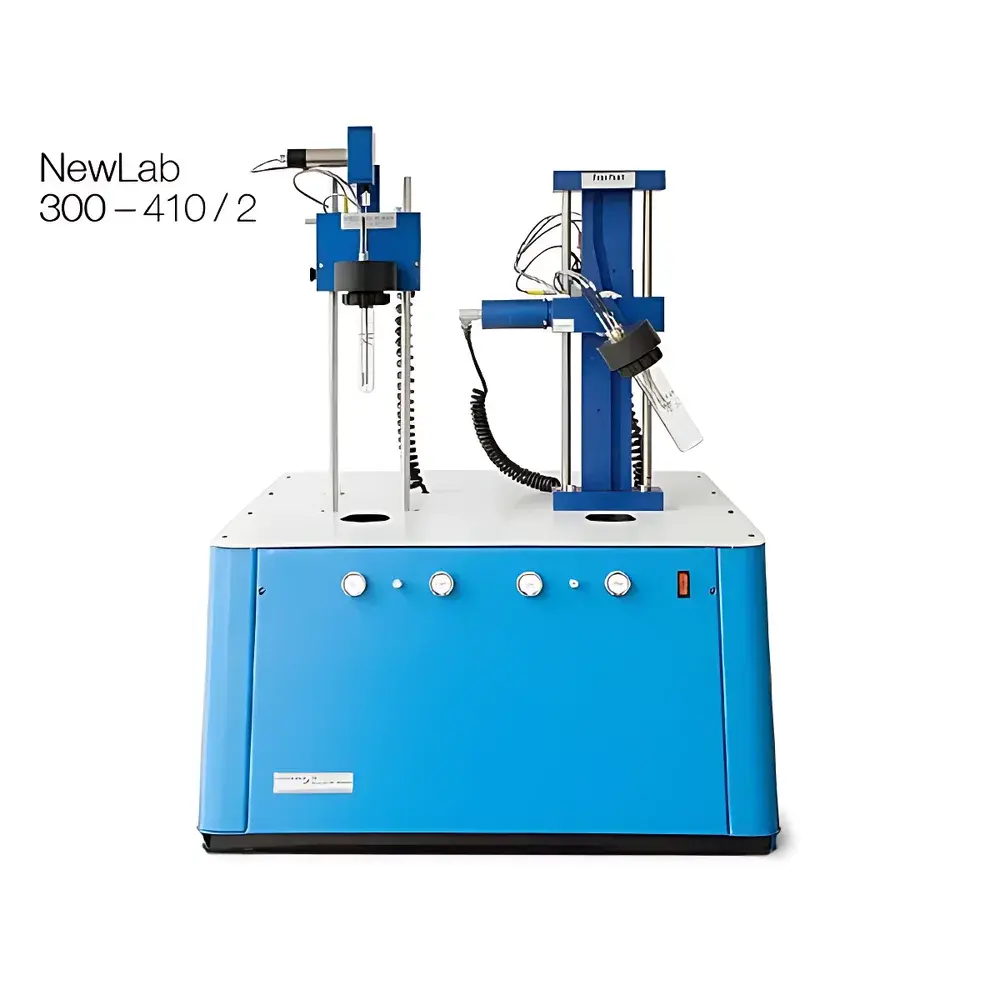
Linetechnic 300/410/2 ASTM D1177 Automated Cloud Point, Pour Point & Freeze Point Analyzer
| Brand | Linetechnic |
|---|---|
| Origin | Switzerland |
| Model | 300/410/2 |
| Standards Compliance | ASTM D1177, D97, D2386, D5901, D5972, D5853, D5950, IP16, IP441, IP528, IP529, ISO 3013, ISO 3016, GB/T 6537, SH/T 0770, GB/T 510 |
| Temperature Range | +80 °C to –80 °C |
| Temperature Resolution | 0.06 °C |
| Temperature Accuracy | ±0.1 °C |
| Cooling System | Dual-stage fluorine-free compressor, min. –85 °C |
| Temperature Sensor | Pt100 Class A |
| Optical Detection | Pulsed IR fiber-optic probe (freeze point) |
| Mechanical Detection | Dual PT100 surface probes + programmable tilt actuator (pour/pour point) |
| Power Supply | 220 V ±15%, 50/60 Hz |
| Dimensions (W×D×H) | 66 × 60 × 80 cm (1-head) |
| Weight | 70 kg (1-head, single-stage), 80 kg (1-head, dual-stage), 90 kg (2-head, single-stage), 100 kg (2-head, dual-stage) |
| Software | LabLink v5.x (Windows 2000/XP/Vista), supports up to 10 analysis heads, LIMS-compatible, 21 CFR Part 11-ready audit trail, Excel-exportable data format (.csv/.xls), >60,000 result storage capacity |
Overview
The Linetechnic 300/410/2 ASTM D1177 Automated Cloud Point, Pour Point & Freeze Point Analyzer is a fully integrated, standards-compliant thermal property testing platform engineered for precise, reproducible low-temperature characterization of petroleum-based fluids. It implements three distinct ASTM- and ISO-aligned measurement principles in a single instrument architecture: freeze point determination via optical crystallization detection (ASTM D1177), pour point assessment through controlled mechanical tilt and surface temperature monitoring (ASTM D97), and cloud point evaluation using turbidity onset detection (though not explicitly listed in the model designation, supported via optional configuration per ISO 3013 and ASTM D2386). The system employs a dual-stage fluorine-free refrigeration unit capable of sustained operation down to –85 °C, ensuring robust thermal stability across the full operational range of +80 °C to –80 °C. All temperature measurements are traceable to Pt100 Class A sensors calibrated per IEC 60751, with resolution of 0.06 °C and accuracy of ±0.1 °C — parameters validated against reference materials certified under NIST-traceable protocols. Designed for routine QC laboratories in refineries, aviation fuel certification centers, and lubricant formulation facilities, the analyzer meets the stringent environmental and safety requirements of CE-marked instrumentation, including overpressure protection, thermal cut-off relays, and dual-stage compressor interlocks.
Key Features
- Dual independent analysis modules: One dedicated freeze point head (fiber-optic IR pulse detection) and one combined pour/cloud point head (dual-surface Pt100 probes + motorized tilt actuator), enabling concurrent or sequential multi-parameter testing.
- Automated thermal profiling with programmable cooling rates (e.g., 1 °C/min, 3 °C/h), user-defined hold times, and adaptive heating ramps — essential for method development and research-grade investigations.
- Optical freeze point detection using coaxial infrared fiber optics eliminates operator subjectivity and ensures high repeatability (RSD < 0.3 °C per ASTM D1177 interlaboratory studies).
- Mechanically actuated sample tube positioning: Precise 45° tilt for pour point (per ASTM D97) and horizontal orientation (90°) for cloud point observation — both executed under software control with positional feedback.
- Integrated bath temperature control with Pt100 immersion probe and active thermal jacketing, maintaining ΔT ≤ 0.2 °C across the test zone during dynamic cycles.
- Full hardware diagnostics accessible via LabLink’s Diagnostic Menu, including real-time analog/digital I/O status, voltage-to-temperature conversion verification, and sensor response curve visualization.
Sample Compatibility & Compliance
The 300/410/2 analyzer accommodates a broad spectrum of hydrocarbon-based samples, including jet fuels (Jet A-1, JP-8), diesel blends (EN 590, ASTM D975), crankcase oils (API SP, ACEA C5), engine coolants, brake fluids (DOT 3/4), and antifreeze formulations. Sample volume requirements conform strictly to ASTM D1177 (50 mL), ASTM D97 (70 mL), and ISO 3016 (30 mL), with standardized glass test tubes supplied with silver-coated, scratch-resistant bases and calibrated meniscus markings. All measurement protocols comply with GLP and GMP documentation requirements: each test record includes operator ID, sample ID, method version, calibration timestamp, raw sensor outputs, and pass/fail flags against defined acceptance criteria. The instrument satisfies regulatory validation prerequisites for laboratories operating under FDA 21 CFR Part 11 (electronic records/signatures), EU Annex 11 (computerized systems), and ISO/IEC 17025:2017 (clause 5.9 — method validation and uncertainty estimation).
Software & Data Management
LabLink software provides a validated, multi-user Windows environment supporting up to ten synchronized analysis heads. Its modular architecture separates method execution (Analysis Menu), system health monitoring (Diagnostic Menu), metrological traceability (Calibration Menu), and post-processing (Data Management). Calibration routines include automatic Pt100 probe offset correction, slope verification against certified reference thermometers, and generation of printable calibration certificates with expiry dates and uncertainty budgets. All analytical data are stored in a structured relational database with immutable audit trails — recording every parameter change, manual override, error event, or calibration action with timestamp, user login, and IP address. Export functions generate ANSI-compliant CSV files compatible with LIMS platforms (e.g., Thermo Fisher SampleManager, LabWare LIMS) and statistical analysis tools (JMP, Minitab). Data retention exceeds 60,000 test records without performance degradation, and backup archives support AES-256 encryption for secure offsite storage.
Applications
This analyzer serves critical roles in petroleum product specification compliance, including aviation fuel cold flow assurance (ASTM D1655 Annex A1), biodiesel blend stability (ASTM D6751), marine distillate classification (ISO 8217), and additive package efficacy testing (e.g., pour point depressants per ASTM D5950). In R&D settings, it enables kinetic crystallization studies using custom cooling profiles (e.g., T-sample–T-bath constant ΔT modes), nucleation threshold mapping, and comparative screening of wax inhibitors. Regulatory laboratories use it for statutory reporting to agencies such as the U.S. Department of Transportation (PHMSA), European Aviation Safety Agency (EASA), and China National Petroleum Corporation (CNPC) Quality Control Division. Its dual-head configuration reduces turnaround time in high-throughput labs by eliminating cross-method reconfiguration delays.
FAQ
Does the 300/410/2 support ASTM D5972 (low-temperature filterability) testing?
No — ASTM D5972 requires specialized filtration hardware and pressure differential monitoring not implemented in this platform. It is compliant with D5972’s *equivalent* freeze point determination clause but does not perform the full filterability test.
Can the same test tube be reused across freeze, pour, and cloud point analyses?
Yes, provided it is thoroughly cleaned and dried between tests per ASTM D4177 cleaning procedures; however, dedicated tubes are recommended for trace-level contamination-sensitive applications such as aviation turbine fuel testing.
Is remote operation supported via Ethernet or USB?
LabLink supports TCP/IP communication over standard Ethernet (10/100BASE-T), enabling remote desktop access and integration into centralized lab networks; USB is used exclusively for local firmware updates and calibration file transfer.
What is the minimum required ambient temperature for stable operation?
The instrument must be installed in an environment maintained at ≤32 °C and ≤80% relative humidity (non-condensing); active HVAC conditioning is strongly advised when ambient temperatures exceed 28 °C to prevent compressor duty-cycle saturation.
How frequently must the Pt100 sensors be recalibrated?
Per ISO/IEC 17025, recalibration is recommended every 6 months or after 500 operational cycles — whichever occurs first — using NIST-traceable dry-block calibrators or liquid baths with certified reference standards.
Related Products





