
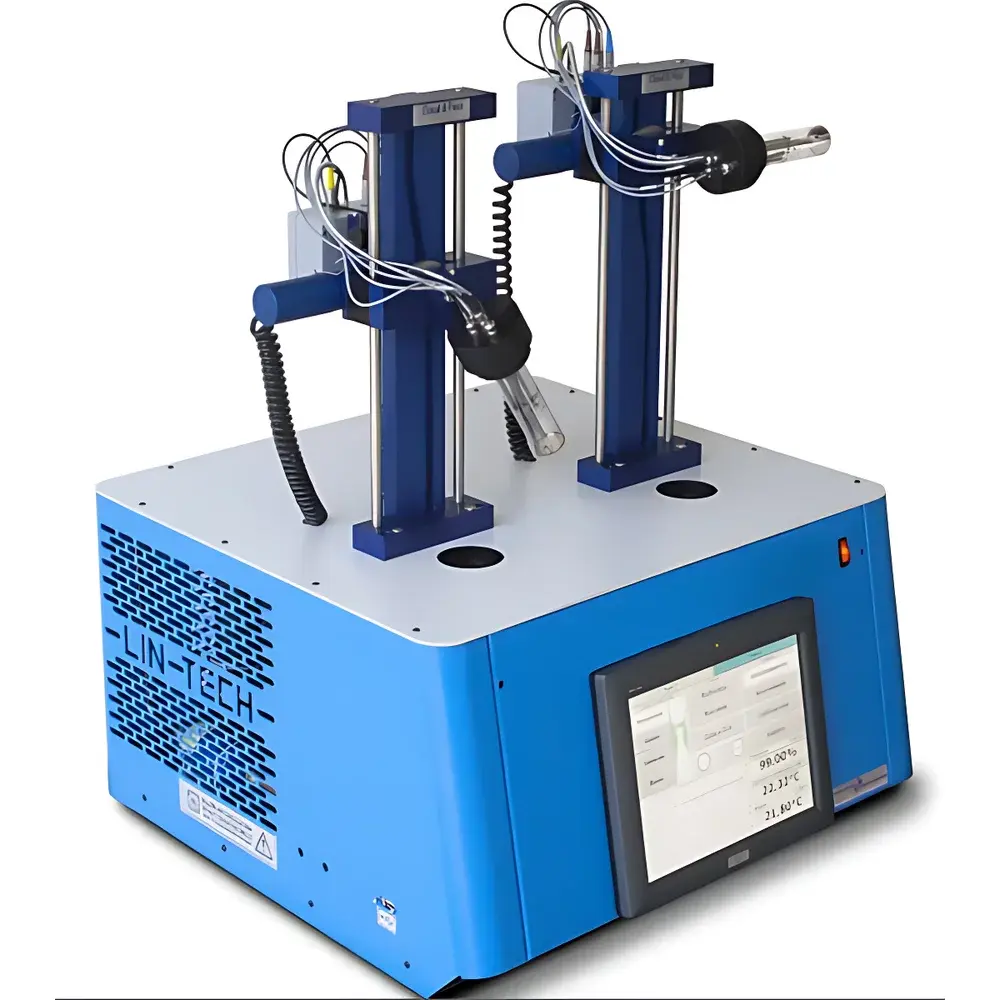
Linetechnic NewLab 1300 Automatic Cloud and Pour Point Analyzer
| Brand | Linetechnic |
|---|---|
| Origin | Switzerland |
| Model | 1300 |
| Temperature Range | +80 °C to –80 °C |
| Cooling System | Single-stage or dual-stage compressor (–40 °C or –85 °C min) |
| Temperature Sensor | PT100 Class A |
| Temperature Resolution | 0.06 °C |
| Temperature Accuracy | ±0.1 °C |
| Compliance | ASTM D2500, D5771–D5773, D97, D5950, D5853 |
| Optical Detection | Pulsed IR fiber-optic probe for cloud point |
| Mechanical Detection | Dual PT100 surface probes + motorized tilt arm for pour point |
Overview
The Linetechnic NewLab 1300 Automatic Cloud and Pour Point Analyzer is a fully automated, dual-function instrument engineered for precise, standardized determination of cloud point (CP) and pour point (PP) in petroleum-based liquids. It operates on two distinct physical principles: cloud point detection relies on optical reflectance changes at the silver-coated bottom of the test tube as wax crystals nucleate upon controlled cooling—captured by a coaxial pulsed infrared fiber-optic probe; pour point assessment employs mechanical tilting combined with real-time thermal response monitoring via dual surface-mounted PT100 Class A sensors, detecting cessation of flow under defined temperature intervals per ASTM and ISO protocols. Designed for laboratories requiring strict regulatory adherence—including those operating under GLP, GMP, or ISO/IEC 17025 frameworks—the system delivers traceable, reproducible results across a wide operational range from +80 °C to –80 °C, supporting both routine QC and method validation workflows.
Key Features
- Simultaneous or independent CP/PP measurement capability with configurable test sequences
- Dual-temperature-zone cooling architecture: single-stage compressor (–40 °C base) or dual-stage configuration (–85 °C base), both equipped with pressure regulation, thermal cut-offs, and redundant overload protection
- Optically agnostic cloud point detection—unaffected by sample color, turbidity, or fluorescence—ensuring reliability across biodiesel, crude oil, distillates, lubricants, fuel additives, and engine oils
- Motorized precision tilt mechanism that lifts and rotates the sample tube to horizontal position at user-defined temperature intervals, synchronized with surface thermal response acquisition
- High-fidelity temperature metrology: PT100 Class A sensors (±0.1 °C accuracy, 0.06 °C resolution) mounted at critical thermal interfaces—bottom wall for CP, surface plane for PP
- Standard-compliant test vessels: precisely dimensioned glass tubes with calibrated fill marks, silver-coated base protected by anti-scratch polymer film, and magnetic coupling for secure head alignment
- CE-marked design with integrated safety systems including pressure controllers for each compression stage, thermostatically activated secondary-stage enablement, and fail-safe solenoid valves in all heating/cooling jackets
Sample Compatibility & Compliance
The NewLab 1300 accommodates a broad spectrum of petroleum-derived and synthetic hydrocarbon samples—including but not limited to diesel fuel, jet fuel (Jet A-1, JP-8), marine distillates, base oils, formulated lubricants, biofuels (FAME, HVO), crude assay fractions, and multifunctional additive packages. All measurements conform rigorously to internationally recognized standard methods: cloud point per ASTM D2500, D5771–D5773, IP 219, IP 444–446, ISO 3015, and DIN 51597; pour point per ASTM D97, D5950, D5853, IP 15, IP 441, and ISO 3016. The instrument’s firmware embeds method-specific ramp rates, hold times, tilt angles, and pass/fail logic—enabling direct compliance reporting for audits aligned with FDA 21 CFR Part 11 (when paired with validated software), ISO 17025 clause 7.8.2 (result reporting), and EU Annex 11 (computerized system validation).
Software & Data Management
Control and data acquisition are managed via Linetechnic’s NewLab Suite v4.x—a Windows-based application supporting multi-user role assignment, electronic signatures, and full audit trail generation per ALCOA+ principles. Each test record includes raw sensor time-series data, annotated event markers (e.g., “first opacity detected”, “no flow at –24.3 °C”), calibration logs, environmental chamber status, and digital signatures tied to operator credentials. Export formats include CSV, PDF (with embedded metadata), and XML for LIMS integration. Optional 21 CFR Part 11 compliance package adds electronic signature enforcement, biometric authentication support, and immutable archive mode with SHA-256 hashing of result files.
Applications
- Refinery quality control labs verifying cold-flow properties of finished fuels prior to dispatch
- R&D departments evaluating wax inhibition efficacy of pour point depressants (PPDs) and cloud point depressants (CPDs)
- Contract testing laboratories performing third-party certification for EN 590, ASTM D975, or ISO 8217 compliance
- Biofuel producers assessing low-temperature operability of FAME and hydrotreated vegetable oil (HVO) blends
- Lubricant formulators characterizing base stock–additive interactions affecting low-temperature rheology
- Regulatory agencies conducting surveillance testing of commercial fuel batches for seasonal specification adherence
FAQ
What standards does the NewLab 1300 natively support?
ASTM D2500, D5771–D5773 (cloud point); ASTM D97, D5950, D5853 (pour point); IP 15, 219, 441, 444–446; ISO 3015, 3016; DIN 51597.
Can the instrument run cloud and pour point tests concurrently?
No—each test head operates independently, but CP and PP may be measured sequentially on the same sample or in parallel on two separate samples using the dual-test-head configuration (models /1300/1 or /1300/2).
Is external chiller or liquid nitrogen required?
No—the system is fully self-contained with integrated air-cooled compressors; no auxiliary cooling media are needed.
How is temperature uniformity verified across the test tube?
Calibration includes axial thermal mapping using NIST-traceable micro-probes; factory verification confirms ≤0.2 °C gradient between bottom and surface positions under steady-state conditions.
Does the system support remote diagnostics or service access?
Yes—optional Secure Remote Maintenance (SRM) module enables encrypted technician access for firmware updates, sensor diagnostics, and parameter validation without compromising network security.






