
Zeiss ASIN Automated Inclusion Analysis System for Steel and Metals
| Origin | Germany |
|---|---|
| Manufacturer Type | Authorized Distributor |
| Origin Category | Imported |
| Model | ASIN |
| Pricing | Upon Request |
Overview
The Zeiss ASIN Automated Inclusion Analysis System is a fully integrated, high-throughput analytical platform engineered specifically for quantitative and qualitative characterization of non-metallic inclusions in ferrous and non-ferrous metallic materials. Built around the Zeiss EVO series scanning electron microscope (SEM), the system combines high-resolution imaging, large-chamber architecture, and state-of-the-art energy-dispersive X-ray spectroscopy (EDS) detection to deliver standardized, repeatable inclusion analysis in accordance with international metallurgical testing protocols. At its core, the ASIN system operates on the principle of automated SEM-EDS correlative microscopy: high-magnification backscattered electron (BSE) imaging identifies inclusion candidates based on atomic number contrast, while fast, high-sensitivity EDS spectral acquisition enables real-time elemental quantification and phase classification. This dual-modality workflow ensures traceable, metrologically sound data generation — critical for quality assurance in steel production, aerospace alloy certification, and automotive component validation.
Key Features
- Zeiss EVO-series SEM platform with multi-port large chamber (≥120 mm diameter), enabling simultaneous loading of up to nine standard 25 mm metallographic mounts or direct examination of oversized specimens (e.g., rolled slabs, billets)
- High-efficiency, large-area silicon drift detector (SDD) EDS system with <123 eV Mn-Kα resolution and ≥200,000 cps count rate for rapid, low-dose elemental mapping
- Fully motorized 5-axis precision stage with sub-micron repeatability and programmable tilt/rotation for comprehensive 3D inclusion localization and re-examination
- Dedicated ASIN software suite supporting ASTM E2141, ISO 4967, DIN 50602, SS 111116, and Pirelli internal standards — including automated inclusion segmentation, morphology-based classification (oxide, sulfide, nitride, composite), size distribution histograms, spatial density mapping, and SmartMap phase identification
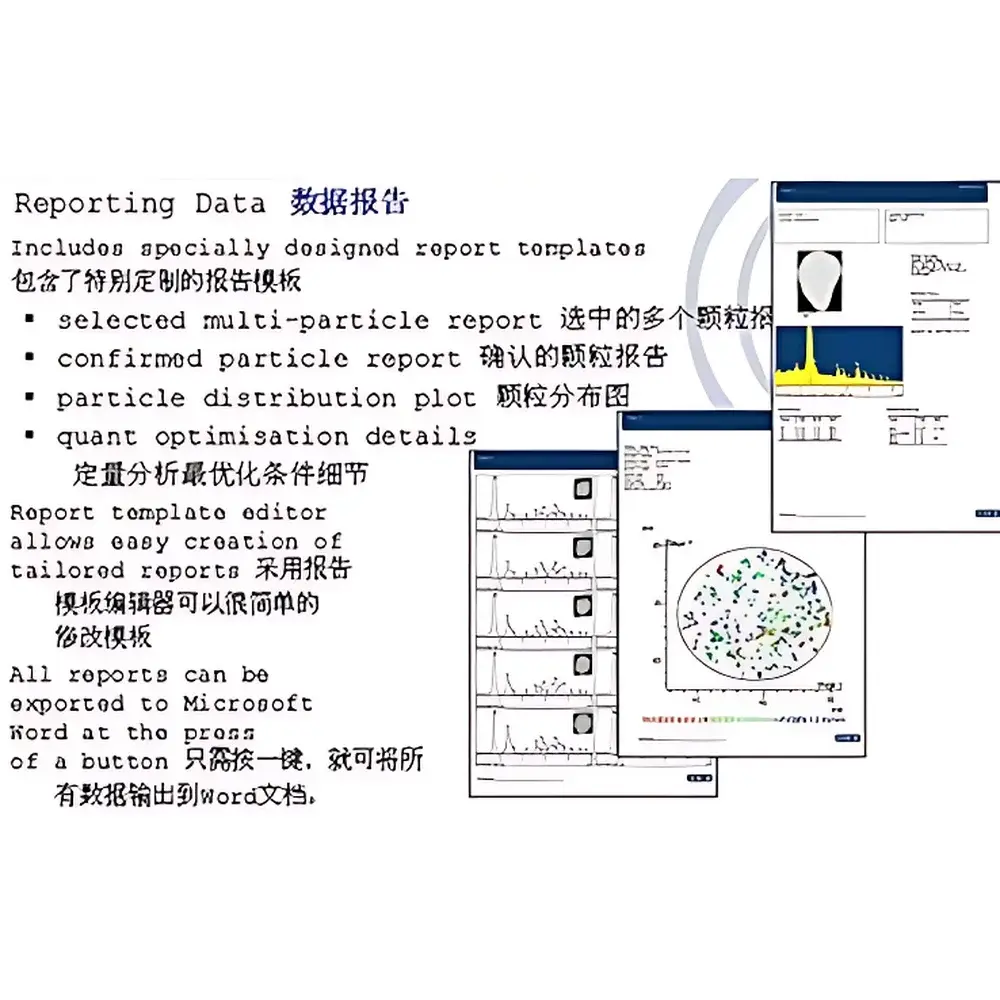
- Integrated digital reporting engine with customizable templates compliant with GLP/GMP documentation requirements, including full audit trail, user authentication logs, and CFR 21 Part 11–ready electronic signatures
Sample Compatibility & Compliance
The ASIN system accommodates polished metallographic cross-sections (up to 50 mm × 50 mm), as-cast samples, and fracture surfaces — all without requiring conductive coating due to low-vacuum BSE imaging capability. It supports both carbon steels, stainless steels, aluminum alloys, titanium grades, and nickel-based superalloys. All analytical workflows are traceable to ISO/IEC 17025-accredited reference materials and validated against certified inclusion standards (e.g., NIST SRM 2829). The system’s classification logic adheres strictly to the morphological and compositional criteria defined in ASTM E2141 Annex A1 and ISO 4967 Clause 6, ensuring inter-laboratory comparability. Data integrity is maintained via hardware-level vacuum interlocks, stage position verification, and real-time EDS spectrum quality monitoring.
Software & Data Management
ASIN Control Software provides a unified interface for method setup, automated acquisition, post-processing, and reporting. It features embedded statistical engines for Weibull analysis of inclusion size distributions, nearest-neighbor distance mapping for clustering assessment, and ternary composition diagrams (e.g., Al₂O₃–SiO₂–CaO, MgO–Al₂O₃–SiO₂) generated directly from quantitative EDS point analyses. Raw data — including BSE images, EDS spectra, stage coordinates, and metadata — are stored in vendor-neutral HDF5 format with SHA-256 checksums. Integration with LIMS systems is supported via ASTM E1482-compliant XML export. Software validation packages (IQ/OQ/PQ documentation, change control records) are available for regulated environments subject to FDA or EU GMP audits.
Applications
- Automated inclusion rating for clean steel certification per customer technical specifications (e.g., automotive OEM tier-1 requirements)
- Root cause analysis of rolling mill defects linked to alumina stringers or calcium-aluminate clusters
- Process optimization support for ladle refining, calcium treatment, and argon stirring parameters
- Comparative evaluation of inclusion evolution during thermo-mechanical processing (hot rolling, forging, heat treatment)
- Research-grade phase identification of complex spinel-type inclusions and interfacial reaction layers at oxide/metal interfaces
FAQ
Does the ASIN system require operator intervention during routine inclusion scans?
No — once calibration and acquisition parameters are defined, the system executes fully unattended analysis across multiple samples, including auto-focus, stage navigation, image capture, EDS acquisition, and classification.
Can the system distinguish between morphologically similar inclusions with overlapping elemental signatures?
Yes — through combined BSE contrast, EDS spectral deconvolution, and SmartMap phase library matching using stoichiometric constraints and peak-shape analysis.
Is remote diagnostics and software update support available?
Yes — Zeiss Remote Service (ZRS) enables secure, encrypted connection for real-time troubleshooting, performance optimization, and version-controlled firmware/software updates.
What vacuum level is maintained during extended automated runs?
The EVO chamber sustains ≤3×10⁻⁴ mbar base pressure throughout multi-hour sessions, with active pressure stabilization and contamination monitoring to preserve detector sensitivity.
How is measurement uncertainty quantified for inclusion size and composition?
Uncertainty budgets follow ISO/IEC Guide 98-3 (GUM), incorporating contributions from pixel calibration, beam broadening, matrix effects in EDS quantification, and statistical counting error — reported alongside each measurement result.
Related Products






