
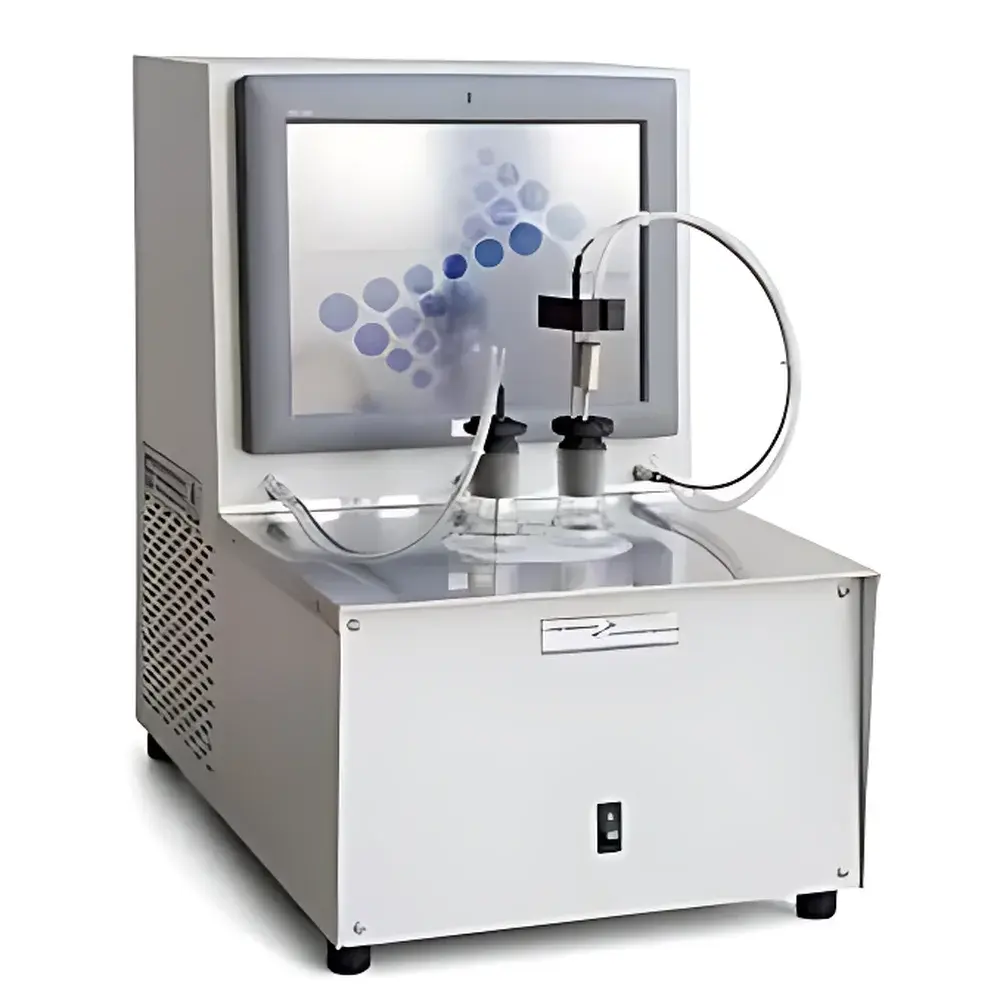
Linetechnic 225 Automated Fuel Filter Blocking Tendency Analyzer (Model 225 / D2068)
| Brand | Linetechnic |
|---|---|
| Origin | Switzerland |
| Model | 225 / D2068 |
| Compliance | ASTM D2068, IP 387 |
| Operating Temperature Range (Bath) | −10 °C to +40 °C |
| Sample Temperature Range | −50 °C to +80 °C |
| Flow Rate | 20 mL/min |
| Pressure Measurement Range | 0–210 kPa |
| Max. Pressure Threshold | 105 kPa |
| Filtration Capacity Resolution | 0.1 mL |
| Temperature Sensor | PT100 Class A |
| Bath Material | Anodized Aluminum |
| Cooling System | Single-phase air-cooled compressor, CFC-free refrigerant |
| Data Storage Capacity | 60,000 test records |
| Display | 6.4″ TFT/LCD touchscreen (640 × 480 pixels) |
| Processor | AMD Geode 800 |
| Interface | 1 × USB, 1 × 10/100 Mbps LAN |
| Safety Certification | CE |
Overview
The Linetechnic 225 Automated Fuel Filter Blocking Tendency Analyzer is a precision-engineered benchtop instrument designed for the quantitative assessment of filter blocking tendency (FBT) in distillate fuel oils—primarily diesel fuels, heating oils, and related middle distillates. It operates on the principle of controlled-pressure filtration kinetics, as defined by ASTM D2068 and IP 387. The method quantifies the volume of fuel that can be passed through a standardized glass fiber filter at a constant flow rate (20 mL/min) before either reaching a predefined pressure drop threshold (105 kPa) or completing the full prescribed sample volume. This volumetric endpoint directly correlates with the presence and concentration of insoluble particulates, oxidation precursors, and cold-flow-related precipitates—including asphaltenes, waxes, and microbial debris—that compromise fuel system integrity. Unlike generic particle counters or viscosity analyzers, the 225 model delivers functional performance data under thermally controlled conditions, enabling predictive evaluation of real-world filter plugging behavior in engines and storage systems.
Key Features
- Full compliance with ASTM D2068 and IP 387 test protocols, ensuring regulatory acceptance in global fuel quality assurance programs.
- Integrated Peltier-assisted cooling system with CFC-free refrigerant and single-phase air-cooled compressor, enabling stable bath temperature control from −10 °C to +40 °C—critical for low-temperature FBT assessment.
- Anodized aluminum bath construction for thermal uniformity, corrosion resistance, and long-term dimensional stability during repeated thermal cycling.
- High-accuracy sensing suite: Class A PT100 temperature probe (±0.15 °C uncertainty), capacitive liquid-level sensor (0–300 mL range), and calibrated pressure transducer (0–210 kPa, ±0.5% FS).
- Embedded industrial computer with AMD Geode 800 processor, 6.4″ resistive touchscreen (640 × 480 resolution), and onboard data logging—eliminating dependency on external PCs or proprietary software installations.
- Robust architecture supporting unattended operation: automatic endpoint detection, pressure-triggered termination, and real-time graphical display of differential pressure vs. filtered volume.
Sample Compatibility & Compliance
The Linetechnic 225 is optimized for distillate fuels exhibiting kinematic viscosity between 1.50 and 6.00 mm²/s (cSt) at 40 °C—a range encompassing EN 590 diesel, ASTM D975 No. 1-D and No. 2-D grades, and ISO 8217 DMA/DMB marine distillates. Samples must meet cleanliness requirements per ASTM D2276 or ISO 4020 to prevent premature filter clogging unrelated to inherent fuel instability. The analyzer supports testing across the full operational temperature spectrum (−50 °C to +80 °C), facilitating both cold-soak FBT studies and accelerated aging simulations. All electronic subsystems conform to CE marking directives (2014/30/EU EMC and 2014/35/EU LVD), and mechanical design adheres to ISO 17025 traceability principles for measurement uncertainty reporting. Routine calibration verification aligns with ISO/IEC 17025 clause 6.5 and supports GLP-compliant audit trails when paired with optional networked data export.
Software & Data Management
The embedded operating environment provides a dedicated, menu-driven interface accessible via the integrated 6.4″ touchscreen. Test parameters—including target bath temperature, sample volume, and pressure threshold—are configured prior to analysis. Each run generates a timestamped record containing raw pressure/time profiles, final filtered volume, maximum observed ΔP, and ambient/environmental metadata. Up to 60,000 complete analyses are retained in non-volatile memory. Data export is supported via USB mass-storage mode or Ethernet (10/100 Mbps) using standard TCP/IP protocols; exported files follow CSV format compatible with LIMS platforms and statistical packages (e.g., JMP, Minitab). Audit-trail functionality logs all user actions (login, parameter changes, result deletion), satisfying FDA 21 CFR Part 11 requirements when deployed in regulated QC laboratories. Firmware updates are delivered via secure HTTPS download and verified using SHA-256 checksums.
Applications
- Quality control of refinery-produced diesel and heating oil batches prior to dispatch.
- Evaluation of fuel stability during extended storage—particularly in biodiesel-blended formulations prone to oxidation-induced sludge formation.
- Validation of additive package efficacy (e.g., dispersants, antioxidants) in mitigating filter-blocking species.
- Root-cause analysis of field-reported injector fouling or fuel filter failures in heavy-duty transport and marine applications.
- Supporting ASTM D975 Annex A4 and EN 590 Clause 6.2 compliance verification for commercial fuel specifications.
- Research into cold-flow improver performance under sub-ambient conditions, leveraging precise thermal control down to −50 °C.
FAQ
What standards does the Linetechnic 225 strictly comply with?
ASTM D2068 and IP 387 are fully implemented—including automated pressure threshold enforcement, flow-rate regulation, and temperature-controlled bath operation.
Can the instrument operate below 0 °C?
Yes—the integrated cooling system maintains bath temperatures from −10 °C to +40 °C, and sample temperature monitoring extends to −50 °C for cold-soak testing.
Is external PC software required to operate the analyzer?
No—all functions—including method setup, execution, data review, and export—are managed natively via the built-in touchscreen interface and embedded OS.
How is calibration traceability maintained?
Temperature and pressure sensors are factory-calibrated against NIST-traceable references; users receive calibration certificates with documented uncertainties per ISO/IEC 17025.
Does the system support network integration into a central laboratory data infrastructure?
Yes—via its 10/100 Mbps Ethernet port, the 225 supports scheduled data push to FTP/SFTP servers or direct ingestion into LIMS using configurable CSV schema mapping.





