
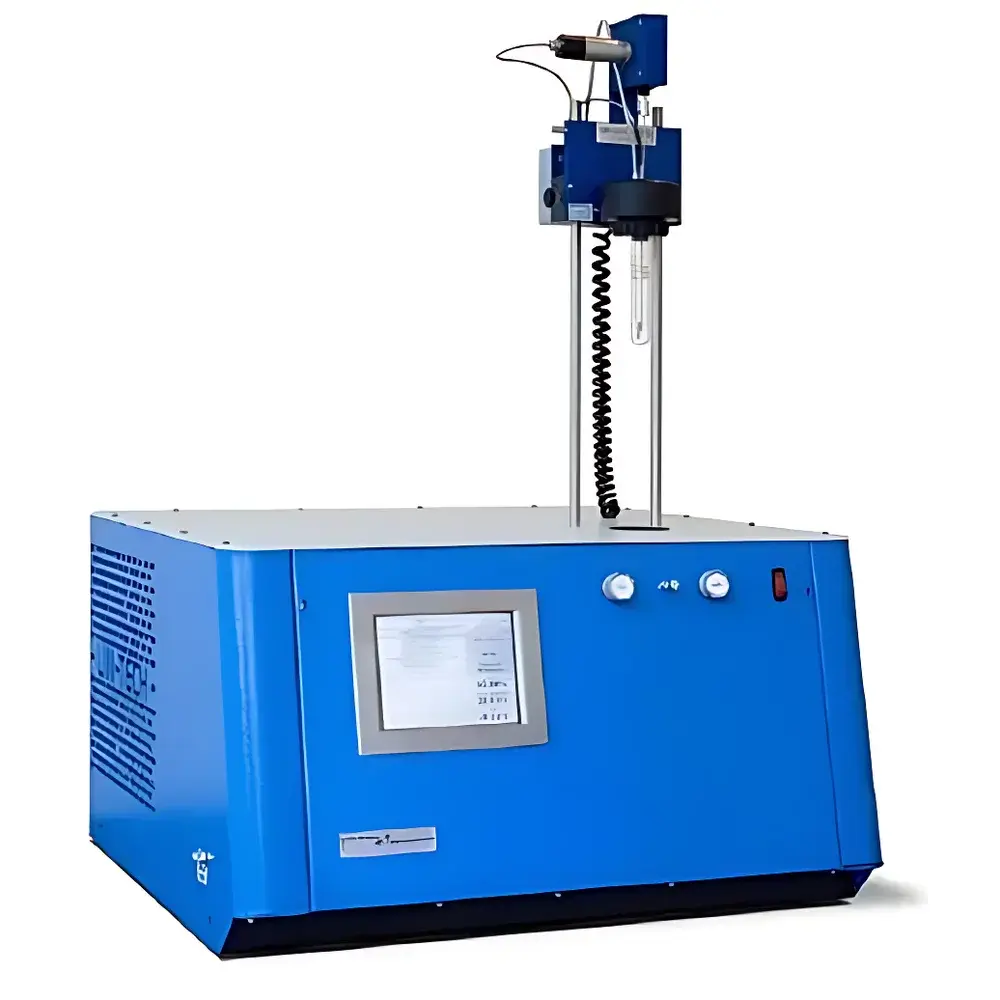
Linetechnic NewLab 410/2 Automatic Petroleum Freezing Point Analyzer
| Brand | Linetechnic |
|---|---|
| Origin | Switzerland |
| Model | NewLab 410/2 |
| Cooling Capacity | −85 °C (dual-stage compressor) |
| Temperature Range | +80 °C to −100 °C |
| Temperature Resolution | 0.06 °C |
| Temperature Accuracy | ±0.1 °C |
| Compliance | ASTM D1177, D2386, D5901, D5972, D1655 |
| Detection Principle | Optical crystallization detection via coaxial IR fiber-optic probe and polished mirror surface |
| Temperature Sensor | PT100 Class A |
| Stirring System | Miniature motor-driven mechanical stirrer |
| Cooling System | Hermetic dual-stage refrigeration (R513A/R1234ze, fluorine-free) |
| Power Supply | 220 V ±15 %, 50/60 Hz |
| Safety Certifications | CE, integrated pressure controllers, thermal cut-offs, compressor overload protection |
| Software | LabLink v5.x (Windows 10/11 compatible), supports up to 10 analysis heads, 21 CFR Part 11–ready audit trail, LIMS integration, Excel-exportable data format (.csv, .xlsx) |
Overview
The Linetechnic NewLab 410/2 Automatic Petroleum Freezing Point Analyzer is an engineered solution for precise, standardized determination of the freezing point of hydrocarbon-based fuels and low-temperature functional fluids. It operates on the principle of optical crystallization detection—based on established international test methods including ASTM D2386 (Standard Test Method for Freezing Point of Aviation Fuels), ASTM D5972 (for automotive fuels), and ISO 3013 (Petroleum products — Determination of freezing point). During analysis, a representative sample is cooled under controlled agitation while a coaxial infrared fiber-optic probe continuously monitors reflectance changes at a precisely polished optical mirror surface. The onset of solid-phase hydrocarbon crystal formation alters the optical signature; this event triggers an automated heating cycle until complete crystal dissolution is confirmed. The temperature at which crystals first appear—and subsequently disappear upon reheating—is recorded as the freezing point. This methodology ensures high reproducibility and alignment with regulatory and quality assurance requirements across aviation, defense, and refinery laboratories.
Key Features
- Dual-stage fluorine-free refrigeration system achieving stable operation down to −85 °C, compliant with EU F-Gas Regulation (EU No 517/2014)
- Coaxial IR fiber-optic probe with integrated mirror surface enables real-time, contactless crystallization detection without sample contamination or optical drift
- PT100 Class A platinum resistance thermometer calibrated traceably to NIST standards, delivering ±0.1 °C accuracy across the full operating range (+80 °C to −100 °C)
- Micro-motor-driven mechanical stirrer ensures consistent shear profile during cooling, critical for detecting metastable nucleation in paraffinic fuels
- Modular design supporting single- or multi-head configurations (up to 6 analysis units per chassis), scalable for high-throughput QC environments
- Integrated safety architecture featuring dual independent pressure controllers, stage-specific thermostats, thermally actuated jacket valves, and compressor internal overload protection
- CE-marked enclosure with environmental rating suitable for ambient conditions up to 32 °C and 80 % relative humidity (non-condensing)
Sample Compatibility & Compliance
The NewLab 410/2 is validated for use with aviation turbine fuel (Jet A-1, JP-5, JP-8), aviation gasoline (Avgas 100LL), engine coolants, brake fluids (DOT 3/4), antifreeze formulations, and specialty solvents. Sample volume is defined per ASTM/IP method requirements (typically 4–6 mL in standardized borosilicate glass tubes). All hardware—including test tube holders, optical mounts, and cooling jackets—meets dimensional specifications outlined in ASTM D2386 Annex A1 and IP 16. Instrument validation documentation supports GLP and GMP compliance, with full traceability for temperature sensor calibration records, software version control, and electronic audit logs. The system meets essential requirements of Directive 2014/30/EU (EMC) and 2014/35/EU (LVD), and its software architecture supports FDA 21 CFR Part 11 compliance when deployed with appropriate IT governance controls.
Software & Data Management
LabLink software (v5.4+, Windows 10/11 64-bit) provides comprehensive instrument control, method management, and data integrity features. It supports concurrent operation of up to 10 analysis heads and includes three primary functional modules: Analysis, Diagnostics, and Calibration. Preconfigured method templates cover all major standard protocols (ASTM, IP, ISO, EN, DIN), with user-defined method creation enabled for research-grade applications such as solvent purity assessment or low-temperature additive evaluation. Calibration routines include automatic PT100 verification, date-stamped calibration history export, and linear/nonlinear compensation entry. Data handling complies with analytical data integrity principles: each result is time-stamped, operator-identified, and stored in CSV/XLSX formats compatible with laboratory information management systems (LIMS). Local storage capacity exceeds 60,000 analyses; optional network-enabled archiving supports centralized data backup and remote review workflows.
Applications
This analyzer serves critical roles in aviation fuel certification labs, petroleum refining QC departments, military logistics testing centers, and OEM fluid development facilities. Typical use cases include batch release testing of Jet A-1 prior to aircraft refueling, monitoring cold flow properties of winter-grade diesel blends, verifying freeze point specifications for deicing fluids (Type I–IV), and assessing thermal stability of heat transfer oils used in arctic infrastructure. Its ability to resolve subtle differences in wax crystallization behavior makes it particularly valuable for evaluating the efficacy of cold flow improver additives. In R&D settings, the instrument supports method development for emerging bio-derived jet fuels (SAF) where traditional freezing point behavior may deviate from conventional hydrocarbons.
FAQ
What standards does the NewLab 410/2 fully support?
ASTM D1177, D2386, D5901, D5972, D1655; IP 16, 435, 528, 529; ISO 3013; EN 228, EN 590.
Can the system be upgraded from single- to dual-stage cooling post-purchase?
No—cooling architecture is hardware-defined at time of manufacture; dual-stage configuration requires factory-integrated compressors and thermal management circuits.
Is LabLink software validated for regulated environments?
Yes—when installed and operated per Linetechnic’s Validation Guide (SOP-LABLINK-VG-2023), it satisfies 21 CFR Part 11 requirements for electronic records and signatures.
How is temperature uniformity maintained across the test zone?
Via a thermally optimized copper-alloy cooling block with embedded PT100 feedback loop and PID-controlled heating/cooling modulation, achieving ±0.05 °C spatial uniformity over the 15 mm active measurement zone.
What maintenance intervals are recommended for the optical detection system?
Mirror surface cleaning every 200 analyses using spectroscopic-grade methanol; IR fiber-optic probe inspection and alignment verification annually or after mechanical shock events.





