
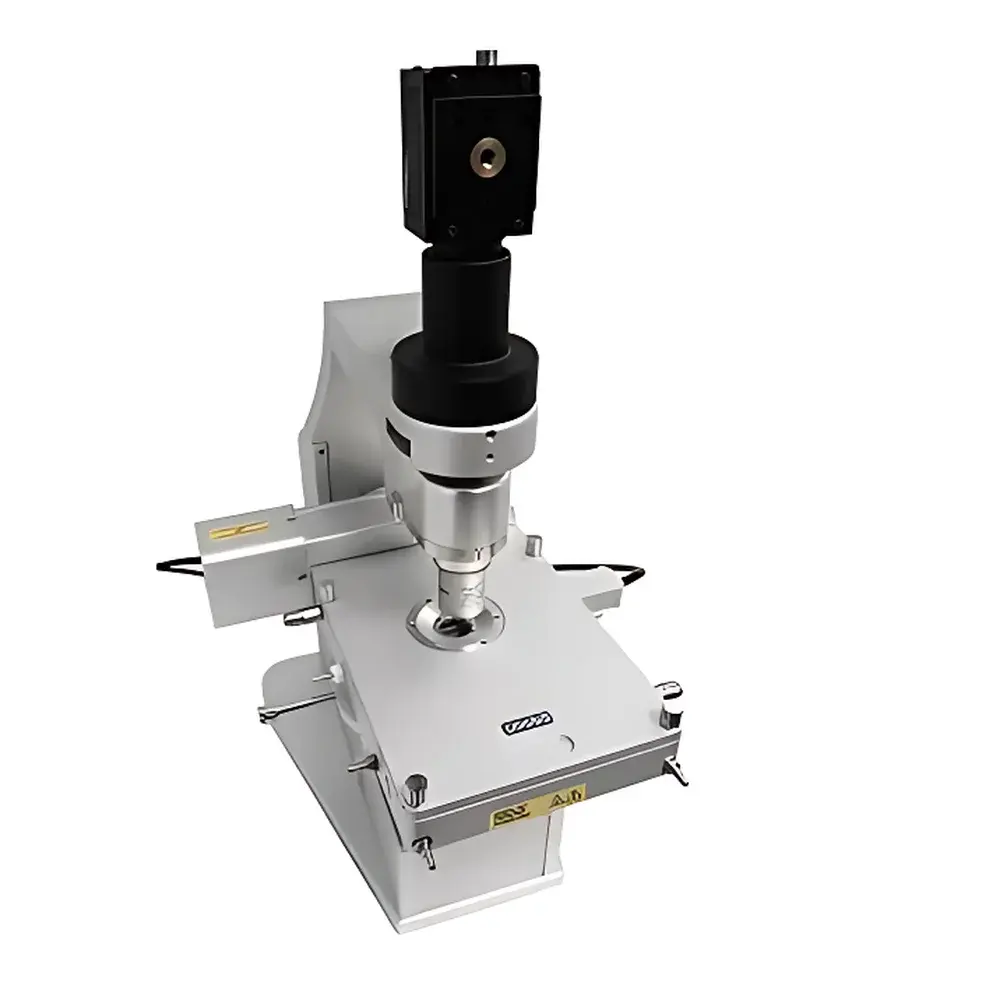
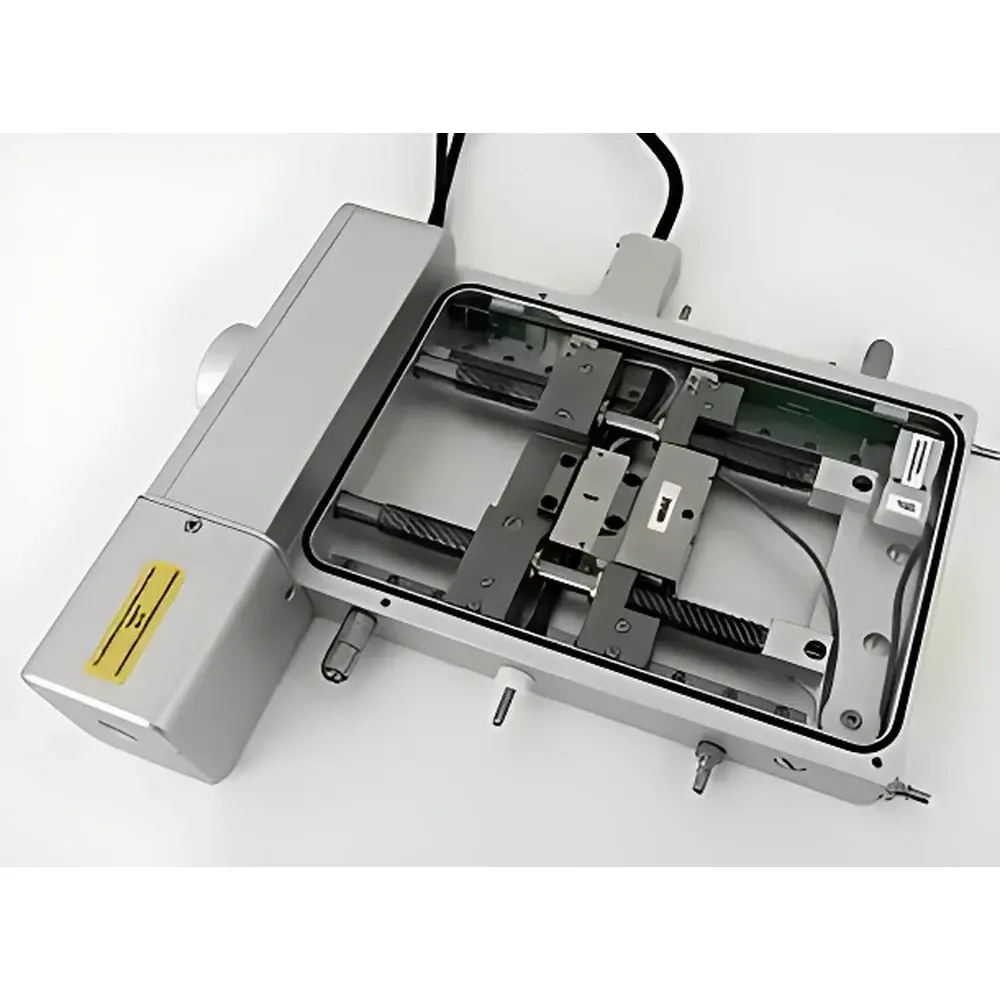
Linkam MFS350 Tensile Heating Stage
| Brand | Linkam |
|---|---|
| Origin | United Kingdom |
| Model | MFS350 |
| Temperature Range | −195 °C to 350 °C |
| Sample Width | 0.001–22 mm |
| Sample Thickness | 0.001–2 mm |
| Minimum Sample Length | 26 mm |
| Tensile Speed | 1–5000 µm/s |
| Force Range | 0.01–20 N or 0.1–200 N |
| Force Resolution | 0.01 N or 0.1 N |
| Maximum Travel | 85 mm |
| Position Resolution | 1 µm |
| Objective Working Distance | 7.5 mm |
| Condenser Working Distance | 12.5 mm |
| Temperature Ramp Rate | 0.1–60 °C/min |
Overview
The Linkam MFS350 Tensile Heating Stage is an engineered solution for in-situ mechanical and thermal characterization of solid materials under controlled temperature and uniaxial tensile stress. Designed for integration with upright and inverted optical microscopes, the stage enables real-time observation of microstructural evolution—including crack initiation, phase transitions, polymer chain alignment, and interfacial delamination—during thermomechanical loading. Its core architecture implements a dual-motor-driven, counter-directional motion system mounted on precision-ground stainless-steel base plates, ensuring exceptional parallelism and minimal lateral deviation during extension. The stage operates on the principle of controlled displacement or force-controlled tensile actuation while maintaining high-fidelity thermal regulation across a broad range from cryogenic (−195 °C, using liquid nitrogen cooling) to elevated temperatures (up to 350 °C). This capability supports fundamental research and industrial QA/QC protocols where coupling thermal history with mechanical response is essential—such as in polymer processing, thin-film adhesion analysis, semiconductor packaging reliability, and biomaterials testing.
Key Features
- Wide operational temperature range: −195 °C to 350 °C, enabled by integrated LN₂ cooling and resistive heating with PID feedback control
- Programmable thermal profiles: constant-temperature holds, linear ramps (0.1–60 °C/min), and multi-step sequences
- Dual-mode mechanical actuation: selectable constant-velocity (1–5000 µm/s) or constant-force (0.01–20 N / 0.1–200 N) tensile modes
- Sub-micron positional resolution (1 µm) and high force resolution (0.01 N standard, 0.1 N optional)
- Optimized optical access: 7.5 mm objective working distance and 12.5 mm condenser clearance for high-NA microscopy
- Modular electrode interface option for simultaneous electrical property monitoring (e.g., resistance, capacitance) during deformation
- Stainless-steel sample stage with parallelism < 5 µm over full travel (85 mm), minimizing bending moments and ensuring pure axial loading
Sample Compatibility & Compliance
The MFS350 accommodates specimens ranging from ultra-thin films (≥0.001 mm thick) to bulk ribbons (≤2 mm thick and ≤22 mm wide), with minimum usable length of 26 mm to ensure secure clamping and load transfer. Its low-profile design and standardized mounting interface (M4 threaded holes, ISO 80/100 compatible) facilitate rapid installation on most commercial microscope stages without optical path obstruction. The system complies with ISO 11357 (Plastics — Differential Scanning Calorimetry), ASTM D638 (Tensile Properties of Plastics), and ISO 6892-1 (Metallic Materials — Tensile Testing) for test environment control. While not a certified GLP/GMP instrument per se, its deterministic thermal and mechanical control, combined with audit-ready software logging (see Software section), supports data integrity requirements under FDA 21 CFR Part 11 when deployed in regulated environments.
Software & Data Management
The stage is operated via Linkam’s proprietary LinkSystem software (Windows-based), which provides synchronized acquisition of temperature, position, force, time, and optional external sensor inputs (e.g., voltage, current, camera triggers). All parameters are timestamped with millisecond resolution and stored in open-format CSV files for post-processing in MATLAB, Python, or Origin. The software supports scripting for automated multi-cycle tests, conditional triggering (e.g., initiate imaging upon force threshold), and real-time plotting of stress–strain–temperature triplets. Data export includes metadata headers describing calibration dates, sensor IDs, and environmental conditions—enabling traceability required for ISO/IEC 17025-accredited laboratories. Optional LabVIEW and Python APIs allow integration into custom test automation frameworks.
Applications
- In-situ observation of ductile-to-brittle transitions in thermoplastics and elastomers across glass transition (Tg) and melting (Tm) regimes
- Quantification of coefficient of thermal expansion (CTE) mismatch-induced interfacial stresses in multilayer thin-film stacks
- Time-resolved analysis of creep and stress relaxation behavior in viscoelastic hydrogels and biological tissues
- Mechano-optical correlation studies: birefringence development, crystallite orientation, and fracture dynamics under thermal cycling
- Reliability assessment of die-attach materials and solder joints in microelectronics packaging
- Characterization of shape-memory alloy (SMA) recovery strain and hysteresis under constrained heating
FAQ
Is the MFS350 compatible with confocal or Raman microscopes?
Yes—the stage’s optical path geometry and working distances are validated for use with standard confocal laser scanning microscopes (CLSM) and Raman spectrometers equipped with long-working-distance objectives.
Can I perform vacuum or inert-gas experiments with this stage?
The base model is designed for ambient air operation; however, optional vacuum-compatible versions (MFS350-VAC) with feedthroughs for force/temperature sensors and gas purge ports are available upon request.
What calibration documentation is provided?
Each unit ships with a factory calibration certificate covering temperature accuracy (±0.5 °C from −50 °C to 350 °C; ±1.5 °C at −195 °C), force linearity (±0.5% FS), and positional repeatability (±0.5 µm), traceable to UKAS-accredited standards.
Does the system support third-party microscope automation (e.g., Zeiss ZEN, Nikon NIS-Elements)?
Linkam provides hardware-trigger interfaces and documented COM/DCOM APIs; integration with major microscope platforms requires collaboration with the respective OEM or use of Linkam’s middleware drivers.
How is thermal uniformity maintained across the sample area during tensile loading?
The heater element is embedded beneath a monolithic sapphire window, and temperature sensing is performed via dual Pt100 sensors placed adjacent to the sample clamps—ensuring spatial uniformity better than ±1.2 °C over a 10 mm × 10 mm central region under static and dynamic conditions.





