
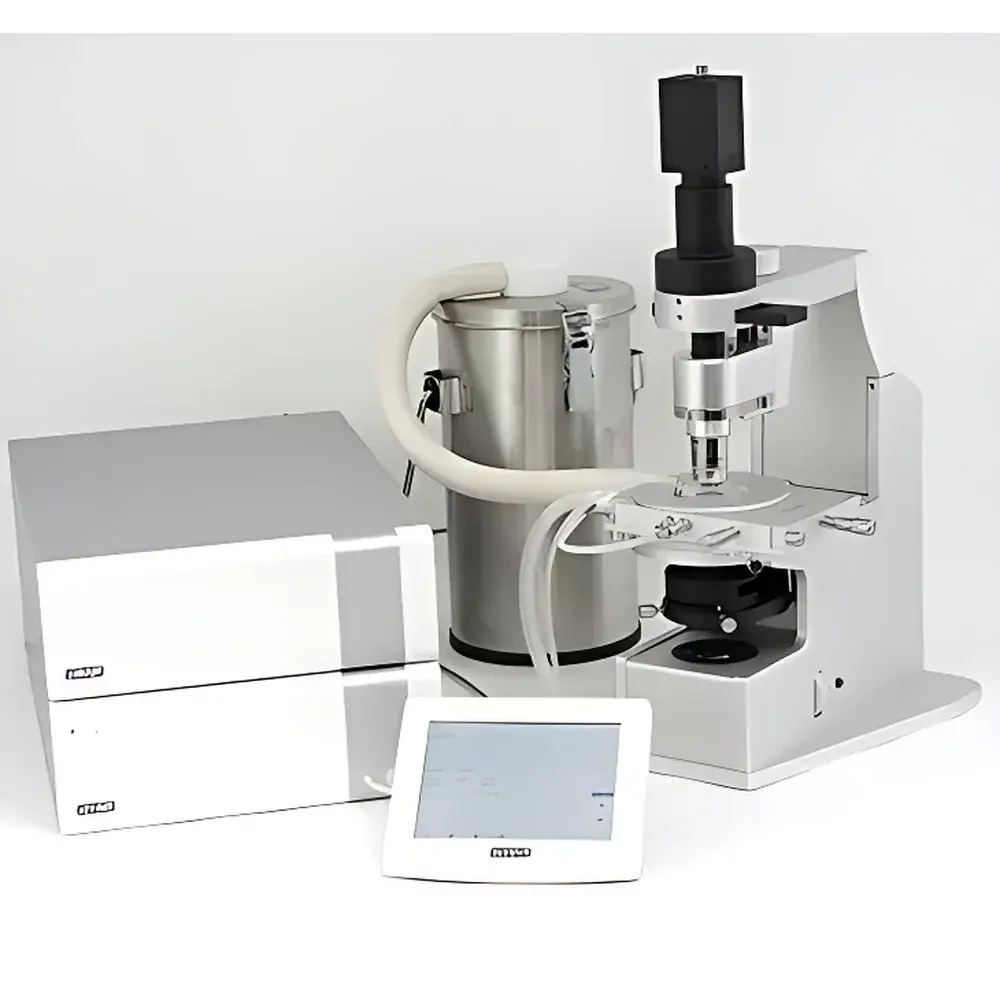
Linkam THMSG600 Geological Heating and Cooling Stage
| Brand | Linkam |
|---|---|
| Origin | United Kingdom |
| Model | THMSG600 |
| Temperature Range | −195 °C to +600 °C |
| Temperature Accuracy | ±0.01 °C |
| Temperature Stability | <0.01 °C |
| Heating/Cooling Rate | 0.01–150 °C/min |
| Optical Aperture Diameter | 1.3 mm |
| Sample XY Travel | 16 mm |
| Heating Area Diameter | 22 mm |
| Window Thickness | 0.17 mm |
| Minimum Objective/Condenser Working Distance | 4.5 mm / 12.5 mm |
| Dimensions | 137 × 92 × 22 mm |
Overview
The Linkam THMSG600 is a purpose-engineered geological heating and cooling stage designed for high-precision microthermometric analysis of fluid inclusions in transparent mineral mounts. It operates on the principle of controlled, symmetric thermal modulation under optical observation—enabling accurate determination of homogenization temperatures (Th), ice-melting temperatures (Tm), and eutectic dissolution events in geological fluid systems. Built upon the proven THMS600 platform, the THMSG600 incorporates targeted enhancements for geoscience applications: an ultra-low-expansion stainless steel sample holder, optimized silver heating block geometry, and a proprietary LNP95 liquid nitrogen delivery system that decouples rapid cryogenic cooling from mechanical perturbation. Its design meets the stringent spatial and thermal stability requirements of confocal Raman microscopy, high-magnification transmitted-light petrography, and time-resolved phase transition imaging—where sub-micron focus drift or sample displacement would compromise data integrity.
Key Features
- Temperature range spanning −195 °C (liquid nitrogen boiling point) to +600 °C, covering the full operational envelope for most aqueous, hydrocarbon, and CO₂-bearing fluid inclusions.
- A-class Pt100 platinum resistance thermometer embedded directly into the silver heating block, delivering real-time feedback with <0.01 s response time and certified accuracy of ±0.01 °C over the entire range.
- LNP95 cryogenic pump system featuring dual-core flexible tubing and closed-loop rate control—enabling programmable cooling rates from 0.01 °C/min (for slow eutectic tracking) to 150 °C/min (for rapid quenching studies).
- Optimized silver heating block architecture minimizes vertical thermal expansion and suppresses nitrogen surge-induced vibration, eliminating the need for refocusing during dynamic thermal cycling.
- Hermetically sealed sample chamber with gas inlet/outlet ports, supporting inert atmosphere purging (N₂, Ar) to prevent oxidation or hydration artifacts during high-temperature runs.
- 0.17 mm-thick fused silica optical window ensures high UV–VIS transmission while maintaining mechanical rigidity and thermal uniformity across the 1.3 mm central aperture.
- Side-loading sample insertion mechanism enables unobstructed access without stage removal—critical for preserving alignment in integrated microscope setups.
Sample Compatibility & Compliance
The THMSG600 accommodates standard 25 × 45 mm or 25 × 75 mm polished doubly-polished thin sections mounted on 1.0–1.2 mm thick glass slides. Its low-expansion stainless steel frame maintains lateral positional stability within ±0.1 µm per 100 °C change—ensuring compatibility with objectives requiring ≤4.5 mm working distance and condensers with ≥12.5 mm clearance. The stage conforms to ISO 17025-relevant thermal calibration traceability protocols when used with NIST-traceable reference materials (e.g., indium, tin, zinc fixed points). It supports GLP-compliant workflows via optional computer-controlled temperature ramping and audit-trail logging through Linkam’s TC125 controller and Linksys software.
Software & Data Management
When paired with the TC125 temperature controller and Linksys v4.x software, the THMSG600 enables synchronized acquisition of thermal profiles, digital video capture, and metadata-tagged image sequences. Software features include multi-segment ramp/soak programming, real-time derivative (dT/dt) monitoring for phase transition onset detection, and export of time-stamped CSV logs compliant with FDA 21 CFR Part 11 requirements (with electronic signature and audit trail modules enabled). All temperature setpoints, sensor readings, and system status flags are timestamped to microsecond resolution and stored in non-volatile memory—even during power interruption.
Applications
- Determination of homogenization temperatures (Th) in aqueous NaCl–H₂O, CaCl₂–H₂O, and mixed-salt inclusions using slow-heating protocols (≤1 °C/min).
- Low-temperature cryometric analysis including ice-melting (Tm_ice), clathrate dissociation (Tm_clath), and eutectic melting (Te) in H₂O–CO₂–CH₄ systems.
- In situ observation of solid–liquid–vapor phase equilibria during controlled freeze–thaw cycles, relevant to ore deposit genesis modeling.
- High-temperature dehydration reactions in hydrous silicates and carbonate minerals under inert gas environments.
- Correlative microstructural evolution studies combining hot-stage thermomicroscopy with synchrotron X-ray diffraction or micro-Raman spectroscopy.
FAQ
What is the maximum recommended heating rate for accurate Th measurements?
For reliable homogenization temperature determination, heating rates should not exceed 1 °C/min above 200 °C; slower rates (0.2–0.5 °C/min) are advised for inclusions with small vapor bubbles or complex salinity.
Can the THMSG600 be integrated with automated microscope stages?
Yes—the stage includes standardized M4 mounting threads and TTL-compatible trigger I/O ports, enabling hardware synchronization with motorized XYZ stages and shutters in OEM-integrated platforms.
Is vacuum operation supported?
No. The THMSG600 is designed for ambient-pressure or positive-pressure inert gas environments only; it is not rated for vacuum or negative-pressure conditions.
How often does the Pt100 sensor require recalibration?
Under normal laboratory use, annual verification against ITS-90 fixed-point cells (e.g., gallium, indium) is sufficient; full recalibration is recommended every two years or after mechanical impact.
Does the LNP95 system require external LN₂ pressure regulation?
No—the integrated cryopump includes automatic back-pressure regulation and flow modulation; only a standard LN₂ dewar with dip tube is required.



