
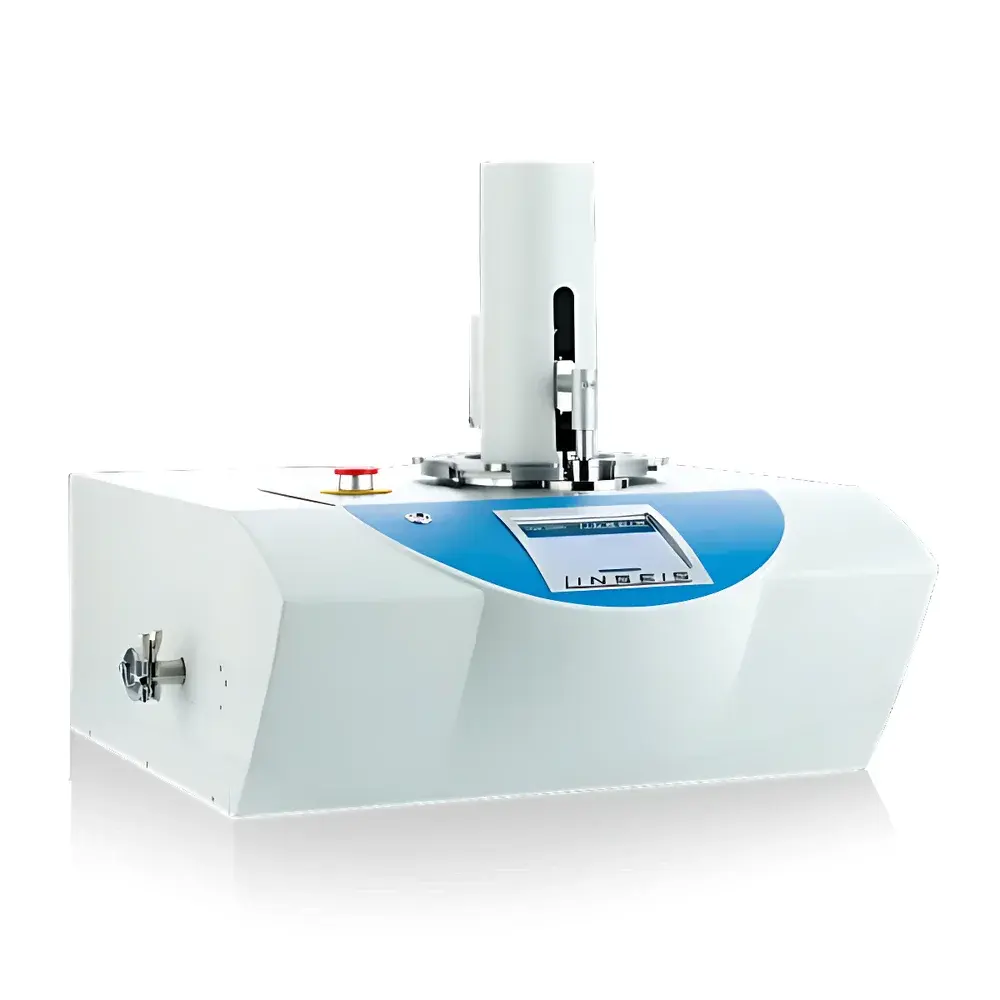
LINSEIS Chip-DSC 100 Differential Scanning Calorimeter
| Brand | LINSEIS |
|---|---|
| Origin | Germany |
| Model | Chip-DSC 100 (Chip-DSC L66 Ultimate) |
| Instrument Type | DSC |
| Temperature Range | −150 to 600 °C (Peltier, closed-loop internal cooler, or liquid nitrogen cooling) |
| Temperature Accuracy | ±0.2 K |
| Temperature Precision | ±0.02 K |
| Heating/Cooling Rate | 0.001–1000 K/min |
| DSC Signal Range | ±2.5–±1000 mW |
| Heat Flow Resolution | 0.03 µW |
| Atmosphere Control | Inert or oxidative (static/dynamic) |
| Recommended Calibration Interval | Every 6 months |
| Digital Imaging Resolution | 1680 megapixels (optical accessories only) |
| Power Consumption | Up to 80% lower than conventional DSC systems |
Overview
The LINSEIS Chip-DSC 100 (Chip-DSC L66 Ultimate) is a high-performance differential scanning calorimeter engineered for precision thermal analysis across demanding research and industrial quality control environments. Unlike conventional DSC systems relying on bulk-sensor architectures, the Chip-DSC 100 employs a monolithic silicon-based microfabricated sensor chip—integrating both reference and sample thermocouple junctions, heater elements, and temperature sensors on a single low-thermal-mass substrate. This chip architecture enables direct measurement of heat flow without signal drift compensation or post-acquisition baseline correction, delivering raw data with intrinsic fidelity. The instrument operates on the principle of symmetric heat-flux DSC, where differential heat flow between sample and reference is measured under controlled heating, cooling, or isothermal conditions. Its extended temperature range (−150 °C to 600 °C), ultra-fast dynamic response (up to 1000 K/min), and sub-millikelvin thermal stability make it particularly suited for kinetic studies, polymer crystallization analysis, pharmaceutical solid-state characterization, and energetic materials screening.
Key Features
- Monolithic chip sensor with integrated thermopiles and resistive heaters—enabling true zero-baseline heat flow measurement and eliminating need for mathematical baseline subtraction
- Ultra-low thermal mass design ensures rapid thermal equilibration, exceptional sensitivity (0.03 µW), and reproducible heating/cooling rates from 0.001 to 1000 K/min
- Triple-cooling configuration support: Peltier stage (−150 °C), closed-loop internal chiller (−90 °C), and liquid nitrogen cryostat (−180 °C optional)
- Modular accessory architecture compatible with HP-DSC (50/150 bar), optical CCD imaging, UV photo-DSC, and Raman-coupled configurations
- 96-position automated sample changer with programmable sequence execution—including unattended overnight operation under GLP-compliant logging
- Energy-efficient operation consuming up to 80% less power than conventional DSC platforms, with no external water cooling required
- High-resolution digital imaging (1680 megapixels) available for real-time morphological correlation during thermal transitions
Sample Compatibility & Compliance
The Chip-DSC 100 accommodates a broad spectrum of sample types—including volatile, corrosive, hygroscopic, and thermally unstable materials—thanks to its hermetically sealed chip cavity and configurable atmosphere control (N₂, Ar, O₂, air; static or dynamic flow up to 200 mL/min). Its robust sensor design permits safe evaluation of hazardous substances such as peroxides, nitrocellulose, or metal hydrides without risk of cross-contamination or sensor degradation. The system complies with ASTM E794 (melting point determination), ASTM E1269 (heat capacity measurement), ISO 11357 series (polymer thermal analysis), and USP (pharmaceutical thermal behavior). Data acquisition and reporting meet FDA 21 CFR Part 11 requirements when used with LINSEIS ThermoSoft™ v8.2+ software, supporting full audit trail, electronic signatures, and role-based access control for GMP/GLP-regulated laboratories.
Software & Data Management
Controlled via LINSEIS ThermoSoft™—a Windows-based platform certified for ISO/IEC 17025 and GxP environments—the Chip-DSC 100 delivers comprehensive method scripting, multi-step temperature programming, and synchronized accessory triggering (e.g., UV lamp activation at defined T-onset). Raw heat flow, temperature, and time-series data are stored in vendor-neutral HDF5 format with embedded metadata (instrument ID, operator, calibration status, gas flow rate, cooling mode). Advanced analysis modules include Ozawa-Flynn-Wall kinetics, Kissinger peak deconvolution, modulated DSC (MDSC®-compatible processing), and crystallinity quantification using enthalpy integration. All reports export to PDF/XLS with customizable templates aligned to internal SOPs or regulatory submission standards (e.g., ICH Q5E, Q1A).
Applications
- Polymer science: Quantitative cold-crystallization kinetics in PET, PLA, and polyolefins; detection of weak transitions (e.g., secondary relaxations) at high scan rates
- Pharmaceutical development: Polymorph screening, amorphous content assessment, excipient compatibility testing, and stability-indicating assays under oxidative stress
- Materials engineering: Glass transition mapping in metallic glasses, decomposition onset in battery cathode materials (e.g., NMC, LFP), and curing exotherm profiling in composites
- Food science: Starch gelatinization enthalpy, lipid polymorphism, and moisture-induced phase transitions in freeze-dried matrices
- Energetic materials: Safety-critical decomposition onset, adiabatic time-to-explosion modeling (TMRad), and compatibility testing of propellant formulations
FAQ
What cooling options are supported—and how do they affect minimum operating temperature?
The standard configuration includes a Peltier-based cooling module (−150 °C). Optional closed-loop internal chillers extend to −90 °C, while LN₂-cooled variants achieve −180 °C. Actual base temperature depends on ambient humidity and ventilation; sub-ambient operation requires dry gas purge.
Is the chip sensor field-replaceable—and what is typical lifetime under routine use?
Yes—the sensor chip is user-swappable in under 90 seconds without tools or recalibration. Typical service life exceeds 5000 measurement cycles when operated within specified thermal and chemical limits.
Can the Chip-DSC 100 be integrated into automated lab workflows?
Yes—via Ethernet TCP/IP interface and SCPI command set, it supports integration with LIMS, MES, and robotic sample handling platforms. The 96-position autosampler includes RS-232 and digital I/O ports for external trigger synchronization.
Does the system support cGMP-compliant data integrity practices?
When deployed with ThermoSoft™ v8.2+ and configured with network authentication, encrypted database storage, and enabled audit trail, the system fulfills ALCOA+ principles and supports inspection readiness for FDA, EMA, and PMDA audits.
How does the chip architecture improve resolution of overlapping thermal events?
The sensor’s nanosecond-scale thermal time constant (<10 ms) and absence of thermal lag enable true separation of closely spaced transitions—such as concurrent glass transition and cold crystallization in semi-crystalline polymers—without reliance on mathematical deconvolution algorithms.



