
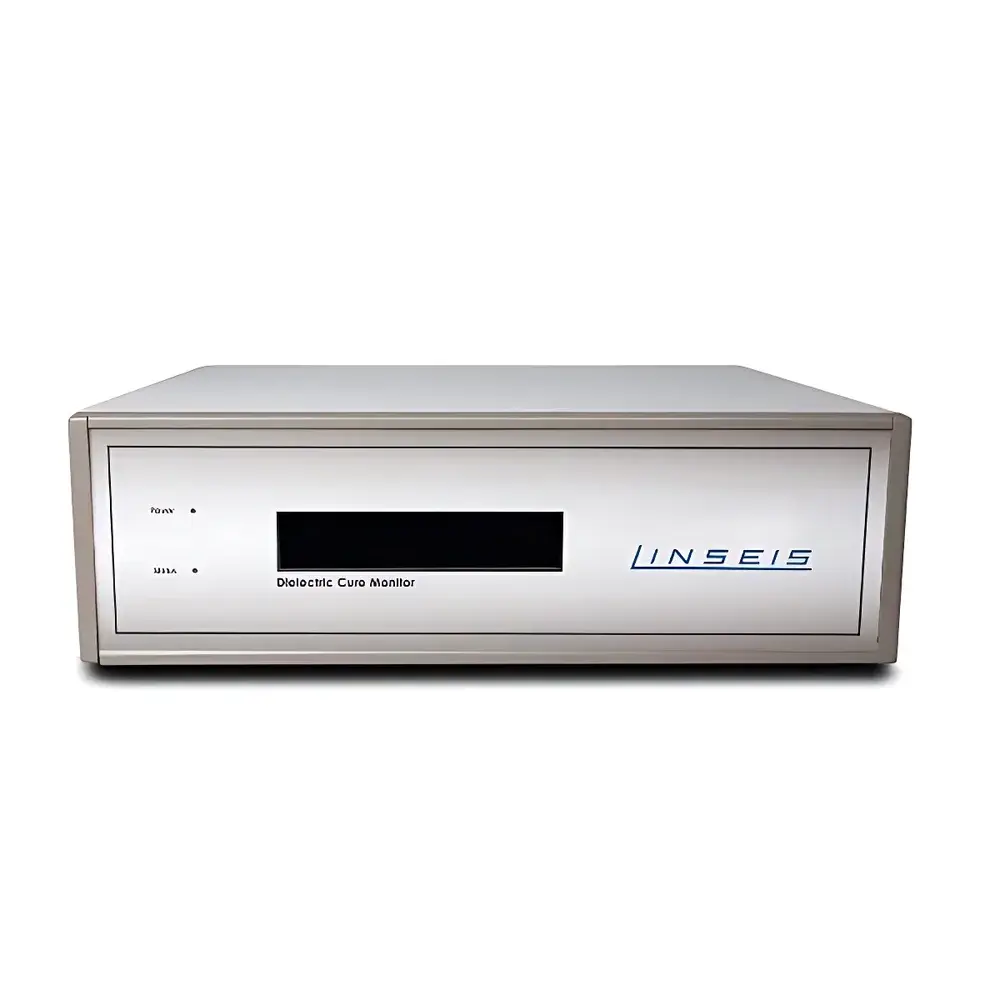
LINSEIS Dielectric Cure Monitoring System
| Brand | LINSEIS |
|---|---|
| Origin | Germany |
| Product Type | Dielectric Cure Monitor |
| Compliance | ASTM E2038, ASTM E2039 |
| Channel Options | 1, 2, 4, or 8 simultaneous channels |
| Measurement Modes | AC (1 Hz–100 kHz) and DC (LT-440 model only) |
| Sensor Compatibility | Parallel-plate & interdigitated electrode sensors |
| Operating Temperature Range | Up to 350 °C (with optional fixtures) |
Overview
The LINSEIS Dielectric Cure Monitoring System is an engineered solution for real-time, non-destructive characterization of thermosetting resin curing kinetics through dielectric spectroscopy. It operates on the fundamental principle that ionic mobility and dipole orientation within a polymer matrix directly correlate with molecular mobility—governing viscosity, crosslink density, gelation, and vitrification. By applying a sinusoidal AC voltage across a sensor embedded in or contacting the resin, the system measures complex permittivity (ε* = ε′ − jε″), from which ionic conductivity (σi) and ion viscosity (ηi = 1/σi) are derived. Unlike optical or thermal methods, dielectric monitoring captures chemical reactivity *in situ* and *in operando*, independent of sample color, opacity, or filler content—making it uniquely suitable for carbon-fiber composites, aerospace prepregs, wind turbine blade resins, and encapsulants used in electronics packaging. The system supports both laboratory-scale R&D and full-scale industrial process validation under ISO 9001, AS9100, and IATF 16949-aligned workflows.
Key Features
- Multi-channel architecture: Configurable 1-, 2-, 4-, or 8-channel operation enables spatially resolved cure profiling across large laminates or parallel batch testing.
- Dual-mode measurement capability (LT-440 model): Simultaneous AC impedance spectroscopy and DC resistivity measurement—critical for high-resistivity systems (e.g., silicone elastomers) where AC signals attenuate near full cure.
- Compliant sensor interface: Supports standardized parallel-plate electrodes (for bulk property assessment) and interdigitated (comb-type) electrodes (for surface-near, pressure-insensitive measurements on Kapton® or polyimide substrates).
- Thermal synchronization: Integrated thermocouple input (Type K) allows precise correlation of dielectric response with temperature ramp profiles—essential for kinetic modeling using Arrhenius or Kamal equations.
- Ruggedized hardware design: Industrial-grade enclosure (IP54), galvanically isolated analog front-end, and EMC-compliant signal conditioning ensure stable operation in manufacturing environments.
- Calibration traceability: Factory-calibrated against NIST-traceable standards; user-accessible calibration routines support periodic verification per ISO/IEC 17025 requirements.
Sample Compatibility & Compliance
The system accommodates a broad range of thermosetting formulations—including epoxies, phenolics, polyurethanes, bismaleimides (BMI), and cyanate esters—as well as UV-curable acrylates and SMC/BMC compounds. It is compatible with both liquid resins and partially cured preforms. Sensor geometries are selected based on application constraints: parallel-plate fixtures (e.g., LT-4203A-200C, rated to 200 °C) enable controlled-pressure cure studies in hot presses, while flexible interdigitated sensors permit embedding into molds or vacuum-bagging tooling without compromising structural integrity. All instruments comply with ASTM E2038 (“Standard Test Method for Determining the Dielectric Cure Behavior of Thermosetting Resins”) and ASTM E2039 (“Standard Practice for Dielectric Cure Monitoring of Thermosetting Resins Used in Composite Materials”). Data acquisition and storage meet FDA 21 CFR Part 11 requirements when paired with validated CureView software (audit trail, electronic signatures, role-based access control).
Software & Data Management
CureView software provides synchronized acquisition, visualization, and analysis of dielectric and thermal data streams. It delivers automated identification of four critical cure points (CP1–CP4) defined by ion viscosity slope inflections—corresponding to onset of flow, minimum viscosity (CP2), gel point (CP3), and vitrification/end-of-cure (CP4). Kinetic parameters (activation energy, reaction order) can be extracted via model-fitting modules compliant with ISO 11357-6. Raw data exports to CSV, HDF5, and MATLAB-compatible formats support integration with LIMS, MES, and statistical process control (SPC) platforms. Network-enabled LT-439 models support Modbus TCP and OPC UA protocols for direct linkage to plant SCADA systems—enabling real-time dashboards for production line monitoring and automated hold/release decisions.
Applications
- R&D: Screening resin formulations, optimizing catalyst loading, mapping time–temperature–transformation (TTT) diagrams, validating kinetic models.
- QA/QC: Incoming raw material qualification, batch-to-batch consistency verification, shelf-life assessment of pre-impregnated fibers (prepregs).
- Manufacturing: Closed-loop control of autoclave cycles, determination of optimal debulk timing, validation of out-of-autoclave (OOA) processes, certification of composite part cure state prior to machining or bonding.
- Failure analysis: Root-cause investigation of delamination, porosity, or incomplete cure in fielded components via retrospective dielectric signature comparison.
FAQ
How does dielectric cure monitoring differ from DSC or DMA?
Dielectric monitoring measures molecular mobility via ionic conduction and dipole relaxation—directly sensitive to chemical conversion—whereas DSC detects enthalpy changes and DMA measures mechanical modulus development, both of which lag behind early-stage reaction kinetics.
Can the system monitor cure under vacuum or pressure?
Yes. Interdigitated sensors operate reliably under vacuum bagging or hydraulic press conditions; parallel-plate fixtures are rated for pressures up to 1500 psi (LTP-250PTC press compatibility confirmed).
Is calibration required before each test?
No. Factory calibration remains valid across operating ranges; however, sensor-specific offset correction is recommended when switching between electrode types or after prolonged high-temperature exposure.
What sample preparation is needed?
Minimal: For parallel-plate tests, a 1–2 mm thick specimen is placed between electrodes; for interdigitated sensors, the resin is simply cast or injected onto the electrode surface—no sectioning or polishing required.
Does the system support GMP/GLP documentation?
Yes. When deployed with validated CureView software and documented SOPs, the platform supports audit-ready electronic records meeting GLP (OECD 1998) and GMP (ICH Q5C) expectations for pharmaceutical excipient or medical device polymer qualification.



