
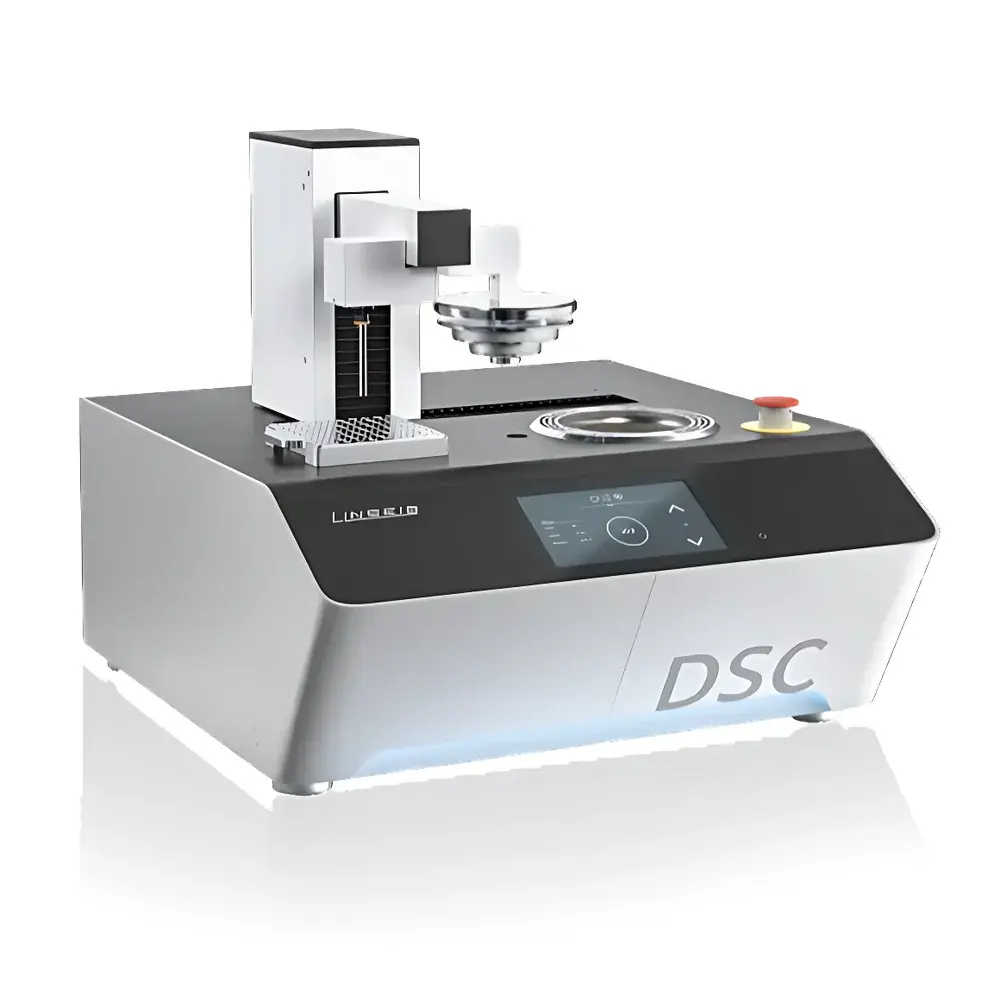
LINSEIS DSC L63 Differential Scanning Calorimeter
| Brand | LINSEIS |
|---|---|
| Origin | Germany |
| Instrument Type | Differential Scanning Calorimeter |
| Model | DSC L63 |
| Temperature Range | −170 °C to 750 °C |
| Heating/Cooling Rate | 0.01–100 K/min |
| Temperature Accuracy | ±0.1 K |
| DSC Signal Range | ±750 mW |
| Sample Capacity | Up to 96 positions (with optional autosampler) |
| Data Acquisition Rate | 100 Hz |
| Enthalpy Accuracy | <1% (verified with In, Zn standards) |
| Sensor Type | Ceramic/metal hybrid high-resolution sensor |
| Gas Control | Optional MFC (3 gases) or integrated MFC |
| 炉 Body & Crucible Interchangeability | Yes |
| Compliance | ASTM E794, ISO 11357, USP <1163>, GLP-ready |
Overview
The LINSEIS DSC L63 is a high-precision differential scanning calorimeter engineered for rigorous thermal characterization across an exceptionally broad temperature range—from cryogenic conditions at −170 °C up to 750 °C. It operates on the fundamental principle of heat flux DSC, measuring the difference in heat flow required to maintain identical temperatures between a sample and an inert reference as both are subjected to controlled, linear heating or cooling programs. This architecture ensures high baseline stability, excellent signal-to-noise ratio, and reproducible quantification of endothermic and exothermic transitions—including melting, crystallization, glass transitions, solid-solid phase changes, oxidative induction time (OIT), decomposition, and combustion events. Designed and manufactured in Germany, the DSC L63 integrates a proprietary ceramic/metal hybrid sensor offering superior resolution and thermal sensitivity, enabling detection of subtle thermal events even in low-mass or thermally weak samples. Its modular furnace design supports rapid, tool-free replacement of both furnace bodies and crucible holders—minimizing downtime and extending service life under demanding laboratory or quality control environments.
Key Features
- Ultra-wide operational temperature range: −170 °C to 750 °C (configurable per furnace module)
- Precise thermal control with programmable heating/cooling rates from 0.01 to 100 K/min (up to 150 K/min in Advanced/Ultimate configurations)
- High-fidelity sensor system delivering ±0.1 K temperature accuracy and <1% enthalpy accuracy (validated against certified In and Zn standards per ASTM E794)
- Robust mechanical construction with chemically resistant furnace housing and optimized thermal shielding for long-term baseline stability
- Modular design supporting interchangeable furnace units and crucible types—including Al, Al2O3, Cu, Au, Pt, and sapphire—enabling application-specific optimization
- Optional integrated mass flow controller (MFC) for precise, automated switching among up to three process gases (e.g., N2, O2, Ar) during dynamic atmosphere experiments
- Available optical DSC module with CCD camera for real-time visual monitoring of sample morphology changes during thermal events
Sample Compatibility & Compliance
The DSC L63 accommodates a wide spectrum of sample forms—powders, granules, films, fibers, gels, and small-volume liquids—within standard and custom crucibles. Its compatibility extends to aggressive matrices including halogenated polymers, acidic catalysts, and reactive metal hydrides, thanks to corrosion-resistant sensor materials and sealed furnace architecture. The instrument meets critical regulatory requirements for GxP-compliant environments: raw data files include full audit trails (user, timestamp, method, parameters), electronic signatures are supported via optional software modules compliant with FDA 21 CFR Part 11, and all thermal calibrations adhere to ISO 11357-1 and ASTM E794 protocols. Routine verification using certified reference materials (In, Zn, Sn, Bi) ensures traceability to NIST standards. For pharmaceutical applications, the system supports USP validation guidelines for thermal analytical instruments.
Software & Data Management
Controlled by LINSEIS’s ThermoSoft® platform, the DSC L63 provides intuitive method setup, real-time visualization, and advanced post-processing capabilities—including peak deconvolution, kinetic modeling (e.g., Ozawa-Flynn-Wall), baseline correction algorithms, and derivative (dH/dT) analysis. All measurement data are stored in vendor-neutral, ASCII-readable formats (.txt, .csv) alongside metadata-rich .tdf files. The software supports automated report generation with customizable templates aligned to internal SOPs or external regulatory submissions. When paired with the optional 96-position autosampler, ThermoSoft® enables unattended overnight operation with full error handling, sample tracking, and QC flagging—reducing manual intervention while maintaining full data integrity and chain-of-custody compliance.
Applications
The DSC L63 serves as a foundational tool across R&D, production QA/QC, and failure analysis laboratories. Key use cases include:
- Determination of melting points, eutectic behavior, and purity assessment in APIs and excipients
- Oxidative Induction Time (OIT) testing of polyolefins (e.g., PE, PP) under controlled oxygen atmospheres per ASTM D3895
- Quantification of cotton fiber content in composite textiles via combustion enthalpy (≈60 J/g) and autoignition temperature (≈430 °C)
- Characterization of phase transitions in shape-memory alloys, lithium-ion battery cathode materials, and polymer blends
- Stability screening of biologics and protein formulations through denaturation onset and aggregation enthalpy
- Food science applications such as sugar polymorphism analysis (fructose, glucose, sucrose) and fat crystallization profiling
FAQ
What is the minimum detectable heat flow change?
The system achieves a noise level below 0.1 µW, enabling reliable detection of transitions in sub-milligram samples.
Can the DSC L63 perform simultaneous TGA-DSC measurements?
No—this is a dedicated heat-flux DSC platform. For coupled thermal analysis, LINSEIS offers separate STA (simultaneous TGA-DSC) systems.
Is nitrogen purge mandatory for baseline stability?
A continuous inert gas purge (N₂ or Ar) is recommended for optimal baseline flatness and oxidation prevention; however, the system operates stably in static air for specific non-reactive applications.
How is calibration verified during routine operation?
Users may execute daily or weekly verification runs using pre-weighed indium (mp = 156.6 °C) and zinc (mp = 419.5 °C) standards; calibration reports are auto-generated and archived with full traceability.
Does the software support automated pass/fail criteria for release testing?
Yes—ThermoSoft® allows definition of acceptance limits for peak temperature, enthalpy, and onset values; results are flagged automatically against user-defined specifications.



