
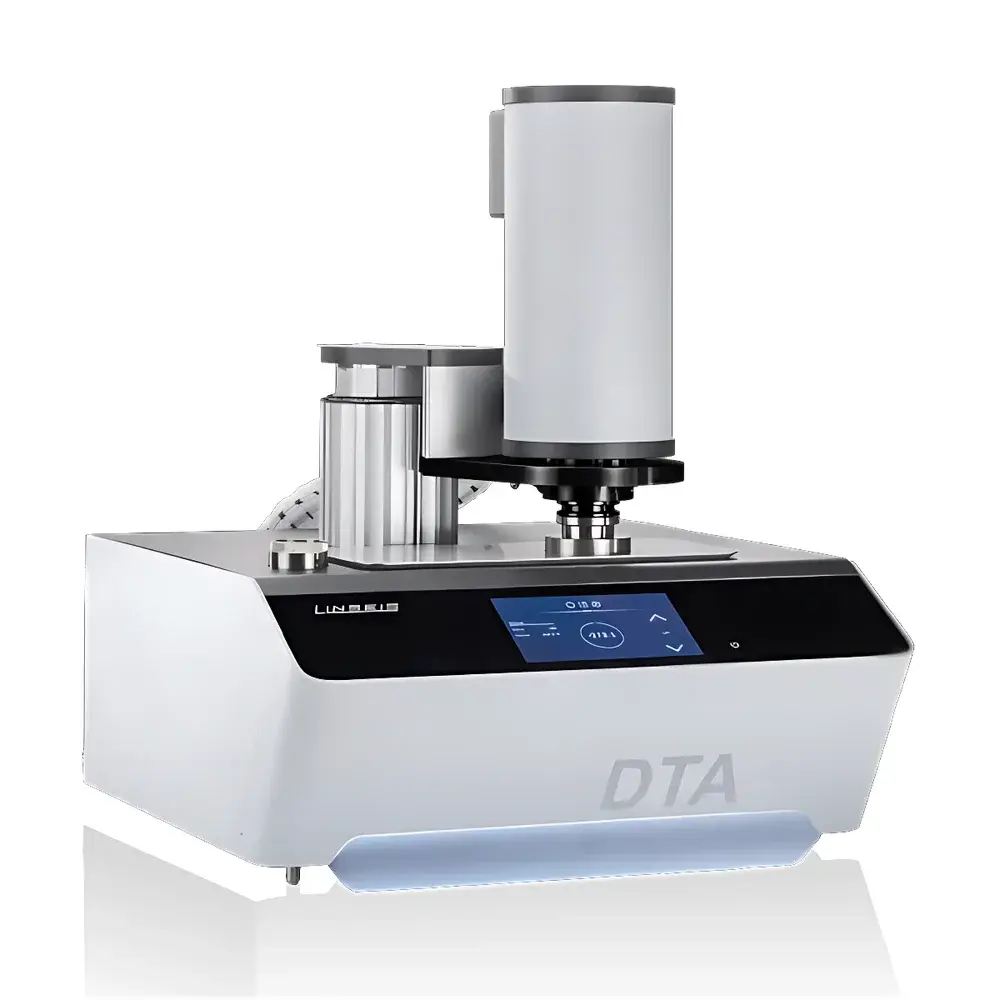
LINSEIS DTA L61 High-Temperature Differential Thermal Analyzer
| Brand | LINSEIS |
|---|---|
| Origin | Germany |
| Model | DTA L61 |
| Instrument Type | Differential Thermal Analyzer (DTA) |
| Temperature Range | −150 °C to 2400 °C (configurable: −150–500 °C, −150–1000 °C, RT–1400 °C, RT–1500 °C, RT–1600 °C, RT–1750 °C, RT–2000 °C, RT–2400 °C) |
| Heating/Cooling Rate | 0.001–50 K/min |
| Vacuum Capability | down to 1×10⁻⁵ mbar |
| Sensor Types | E-, K-, S-, B-, and C-type thermocouples |
| Measurement Principle | Heat-Flux DTA |
| Atmosphere Control | Oxidizing, reducing, inert (static/dynamic) |
| Optional Coupling | Mass Spectrometry (MS), Fourier Transform Infrared Spectroscopy (FTIR) |
Overview
The LINSEIS DTA L61 is a high-precision, modular differential thermal analyzer engineered for rigorous thermoanalytical characterization across an industry-leading temperature range—from cryogenic conditions at −150 °C up to extreme temperatures of 2400 °C. Operating on the heat-flux DTA principle, the instrument detects temperature differentials between a sample and an inert reference material under identical thermal conditions. Unlike DSC, which quantifies heat flow directly, DTA identifies endothermic and exothermic events—such as glass transitions, crystallization, melting, solid-state phase transformations, and sublimation—by monitoring relative temperature shifts with high temporal resolution and baseline fidelity. The DTA L61’s robust architecture integrates vacuum-tight furnace chambers, low-thermal-mass sensor assemblies, and actively stabilized temperature control systems—ensuring reproducible signal integrity over extended operational lifetimes. Its design adheres to fundamental metrological requirements for thermal analysis, supporting both routine quality control and advanced materials research in academic, pharmaceutical, metallurgical, and ceramic laboratories.
Key Features
- Ultra-broad operational temperature range: configurable from −150 °C to 2400 °C via interchangeable furnace modules (e.g., low-temperature cryo-furnace, high-temperature graphite or tungsten-heated furnaces)
- High-resolution thermal detection using calibrated E-, K-, S-, B-, or C-type thermocouple sensor pairs optimized for specific temperature domains and chemical compatibility
- Vacuum-sealed measurement chamber capable of sustained operation down to 1×10⁻⁵ mbar, enabling studies under ultra-high-purity inert atmospheres or controlled reactive gas environments
- Precise dynamic thermal control: programmable heating and cooling rates from 0.001 K/min to 50 K/min with <±0.1 K accuracy over full range
- Modular gas handling system options—including manual, semi-automatic, and mass-flow-controller (MFC)-based configurations—for reproducible atmosphere switching (oxidizing, reducing, inert) during measurement
- Native interface for hyphenated techniques: direct integration ports for quadrupole mass spectrometers (QMS) and Fourier-transform infrared (FTIR) spectrometers to enable simultaneous evolved-gas analysis (EGA)
Sample Compatibility & Compliance
The DTA L61 accommodates diverse sample geometries and chemistries through a wide selection of crucible materials—including high-purity Al₂O₃, Pt, Au, Ag, graphite, W, stainless steel (for high-pressure applications), and custom-designed ceramic holders. This flexibility supports analysis of pharmaceuticals, polymers, food matrices, inorganic oxides, refractory metals, and nuclear fuel simulants without cross-contamination or catalytic interference. The system complies with internationally recognized standards for thermal analysis methodology, including ASTM C351 (thermal conductivity of insulating materials), ASTM D3417 (heat of fusion of plastics), ASTM D3418 (transition temperatures of polymers), ASTM D3895 (oxidative induction time), ASTM D4565 (thermal stability of elastomers), ASTM E793 (enthalpy of fusion), ASTM E794 (melting and crystallization temperatures), DIN 51004 (DTA general requirements), DIN 51007 (calibration procedures), and ISO 10837 (thermal analysis terminology and definitions). All firmware and data acquisition protocols are structured to support GLP/GMP audit readiness, with timestamped metadata, user-access logs, and electronic signature capabilities aligned with FDA 21 CFR Part 11 expectations.
Software & Data Management
Control and analysis are performed via LINSEIS ThermoSoft™—a Windows-based platform offering real-time visualization, multi-step temperature programming, automatic peak identification, baseline correction algorithms, and quantitative enthalpy calculation tools. Raw data files (.tdt) are stored in ASCII-compatible format for third-party processing (e.g., MATLAB, Origin, Python-based SciPy workflows). The software supports automated report generation compliant with ISO/IEC 17025 documentation requirements, including uncertainty estimation per ISO/IEC Guide 98-3 (GUM). Audit trails record all parameter modifications, calibration events, and user actions with immutable timestamps. USB 2.0 interface ensures plug-and-play connectivity with modern laboratory PCs; optional Ethernet upgrade enables remote monitoring and centralized fleet management in multi-instrument facilities.
Applications
The DTA L61 delivers critical insights across multiple domains: in metallurgy, it resolves austenite-to-ferrite transformations, eutectic reactions, and liquidus/solidus boundaries—as demonstrated in low-alloy steel analysis where magnetic transition at 731 °C, phase change at 637 °C, and melting onset at 1411 °C were resolved with <0.5 °C repeatability; in pharmaceutical development, it validates polymorphic stability, desolvation kinetics, and excipient compatibility; in ceramics and nuclear materials science, it characterizes sintering behavior, decomposition pathways, and high-temperature redox equilibria under controlled pO₂. Its compatibility with evolved-gas analysis extends utility to catalysis research, battery electrode degradation studies, and pyrolysis mechanism elucidation.
FAQ
What temperature ranges are physically achievable with standard configurations?
Standard configurations include −150–500 °C (cryo-furnace), −150–1000 °C (dual-zone furnace), and RT–2400 °C (tungsten-heated ultra-high-temp furnace). Maximum operating temperature depends on crucible material, atmosphere, and sensor type.
Can the DTA L61 perform quantitative enthalpy measurements?
While DTA is primarily qualitative/semi-quantitative, comparative enthalpy estimation is possible using reference materials with certified transition enthalpies (e.g., high-purity indium, tin, or zinc) and careful calibration of sensor sensitivity and thermal lag.
Is the system compatible with inert glovebox integration?
Yes—the instrument features standardized flange interfaces (CF-40, CF-63) for direct coupling to argon- or nitrogen-purged gloveboxes, enabling air-sensitive sample loading without atmospheric exposure.
How is baseline stability maintained over long-duration experiments?
Baseline stability is ensured through symmetric dual-sensor geometry, active furnace wall temperature compensation, and proprietary thermal shielding that minimizes radiative asymmetry—achieving drift <1 µV/h over 24-hour runs.
What validation documentation is supplied with the system?
Each unit ships with factory calibration certificates traceable to NIST (USA) or PTB (Germany), IQ/OQ documentation templates, and a full set of ASTM/DIN/ISO-compliant test reports for thermal homogeneity, temperature accuracy, and noise floor verification.



