
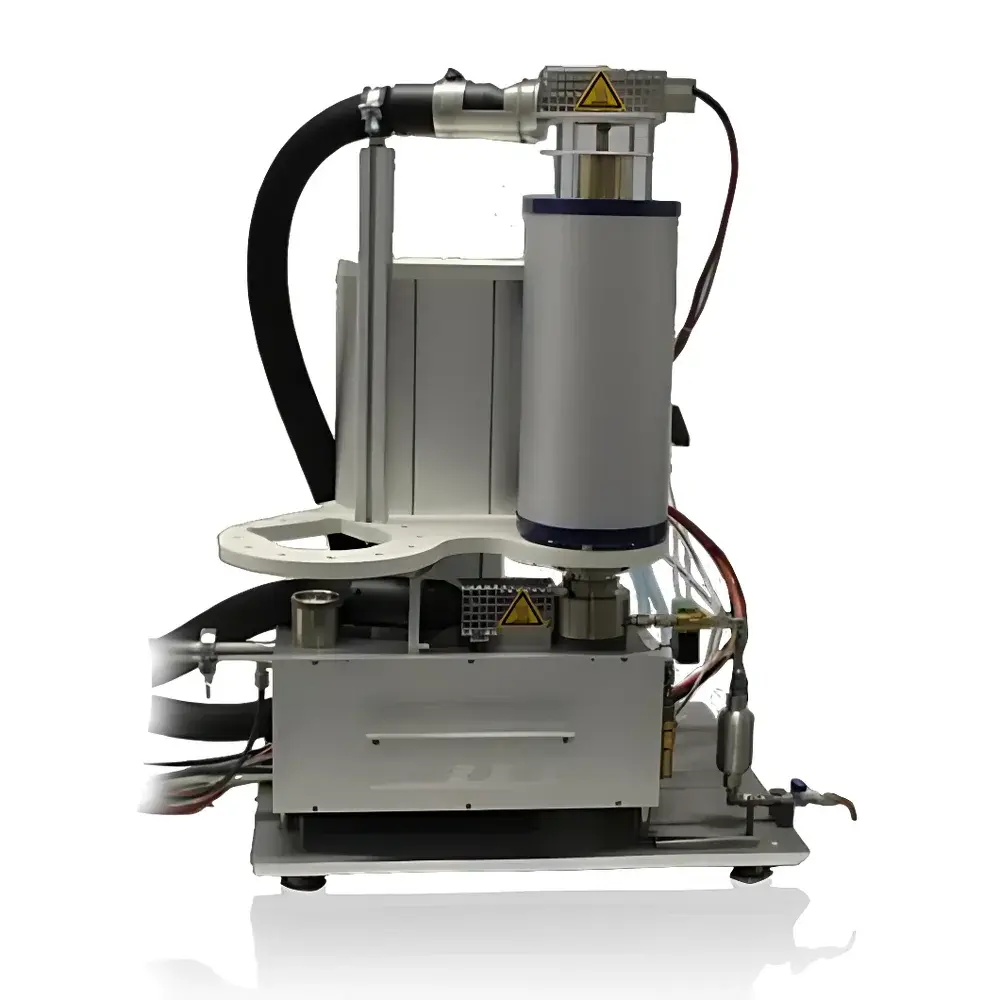
LINSEIS STA L81 Nuclear Simultaneous Thermal Analyzer for Nuclear Applications
| Brand | LINSEIS |
|---|---|
| Origin | Germany |
| Model | STA L81 Nuclear |
| Temperature Range | −150 °C to 500 / 700 / 1000 °C |
| Heating Rate | 0.01–100 K/min |
| Temperature Stability | 0.001 °C |
| Maximum Sample Mass | ±35,000 mg |
| Vacuum Capability | 10⁻² mbar (pump-dependent) |
| Pressure Range (optional) | up to 5 bar |
| TG Resolution | 0.01 / 0.02 / 0.1 µg |
| DSC Resolution | 0.3 / 0.4 / 1 / 1.2 µW |
| DTA Resolution | 0.03 nV |
| DTA Sensitivity | 1.5 µV/mW |
| DTA Range | 250 / 2500 µV |
| Sensor Types | E / K / S / B / C (C = DTA-only) |
Overview
The LINSEIS STA L81 Nuclear is a purpose-engineered simultaneous thermal analyzer designed explicitly for nuclear materials research under stringent radiological safety and chemical compatibility requirements. Unlike standard STA systems, the L81 Nuclear integrates dual-mode operation—thermogravimetric analysis (TGA) and differential scanning calorimetry (DSC) or differential thermal analysis (DTA)—within a fully reconfigurable architecture that supports remote operation, glovebox integration, and corrosion-resistant material handling. Its core measurement principle relies on high-stability thermocouple-based heat flow detection (for DSC/DTA) coupled with microgram-level electromagnetic force compensation (EMFC) balance technology for mass change quantification. The system operates across an industry-leading temperature range—from cryogenic −150 °C up to 2400 °C—enabling characterization of advanced nuclear fuels, molten salt reactor (MSR) candidates, structural alloys, and fission product-bearing compounds under controlled inert, reducing, oxidizing, or vacuum atmospheres.
Key Features
- Modular remote control architecture: Main furnace and sensor unit physically separated from electronics cabinet, allowing placement inside gloveboxes, fume hoods, or shielded rooms while retaining full operational functionality via fiber-optic or isolated Ethernet interfaces.
- Corrosion-resistant construction: All wetted components—including sample holders, crucibles, gas lines, and furnace liners—are fabricated from high-purity alumina, silicon carbide, or Hastelloy® variants to withstand aggressive molten salts (e.g., FLiBe, FLiNaK), halides, and oxidizing fission products.
- Triple-thermocouple DSC sensor array: Provides enhanced signal-to-noise ratio and baseline stability for precise enthalpy determination in low-heat-capacity nuclear samples, critical for phase transition mapping in actinide-bearing systems.
- Multi-range EMFC balance with selectable resolution modes (0.01–0.1 µg): Enables accurate mass tracking across wide dynamic ranges—from sub-milligram irradiated fuel fragments to multi-gram ceramic pellets—without mechanical recalibration.
- Programmable atmosphere control: Integrated mass flow controllers support precise gas blending (Ar, He, N₂, H₂, CO, O₂, air) up to 5 bar absolute pressure; optional vacuum pumping down to 10⁻² mbar ensures dehydrated or oxide-free environments for sensitive fuel oxidation studies.
- Glovebox-compatible service design: All maintenance-accessible components—including balance head, furnace lid, sensor cartridge, and gas inlet manifolds—are front-mounted and operable using standard laboratory gloves, eliminating need for containment breach during routine servicing.
Sample Compatibility & Compliance
The STA L81 Nuclear accommodates diverse nuclear-relevant sample forms—including powders, sintered pellets, metallic foils, molten salt aliquots (in sealed crucibles), and spent fuel simulants—within standardized platinum, alumina, or tungsten crucibles. Crucible selection adheres to ASTM E1131 and ISO 11357 standards for thermal stability and inertness verification. The system complies with IAEA Safety Standards Series No. SSG-29 (Handling of Radioactive Materials) and supports GLP/GMP-aligned data integrity through hardware-enforced audit trails, electronic signatures, and 21 CFR Part 11–compliant software configuration. All radiation-shielded configurations are validated per DIN 25421-2 for external dose rate limits (<1 µSv/h at 30 cm).
Software & Data Management
ThermoSoft® Nuclear Edition provides integrated acquisition, real-time baseline correction, peak deconvolution, and kinetic modeling (e.g., Kissinger, Ozawa-Flynn-Wall) tailored for nuclear thermal behavior. Raw data files (.tdf) are stored with embedded metadata including operator ID, atmospheric composition, purge gas flow rates, and calibration traceability to NIST SRM 720 (indium). Export formats include ASTM E1269-compliant .csv, ISO 11357-1–aligned .xml, and proprietary .tdf archives with SHA-256 checksums. Audit logs record every parameter change, method execution, and user login—retained for ≥36 months without manual intervention.
Applications
- Thermal stability assessment of fluoride and chloride-based molten salts for Generation IV MSRs, including decomposition onset, volatility loss, and redox-driven mass changes.
- Phase transformation thermodynamics of uranium/plutonium oxides, carbides, and nitrides under simulated accident conditions (e.g., LOCA, RIA).
- Decomposition kinetics of nitrate-based heat transfer salts (e.g., Ca(NO₃)₂·4H₂O) used in concentrated solar power–nuclear hybrid systems.
- Oxidation resistance evaluation of SiC/SiC composites and FeCrAl alloys under high-temperature steam environments relevant to light water reactor (LWR) severe accident mitigation.
- Calorimetric quantification of latent heats in eutectic salt mixtures, enabling extrapolation to pure-component thermophysical properties via van’t Hoff analysis.
FAQ
Can the STA L81 Nuclear be operated inside a nitrogen-filled glovebox?
Yes—the instrument’s modular design allows full separation of the furnace/sensor module from the electronics cabinet. All electrical and pneumatic feedthroughs are rated for inert-atmosphere glovebox integration, with optional stainless-steel bellows-sealed sample loading ports.
What crucible materials are certified for use with molten fluorides at 800 °C?
High-purity nickel-based alloy (Inconel® 600) and tungsten crucibles are supplied with certificate of conformance to ASTM B166 and ISO 6892-1, validated for ≤1000 h exposure to FLiBe at 750 °C.
Is the system compliant with USNRC regulatory guidance for irradiated material testing?
While the STA L81 Nuclear itself is not a licensed nuclear device, its design meets NUREG/CR-7213 requirements for remote-operated analytical instrumentation in Category 2 radiological laboratories, including fail-safe interlocks, dose-rate monitoring interface capability, and ALARA-compliant workflow documentation.
How is temperature calibration verified across the full 2400 °C range?
Calibration employs NIST-traceable fixed-point standards (In, Sn, Zn, Al, Ag, Au, Cu) and certified reference materials (e.g., NIST SRM 720, 781, 1976) with uncertainty budgets conforming to ISO/IEC 17025:2017 Clause 6.5.
Does the software support automated peak integration for multi-step decomposition events?
Yes—ThermoSoft® Nuclear Edition includes constrained Gaussian/Lorentzian peak fitting with user-definable baseline algorithms (tangent, linear, polynomial), supporting concurrent identification of dehydration, nitrate decomposition, and oxide formation steps in single-run TG-DSC data.



