
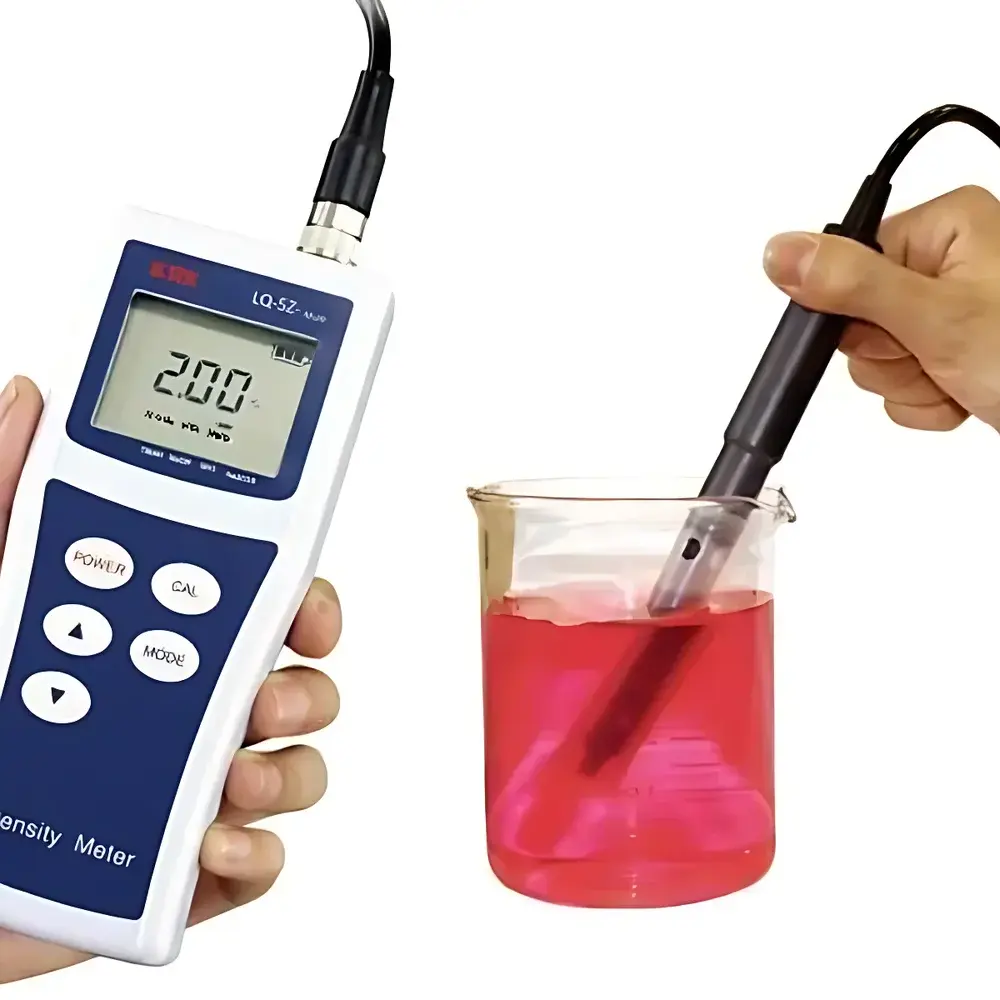
LiquriTech LQ-5Z-HNO3 Nitric Acid Concentration Meter
| Brand | LiquriTech |
|---|---|
| Model | LQ-5Z-HNO3 |
| Measurement Principle | Conductivity-based Electrochemical Sensing |
| Measuring Range | 0.00–2.00% HNO₃ (w/w) |
| Sample Temperature Range | 0.0–40.0°C |
| Accuracy | ±0.02% (full scale, typical) |
| Temperature Compensation | Automatic (NTC sensor, 0–40°C) |
| Calibration | Zero & Span (single-point or two-point) |
| Enclosure Rating | IP66 |
| Power Supply | 3× LR03 (AAA) alkaline batteries with auto-off |
| Electrode Material | PPS (Polyphenylsulfone) body, platinum/SS sensing elements |
| Cable Length | 1 m |
| Dimensions (instrument) | 38(H) × 75(W) × 180(D) mm |
| Weight (instrument only) | ~300 g |
| Electrode Dimensions | φ17 × 180 mm |
| Electrode Weight | ~50 g |
| Compliance | CE-marked, RoHS-compliant, designed per IEC 60529 (IP66), suitable for GLP-aligned routine QC |
Overview
The LiquriTech LQ-5Z-HNO3 is a dedicated, handheld nitric acid concentration meter engineered for reliable, on-site quantitative analysis of aqueous HNO₃ solutions in industrial process control and environmental monitoring applications. Unlike generic conductivity meters, the LQ-5Z-HNO3 employs a chemically selective electrode architecture calibrated specifically for nitric acid across a defined concentration range (0.00–2.00% w/w), minimizing cross-sensitivity to common ionic interferents such as chloride or sulfate under typical operating conditions. Its measurement principle relies on temperature-compensated conductometric detection—where solution conductivity is correlated to HNO₃ concentration via a factory-established calibration curve validated against traceable NIST-traceable reference standards. The instrument operates without reagents or consumables beyond standard alkaline batteries, making it suitable for unattended or field-deployed use in wastewater treatment plants, semiconductor wet benches, metal etching lines, and chemical storage areas where rapid verification of acid strength is critical for safety and process consistency.
Key Features
- Application-specific calibration for nitric acid (HNO₃), optimized for 0.00–2.00% w/w range with <±0.02% full-scale typical repeatability
- Robust PPS (polyphenylsulfone) electrode housing offering exceptional resistance to oxidative degradation, thermal shock, and prolonged exposure to concentrated HNO₃ up to 40°C
- Integrated NTC-based automatic temperature compensation (ATC) ensuring measurement stability across 0.0–40.0°C sample temperatures
- IP66-rated enclosure certified to IEC 60529—dust-tight and protected against powerful water jets, enabling operation in humid, washdown, or outdoor environments
- Zero-and-span calibration capability supporting both single-point verification and two-point adjustment using certified standard solutions
- Low-power design with three LR03 (AAA) alkaline cells and programmable auto-shutdown (after 10 min inactivity), delivering >200 hours of continuous operation
Sample Compatibility & Compliance
The LQ-5Z-HNO3 is intended for use with aqueous nitric acid solutions containing minimal suspended solids (<10 mg/L) and low organic load (e.g., <5 ppm TOC). It is not suitable for highly viscous, emulsified, or non-aqueous media. Electrode performance remains stable in solutions with pH <1.0 and redox potentials up to +1.2 V vs. SHE. The instrument complies with EU RoHS Directive 2011/65/EU and carries CE marking under the EMC Directive 2014/30/EU and Low Voltage Directive 2014/35/EU. While not FDA 21 CFR Part 11-certified (as it lacks electronic audit trail functionality), its calibration records, zero/span logs, and operator entries can be manually documented to support GLP and ISO/IEC 17025-aligned quality systems. Routine verification against certified reference materials (CRM) is recommended per ASTM D1125–22 (Standard Test Methods for Electrical Conductivity and Resistivity of Water).
Software & Data Management
The LQ-5Z-HNO3 operates as a standalone, embedded-system device with no onboard data logging or Bluetooth/Wi-Fi connectivity. All measurements are displayed in real time on a high-contrast LCD with backlight and retained only during active session. For traceability, users must manually record readings—including date/time, sample ID, temperature, calibration status, and operator name—in laboratory notebooks or LIMS-compatible spreadsheets. The instrument supports optional external thermal printers (via RS-232 adapter, sold separately) for hard-copy output. Firmware updates are not field-upgradable; calibration constants and operational parameters are factory-programmed and immutable to ensure metrological integrity.
Applications
- Real-time verification of nitric acid bath concentration in printed circuit board (PCB) etching and passivation processes
- Monitoring of HNO₃ strength in metal surface treatment lines (e.g., stainless steel pickling, aluminum anodizing pretreatment)
- Quality control of incoming nitric acid shipments at chemical distribution terminals
- Environmental compliance checks for acidic effluent discharge from electroplating or semiconductor fabrication facilities
- Field-based assessment of acid neutralization efficiency in wastewater equalization tanks prior to pH adjustment
FAQ
Can the LQ-5Z-HNO3 measure other acids besides nitric acid?
No—the electrode and internal calibration curve are optimized exclusively for HNO₃. Using it for sulfuric, hydrochloric, or phosphoric acid will yield inaccurate and non-linear results due to differing ionic mobility and dissociation behavior.
Is electrode cleaning required between measurements?
Yes—rinse thoroughly with deionized water after each use; avoid wiping the sensing surface. For residual oxide buildup, soak the electrode in 5% citric acid for 2 minutes, then rinse. Never use abrasive cleaners or solvents.
What is the expected service life of the electrode?
Under normal use (≤4 hrs/day, proper rinsing, storage in DI water), the PPS-bodied electrode typically maintains specification accuracy for ≥18 months. Performance drift beyond ±0.05% should trigger recalibration or replacement.
Does the instrument meet ISO 5725 or ISO 8466 validation requirements?
It supports user-performed validation per ISO 8466-1:2022 (calibration function models for instrumental analysis) when used with certified reference standards traceable to national metrology institutes.
Can the battery compartment be opened in hazardous locations?
No—battery replacement must occur in non-classified areas. The device is not ATEX or IECEx certified and is not rated for use in explosive atmospheres.
Related Products







