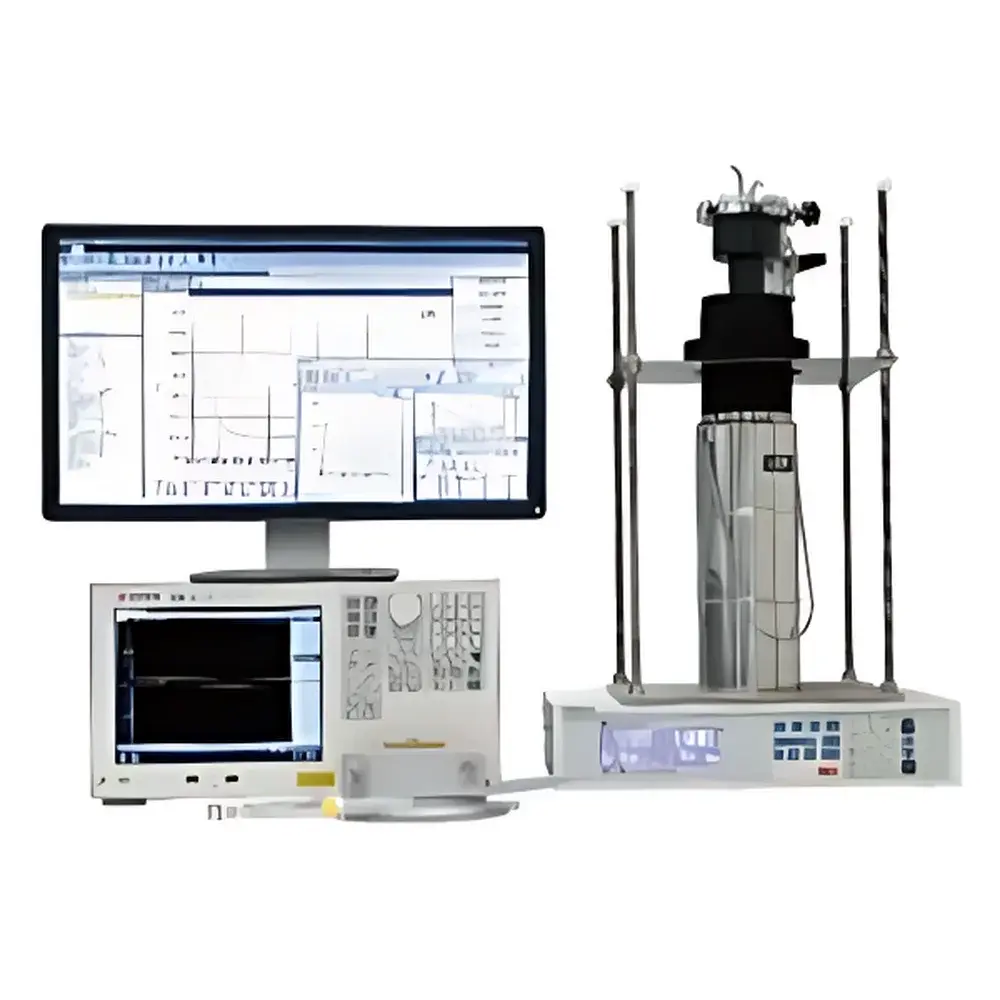
LN-Z2-HF Variable-Temperature High-Frequency AC Impedance Analyzer
| Brand | TOYO Corporation (Japan) |
|---|---|
| Origin | Japan |
| Model | LN-Z2-HF |
| Frequency Range | 1 kHz – 90 MHz |
| Temperature Control Range | 170 K – 300 K (with cryogenic stage) |
| Compliance | ASTM D257, ISO 60068-2-1/2, IEC 60404-6 |
| Software Interface | USB 2.0, SCPI-compatible command set |
| Data Output | Complex impedance (Z*, θ), admittance (Y*), capacitance (C), conductance (G), loss tangent (tan δ) |
Overview
The LN-Z2-HF Variable-Temperature High-Frequency AC Impedance Analyzer is a precision metrology platform engineered for dielectric and electrochemical impedance spectroscopy (EIS) under controlled thermal conditions. It operates on the principle of small-signal sinusoidal voltage excitation across a defined frequency sweep, measuring both magnitude and phase shift of the resulting current to compute complex impedance (Z* = Z′ + jZ″) over a broad bandwidth. Unlike conventional LCR meters limited to sub-MHz ranges, the LN-Z2-HF extends high-fidelity impedance characterization up to 90 MHz—enabling resolution of fast relaxation processes in ion-conducting ceramics, grain boundary polarization in solid electrolytes, and interfacial charge transfer dynamics at electrode–electrolyte junctions. Its integrated cryogenic temperature stage supports stable, programmable operation from 170 K to 300 K with ±0.1 K thermal stability, making it suitable for fundamental studies of thermally activated conduction mechanisms in advanced battery materials.
Key Features
- Wideband impedance measurement from 1 kHz to 90 MHz with <0.1% basic amplitude accuracy and ±0.3° phase uncertainty (typical at 10 MHz)
- Integrated variable-temperature stage with closed-cycle helium cooling, supporting continuous ramping or isothermal hold modes
- Dual-channel vector voltage/current sensing architecture optimized for low-loss, high-resistivity samples (e.g., LLTO, LATP, garnet-type oxides)
- Four-terminal (Kelvin) probe interface with shielded coaxial cabling to minimize stray capacitance and EMI coupling
- Real-time impedance mapping across temperature–frequency grids, with automated data logging at user-defined thermal setpoints
- Compliance with international test standards including ASTM D257 (DC and AC resistance of insulating materials) and IEC 60404-6 (magnetic materials — measurement of magnetic properties at high frequencies)
Sample Compatibility & Compliance
The system accommodates solid-state samples in pellet, thin-film, or sintered ceramic formats (diameter ≤ 15 mm, thickness 0.5–3 mm), compatible with standard two- or three-electrode configurations. Electrode contact is established via spring-loaded gold-plated probes or evaporated metal contacts, minimizing interfacial artifacts. All measurements adhere to GLP-aligned documentation protocols, with timestamped metadata (temperature, frequency, bias voltage, ambient humidity) embedded in raw data files. The instrument meets environmental stress testing requirements per ISO 60068-2-1 (cold) and ISO 60068-2-2 (dry heat), and supports audit-ready reporting for FDA 21 CFR Part 11–compliant workflows when paired with validated software modules.
Software & Data Management
Control and analysis are performed via TOYO’s proprietary ImpedanceStudio v3.2 software, running on Windows 10/11 x64 platforms. The application provides real-time Bode and Nyquist plot rendering, equivalent circuit modeling (via ZView-compatible .z file import/export), and Arrhenius/Williams–Landel–Ferry (WLF) parameter fitting for activation energy extraction. All commands conform to Standard Commands for Programmable Instruments (SCPI), enabling seamless integration into LabVIEW, Python (PyVISA), or MATLAB automation sequences. Raw datasets are stored in HDF5 format with embedded calibration coefficients, traceable to NIST-traceable impedance standards. Audit trails record operator ID, session start/end time, instrument configuration changes, and manual overrides—fully compliant with GMP/GLP data integrity requirements.
Applications
- Temperature-dependent conductivity analysis of Li0.33La0.56TiO3 (LLTO) and other perovskite-type solid electrolytes
- Grain boundary vs. bulk conduction separation in polycrystalline oxide ion conductors using modulus spectroscopy
- Dielectric relaxation mapping of polymer-ceramic composite electrolytes across glass transition regimes
- High-frequency characterization of electrode/electrolyte interphases in all-solid-state Li-metal batteries
- Validation of microstructural models (e.g., brick-layer, core-shell) through multi-frequency impedance deconvolution
FAQ
What minimum sample resistance can be accurately measured at 90 MHz?
At 90 MHz, the system maintains reliable measurement capability down to ~10 Ω for samples with low parasitic inductance; optimal accuracy is achieved for impedances between 10 Ω and 10 MΩ.
Is cryogenic vacuum compatibility supported?
Yes—the LN-Z2-HF stage is designed for operation under vacuum (≤10⁻² Pa) or inert gas purge (Ar/N₂), ensuring thermal stability and eliminating condensation during low-temperature sweeps.
Can the system perform bias-dependent impedance spectroscopy?
It supports DC bias superposition up to ±10 V with programmable offset control, enabling investigation of field-assisted ion migration and space-charge layer effects.
Does the software support automatic temperature–frequency matrix acquisition?
Yes—users define a grid of temperature setpoints and frequency lists; the system executes sequential isothermal sweeps with thermal equilibration verification before each scan.
Is hardware calibration traceable to national standards?
Factory calibration includes verification against NIST-traceable RF impedance standards (SRM 1701 series) and is documented in the Certificate of Conformance supplied with each unit.