
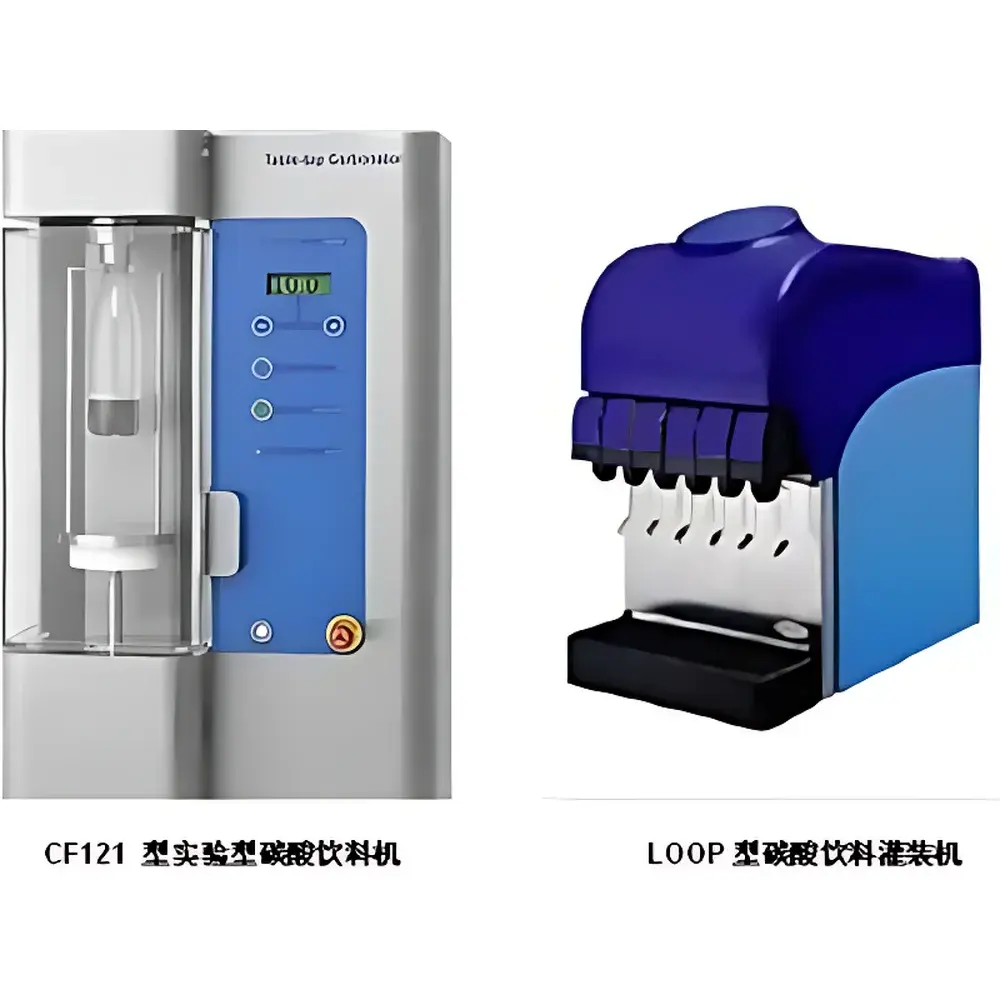
LOOP & CF121 Experimental Carbonated Beverage Filling Systems – Benchtop CO₂ Saturation and Aseptic Filling Units
| Origin | Shanghai, China |
|---|---|
| Manufacturer Type | Authorized Distributor |
| Regional Origin | Domestic (PRC) |
| Model | CF121 |
| Pricing | Available Upon Technical Inquiry |
Overview
The LOOP and CF121 experimental carbonated beverage filling systems are benchtop-scale, integrated CO₂ saturation and precision filling platforms engineered for laboratory-based process development, formulation optimization, and quality assurance in carbonated beverage R&D. These units operate on the principle of pre-pressurized, counter-pressure filling—leveraging controlled CO₂ partial pressure, inline chilling, and inert gas purging to achieve reproducible carbonation levels while minimizing oxygen ingress and CO₂ loss during transfer. Designed to emulate industrial-scale carbonation dynamics at sub-liter batch volumes, they serve as critical tools for food science laboratories, beverage innovation centers, and regulatory-compliant pilot studies under GLP-aligned workflows. Both models comply with CE Machinery Directive 2006/42/EC and NSF/ANSI Standard 169 (Food Equipment—Laboratory Use), ensuring mechanical safety, material compatibility with potable water and soft drinks (316 stainless steel wetted parts, FDA-compliant elastomers), and hygienic design principles.
Key Features
- Pre-pressurized counter-pressure filling architecture to maintain dissolved CO₂ integrity throughout the fill cycle
- Integrated refrigeration system with precise temperature control (CF121: stabilized at 6 °C; LOOP: adjustable chilled product loop)
- Automated CO₂ saturation and dosing—user-selectable target carbonation level (5.0–10.0 g/L in 0.5 g/L increments for CF121; 20–100 PSI working pressure range for LOOP)
- Inert CO₂ bottle purging prior to filling eliminates headspace oxygen (<0.5 ppm residual O₂ typical)
- Five-nozzle continuous filling configuration (LOOP model); single-station sequential filling (CF121)
- Self-contained operation—no external chiller, compressed air, or CO₂ manifold required; powered solely by standard 220 V / 50 Hz supply
- Compact footprint: CF121 (520 × 580 × 950 mm); LOOP (900 × 800 × 1000 mm)
- Single-stage pressure regulation (LOOP) and closed-loop PID-controlled CO₂ mass flow management (CF121)
Sample Compatibility & Compliance
These systems accommodate PET, glass, and aluminum containers up to 1.5 L volume, with adjustable nozzle height and clamping mechanisms for varied neck geometries. All fluid-contact surfaces conform to EC No. 1935/2004 and FDA 21 CFR §177.1520 (polyolefins) and §177.1680 (elastomers). The CF121’s automated post-fill rinse-and-re-saturate cycle ensures consistent CO₂ equilibrium across consecutive batches—critical for ASTM D512-22 (carbon dioxide content in beverages) method validation. Both units support traceable operation when integrated with external data loggers compliant with 21 CFR Part 11 requirements for electronic records and signatures.
Software & Data Management
While hardware-driven for operational simplicity, the CF121 includes an embedded digital interface with real-time display of saturation temperature, setpoint CO₂ concentration, and elapsed cooling time. Loop-based data logging (via optional RS-485 or analog 4–20 mA output) enables integration into LIMS or SCADA environments. Audit trails—including operator ID, timestamped parameter changes, and cycle completion logs—can be exported in CSV format for QA documentation and internal SOP compliance review per ISO/IEC 17025:2017 clause 7.7 (result reporting).
Applications
- Carbonation stability testing across pH, sugar concentration, and stabilizer matrix variations
- Accelerated shelf-life studies under controlled CO₂ headspace conditions
- Formulation screening for low-sugar, functional, or probiotic carbonated beverages
- Validation of dissolution kinetics and bubble nucleation behavior in novel packaging formats
- Training platform for QC technicians on USP and principles applied to pressurized liquid handling
- Method development for ISO 21730 (determination of CO₂ in carbonated soft drinks) and AOAC Official Method 960.22
FAQ
What regulatory certifications do these units hold?
CE marking per Machinery Directive 2006/42/EC and NSF/ANSI 169 certification for laboratory food equipment.
Can the CF121 produce repeatable carbonation levels across different base liquids (e.g., juice vs. purified water)?
Yes—the system compensates for liquid-specific solubility via integrated temperature and pressure feedback; validated repeatability is ±0.15 g/L across 10 consecutive fills under identical settings.
Is external CO₂ supply required, and what purity specification is recommended?
Food-grade CO₂ (≥99.9% purity, ISO 8573-1 Class 2:2:2) is required; built-in single-stage regulator accepts standard 0–200 bar cylinder input.
How does the system prevent foaming during fill?
Through synchronized bottle pressurization, submerged nozzle entry, and controlled fill rate modulation—eliminating nucleation-triggered foam generation.
Does the LOOP model support GMP-aligned documentation?
When paired with third-party validated data acquisition software, it supports ALCOA+ data integrity principles for batch record generation and audit readiness.



