
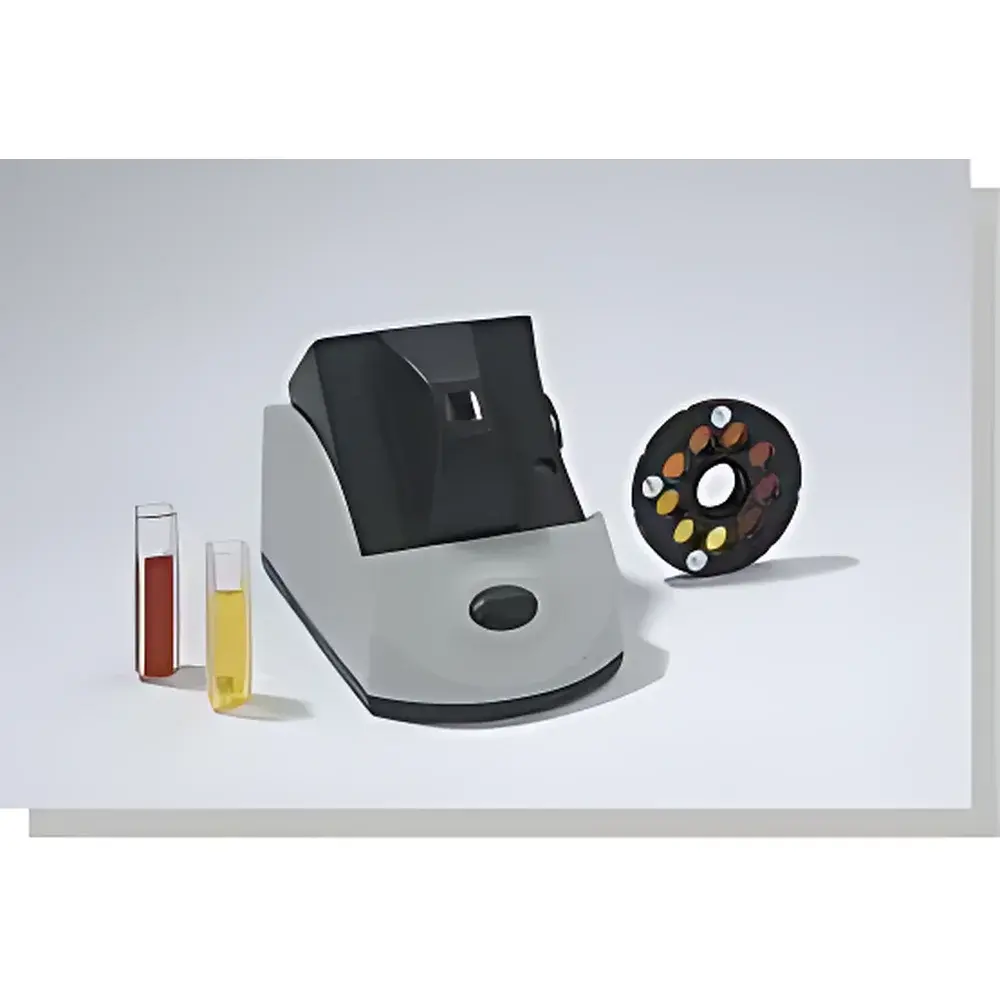
Lovibond AF334 Gardner Colorimeter
| Brand | Lovibond (Tintometer) |
|---|---|
| Origin | United Kingdom |
| Model | AF334 (Gardner Scale) |
| Measurement Range | Gardner Scale 1–18 |
| Compliance | ASTM D1544, ISO 4630, DIN 6162-1 |
| Light Source | Tungsten-halogen lamp with stable spectral output |
| Viewing Geometry | 0°/45° (single-beam, visual comparison design) |
| Optical Path | Fixed 10.0 mm cell pathlength |
| Calibration | Pre-calibrated with NIST-traceable Gardner liquid standards |
| Dimensions | 220 × 120 × 180 mm |
| Weight | 2.1 kg |
| Power Supply | AC 100–240 V, 50/60 Hz |
Overview
The Lovibond AF334 Gardner Colorimeter is a precision optical instrument engineered for quantitative color assessment of transparent to semi-transparent liquids according to the internationally standardized Gardner color scale. Based on visual comparison methodology aligned with ASTM D1544 and ISO 4630, the AF334 employs a fixed-pathlength (10.0 mm), single-beam optical system with a stabilized tungsten-halogen light source to ensure consistent spectral illumination across repeated measurements. Unlike digital spectrophotometers, the AF334 maintains the fundamental principle of human-eye-based color matching—where trained observers compare sample transmittance against a series of certified Gardner reference liquids under controlled viewing conditions. This approach remains the industry-accepted reference method for quality control in petrochemicals, coatings, and edible oil refining, where regulatory specifications explicitly require Gardner-scale reporting.
Key Features
- Compliance with ASTM D1544, ISO 4630, and DIN 6162-1 for Gardner color determination
- Pre-calibrated optical system with NIST-traceable Gardner liquid standards (Gardner 1 through 18)
- Fixed 10.0 mm pathlength cuvette holder ensuring reproducible sample presentation
- Tungsten-halogen illumination with thermal stabilization to minimize spectral drift during extended operation
- Ergonomic viewing chamber with anti-glare baffles and neutral background for optimal observer contrast perception
- Robust aluminum alloy housing rated for continuous laboratory use in QC environments
- No software dependency—designed for rapid, operator-independent pass/fail verification per batch release protocols
Sample Compatibility & Compliance
The AF334 is validated for use with low-turbidity, Newtonian liquids including alkyd resins, varnishes, drying oils (e.g., linseed, safflower), fatty acids, phospholipids (e.g., lecithin), and refined mineral and vegetable oils. Samples must be filtered to ≤5 µm particulate content and free of suspended solids or micro-bubbles to meet ASTM D1544 sample preparation requirements. The instrument supports full traceability under GLP and GMP frameworks: each Gardner standard vial carries individual lot certification with uncertainty statements referenced to NIST SRM 2101b. Documentation packages include IQ/OQ templates compliant with FDA 21 CFR Part 11 audit readiness requirements for regulated manufacturing sites.
Software & Data Management
The AF334 operates as a standalone visual comparator without embedded electronics or data logging capability—consistent with its role as a primary reference instrument per ISO/IEC 17025 Clause 6.4.1. However, optional companion tools include the Lovibond® LabManager™ software suite (sold separately), which enables digital capture of observer decisions, integration with LIMS via ASTM E1384-compliant ASCII export, and generation of audit-ready reports containing observer ID, calibration date, ambient illuminance log (measured with integrated lux sensor), and deviation flags against specification limits. All electronic records support time-stamped, password-protected user access logs required for 21 CFR Part 11 compliance.
Applications
- Quality release testing of refined edible oils (e.g., sunflower, soybean) per Codex Alimentarius Standard 210–1999
- In-process monitoring of alkyd resin polymerization in coating manufacturing
- Stability assessment of fatty acid esters during storage under accelerated oxidation protocols (AOCS Cd 12b–92)
- Regulatory submission support for pharmaceutical excipients requiring USP color evaluation
- Supplier qualification audits in automotive lubricant supply chains referencing SAE J1881 color thresholds
- Teaching laboratories demonstrating classical colorimetric principles per IUPAC Compendium of Analytical Nomenclature
FAQ
What is the difference between Gardner color and APHA/Pt-Co color scales?
Gardner scale (1–18) is optimized for yellow-to-brown hues in organic liquids with higher chroma; APHA/Pt-Co (0–500) targets near-colorless aqueous solutions. ASTM D1544 explicitly prohibits interconversion between scales due to non-linear perceptual relationships.
Can the AF334 measure opaque or turbid samples?
No. Per ISO 4630, samples must exhibit ≥90% transmittance at 425 nm. Turbid or hazy samples require prior clarification by filtration or centrifugation.
How often must the Gardner reference standards be replaced?
NIST-traceable liquid standards are certified for 24 months from date of manufacture when stored at 15–25°C in amber glass vials protected from UV exposure.
Is operator training required for ASTM D1544 conformance?
Yes. ASTM mandates documented vision screening (Ishihara test) and annual proficiency verification using blind duplicate samples per ASTM D1544 Section 8.3.
Does the AF334 support automated pass/fail decision logic?
Not natively. Pass/fail determination follows written SOPs based on observer consensus; however, LabManager™ software can apply configurable tolerance bands (±0.5 Gardner units) to recorded judgments.






