
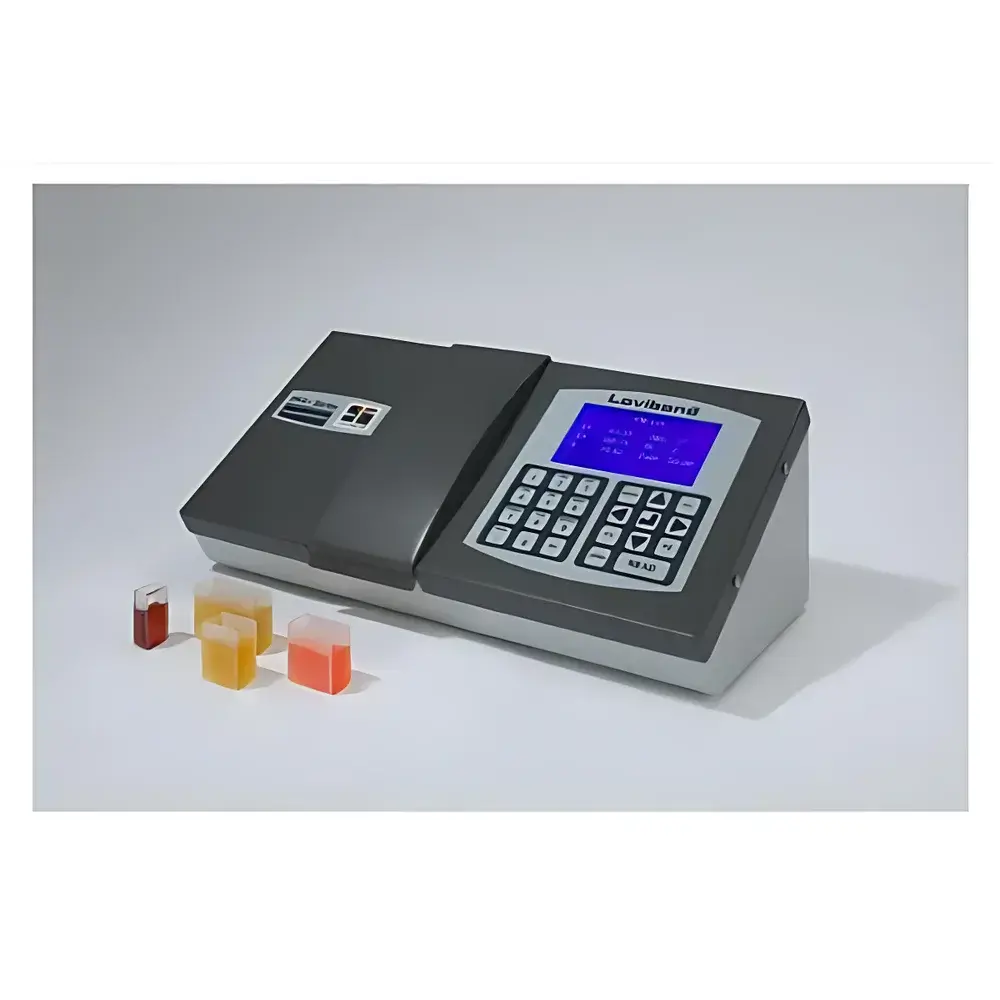
Lovibond PFXi195/1 Automated Colorimeter
| Brand | Lovibond (Tintometer) |
|---|---|
| Origin | United Kingdom |
| Model | PFXi195/1 |
| Measurement Standards | Pt-Co/Hazen/APHA, Gardner, Iodine, CIE L*a*b*, CIE XYZ, Spectral Reflectance (360–780 nm) |
| Display | 7-inch TFT LCD with multi-language UI (including Chinese) |
| Interface | USB 2.0 & 10/100 Mbps Ethernet (LAN) |
| Compliance | ISO 9001, ISO/IEC 17025, ASTM D1209, ASTM D1500, ASTM D5386, ISO 6271, ISO 4630 |
| Data Management | GLP-compliant audit trail (date/time, operator ID, sample ID), internal storage for ≥10,000 results |
| Sample Handling | Removable stainless-steel cuvette holder, compatible with 10–50 mm pathlength glass or quartz cuvettes, optional flow-through cell |
| Enclosure | Powder-coated stainless-steel chassis with chemical-resistant surface finish |
| Software | Included ColorSoft™ PC software for spectral visualization, CIE chromaticity diagram plotting, deviation analysis (ΔE*ab, ΔL*, Δa*, Δb*), and custom standard creation |
| Remote Maintenance | RCMSi™ Remote Calibration & Monitoring System enabled |
Overview
The Lovibond® PFXi195/1 Automated Colorimeter is a precision-engineered optical measurement instrument designed for objective, repeatable color quantification in liquid samples across laboratory and industrial quality control environments. Operating on the principle of spectrophotometric absorbance measurement across the visible spectrum (360–780 nm), the PFXi195/1 employs a stabilized tungsten-halogen light source and a high-resolution CCD array detector to capture full spectral data at 10 nm intervals. Unlike visual comparison methods or single-wavelength photometers, this instrument delivers traceable, instrument-independent color values compliant with internationally recognized scales—including Pt-Co/Hazen/APHA for water clarity and wastewater effluent, Gardner for resin and varnish yellowness, Iodine for oxidative stability in hydrocarbons, and full CIE color space parameters (L*a*b*, L*C*h°, XYZ, and spectral reflectance curves). Its optical architecture is optimized to minimize stray light and thermal drift, ensuring long-term stability under variable ambient conditions. The system is calibrated at manufacture against NIST-traceable reference standards and maintains metrological integrity through built-in diagnostic routines and RCMSi-enabled remote verification.
Key Features
- Automated spectral acquisition with no user interpretation required: eliminates inter-operator variability inherent in visual color matching.
- Dual communication interface—USB 2.0 and Ethernet (10/100 Mbps)—enabling seamless integration into LIMS, MES, or centralized QA databases.
- GLP-compliant data logging: automatically records date/time stamp, operator ID, sample ID, measurement mode, and calibration status for full auditability per FDA 21 CFR Part 11 and ISO/IEC 17025 requirements.
- Removable stainless-steel measurement chamber with corrosion-resistant coating—designed for rapid cleaning and resistance to aggressive solvents, acids, and hydrocarbon-based samples.
- RCMSi™ Remote Calibration & Monitoring System support allows authorized service personnel to perform diagnostic checks, firmware updates, and spectral recalibration over secure LAN or internet connections—reducing instrument downtime and travel costs.
- Customizable user interface: language selection (including English, German, French, Spanish, Chinese), configurable display fields, password-protected administrator settings, and role-based access control.
- Integrated deviation analysis engine computes quantitative mismatch metrics—including ΔE*ab (total color difference), ΔL* (lightness shift), Δa* (green-red shift), Δb* (blue-yellow shift), and saturation ratio—against user-defined or standard reference spectra.
Sample Compatibility & Compliance
The PFXi195/1 accommodates standard rectangular cuvettes with optical path lengths from 10 mm to 50 mm, supporting both transmission and reflectance measurements (with optional accessories). It is routinely deployed for color assessment of liquid chemicals (e.g., solvents, surfactants, dyes), edible oils, petrochemicals (lubricants, fuels, transformer oils), pharmaceutical excipients, and polymer intermediates. All preloaded color scales are aligned with globally accepted test methods: ASTM D1209 (Pt-Co), ASTM D1500 (ASTM Color), ASTM D5386 (instrumental color), ISO 6271 (Gardner), ISO 4630 (Iodine Value correlation), and ISO 9001-certified reference material protocols. Certified liquid standards and filter-based calibrants are supplied with ISO/IEC 17025-accredited certificates of analysis, ensuring metrological traceability to national standards bodies.
Software & Data Management
ColorSoft™ PC software is included as standard and provides comprehensive post-acquisition analysis capabilities. Users can generate CIE 1931 chromaticity diagrams, overlay spectral curves, compare batch-to-batch variation, and export data in CSV, PDF, or XML formats compatible with statistical process control (SPC) platforms. The software supports creation and validation of custom color standards using series of reference samples—a critical capability for proprietary formulations or non-standard product specifications. All instrument configurations, measurement logs, and calibration histories are stored locally and synchronized via network share or encrypted cloud backup. Audit trails meet GLP/GMP documentation requirements, including electronic signatures where mandated by regulatory frameworks.
Applications
- Quality assurance of raw materials and finished products in chemical manufacturing, including solvent purity verification and dye lot consistency monitoring.
- Monitoring oxidation stability in turbine oils and hydraulic fluids via Gardner or APHA scale trending.
- Pharmaceutical excipient release testing per USP and EP 2.2.57 guidelines for color impurity limits.
- Food-grade oil grading (e.g., soybean, sunflower, palm) in compliance with AOCS Cd 13b-92 and ISO 1207.
- In-process control during polymer synthesis where color shift indicates degradation, catalyst residue, or side-reaction byproducts.
- Environmental testing laboratories performing wastewater color analysis per EPA Method 8023 and ISO 7887.
FAQ
Does the PFXi195/1 require annual recalibration by an external lab?
No—routine calibration is performed internally using certified reference standards; however, periodic verification against accredited standards (e.g., annually or per internal SOP) is recommended to maintain ISO/IEC 17025 conformance.
Can the instrument measure opaque or turbid samples?
It is optimized for transparent to slightly hazy liquids; for highly scattering or opaque suspensions, a dedicated turbidity-corrected module or integrating sphere accessory is required—neither is supported by the base PFXi195/1 configuration.
Is spectral data exportable in raw format for third-party modeling?
Yes—full 360–780 nm absorbance spectra (at 10 nm resolution) can be exported as ASCII text files for multivariate analysis (e.g., PLS regression) or integration into chemometric software suites.
How does RCMSi enhance compliance in regulated industries?
RCMSi provides time-stamped, digitally signed remote calibration reports and firmware version logs—fulfilling FDA 21 CFR Part 11 requirements for electronic records and signatures when used with appropriate organizational controls.
What maintenance is required beyond routine cleaning?
The tungsten-halogen lamp has a rated lifetime of ≥2,000 hours; replacement is tool-free and guided by on-screen prompts. No optical alignment or factory recalibration is needed after lamp exchange due to self-referencing spectral normalization.






