
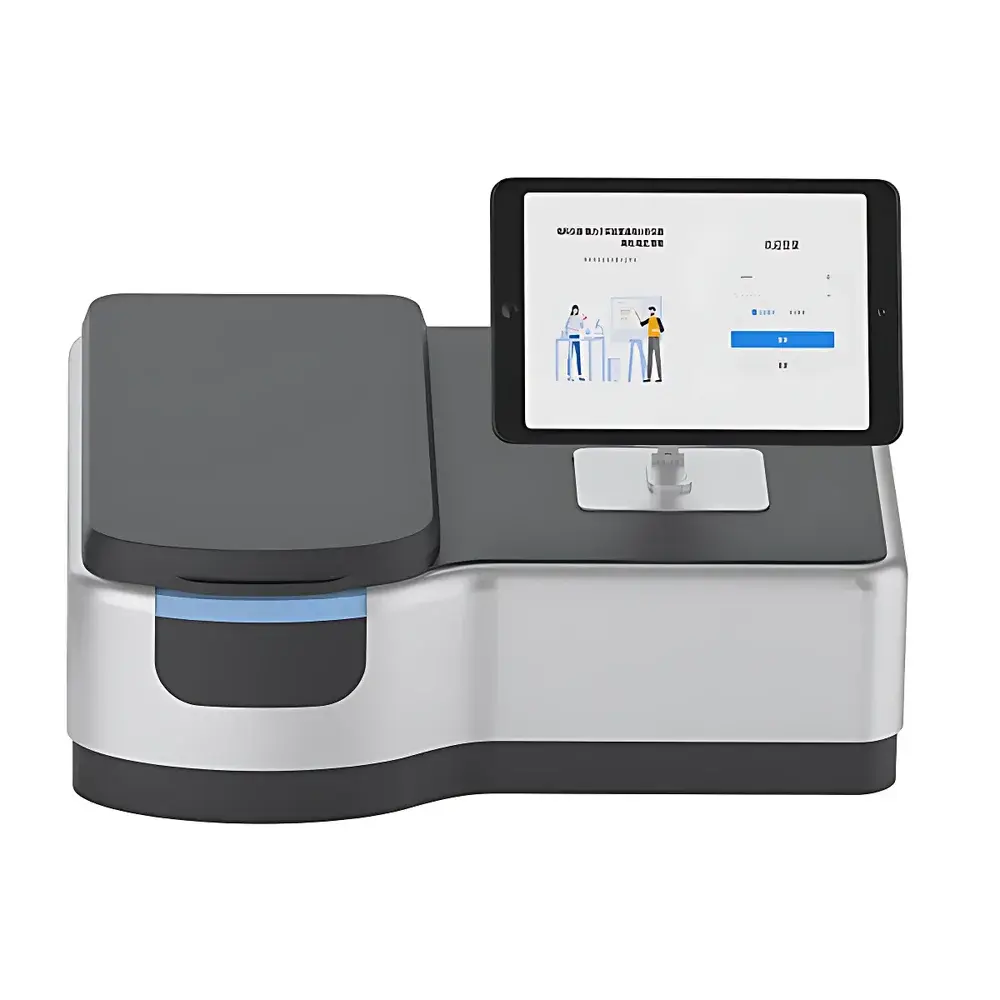
Luban Instruments M8 Xenon Lamp UV-Vis Spectrophotometer
| Brand | Yoke |
|---|---|
| Origin | Shanghai, China |
| Manufacturer Type | OEM Manufacturer |
| Regional Classification | Domestic (China) |
| Model | M8 |
| Pricing | Upon Request |
| Optical Design | Pseudo-Double-Beam |
| Detector | Photodiode Array (PDA) |
| Wavelength Range | 190–1100 nm |
| Automation Level | Motorized Wavelength Scanning |
| Display | 11-inch 2.8K Tablet (iPad-compatible interface) |
| Spectral Bandwidth | 1 nm |
| Absorbance Resolution | 0.00001 Abs |
| Light Source | Pulsed Xenon Lamp |
| IoT Connectivity | Embedded Wi-Fi & Bluetooth |
| User Management | Multi-tier Role-Based Access Control |
| Data Notification | Email & SMS Alerting for Anomalies |
| Compliance Support | Audit Trail Ready (GLP/GMP-aligned logging) |
Overview
The Luban Instruments M8 Xenon Lamp UV-Vis Spectrophotometer is a high-performance pseudo-double-beam spectrophotometer engineered for precision quantitative and qualitative analysis across research laboratories, quality control environments, and environmental monitoring facilities. Utilizing a pulsed xenon lamp as its broadband light source, the M8 eliminates the need for dual-lamp switching—offering stable spectral output from 190 nm to 1100 nm without warm-up delays or lamp degradation during routine operation. Its optical architecture integrates an internal reference detector and real-time beam-ratio correction, ensuring exceptional photometric stability and minimizing baseline drift over extended acquisition periods. The instrument employs a fixed-grating monochromator coupled with a high-density photodiode array (PDA) detector, enabling rapid full-spectrum acquisition (<1 second per scan) and high-fidelity spectral reconstruction. Designed for regulatory-compliant workflows, the M8 supports traceable calibration protocols and meets foundational requirements for ISO/IEC 17025 method validation in accredited testing labs.
Key Features
- Pulsed xenon lamp with user-controllable on/off scheduling—extends operational lifetime beyond 10⁹ flashes and reduces thermal load on optical components.
- 11-inch 2.8K resolution tablet interface with auto-switching bilingual (English/Chinese) UI, Bluetooth-paired for seamless device synchronization and remote parameter configuration.
- Pseudo-double-beam design with integrated reference channel ensures <0.0001 Abs/h baseline stability under ambient temperature fluctuations (20–30 °C).
- Absorbance resolution of 0.00001 Abs enables detection of low-concentration analytes in pharmaceutical dissolution studies and oligonucleotide quantification.
- Motorized wavelength scanning with 1 nm spectral bandwidth complies with ASTM E275 and USP specifications for spectrophotometric system suitability.
- Embedded IoT module supports secure TLS-encrypted data transmission, email/SMS alerts for error conditions (e.g., lamp failure, cuvette misalignment), and cloud-synced audit logs.
Sample Compatibility & Compliance
The M8 accommodates diverse sample formats via standardized 10 mm pathlength cuvettes, microvolume adapters (down to 2 µL), solid reflectance accessories, integrating spheres for diffuse transmittance/reflectance, and variable-pathlength cells (1–10 cm). It supports compliance-critical workflows including EPA Method 365.1 (phosphate), APHA Standard Methods 4500-NO₂⁻, and ISO 105-X12 (colorfastness). All software operations maintain ALCOA+ principles: attributable, legible, contemporaneous, original, accurate, complete, consistent, enduring, and available. Audit trail functionality records user actions, method changes, calibration events, and result modifications—fully aligned with FDA 21 CFR Part 11 requirements for electronic records and signatures.
Software & Data Management
The embedded analytical suite provides six core measurement modes: photometric, quantitative (single/multi-point calibration), kinetic, wavelength scanning, 3D spectral mapping, and multi-wavelength analysis. Nucleic acid and protein analysis modules implement built-in extinction coefficient libraries (e.g., 50 µg/mL dsDNA = 1.0 A₂₆₀) and automatic dilution factor compensation. Data export supports CSV, XML, and PDF formats with embedded metadata (instrument ID, timestamp, operator, method version). Role-based access control enforces three-tier permissions: Administrator (system configuration), Supervisor (method editing), and Operator (routine measurement only). All raw spectra and processed results are stored locally with optional encrypted backup to network drives or validated cloud storage.
Applications
- Environmental testing: Quantification of nitrate, nitrite, phosphate, and heavy metal complexes in wastewater per EPA and ISO standards.
- Pharmaceutical QC: Assay of active pharmaceutical ingredients (APIs), excipient compatibility screening, and dissolution profile monitoring.
- Life sciences: DNA/RNA purity assessment (A₂₆₀/A₂₈₀ ratio), Bradford/Lowry protein assays, enzyme kinetics (e.g., LDH, ALP), and cell culture density estimation.
- Materials science: Thin-film optical characterization, pigment dispersion analysis, and solar cell absorber layer transmittance profiling.
- Food & beverage: Colorimetric evaluation (CIE L*a*b*), antioxidant capacity (FRAP/DPPH), and adulterant detection in oils and juices.
FAQ
Does the M8 support GLP-compliant data integrity requirements?
Yes—the system maintains immutable audit trails, electronic signatures, and time-stamped calibration records required for GLP audits.
Can the xenon lamp be replaced by the end user?
Lamp replacement requires factory calibration; users must contact authorized service centers to preserve photometric accuracy and warranty validity.
Is the tablet interface compatible with third-party LIMS integration?
Yes—via RESTful API and HL7-compliant data export, supporting bidirectional communication with major LIMS platforms including LabWare and Thermo Fisher SampleManager.
What is the maximum scan speed for full 190–1100 nm acquisition?
Full-range scanning at 1 nm intervals completes in ≤0.8 seconds using the PDA readout mode.
How does the M8 handle stray light correction?
Stray light is minimized optically via double-monochromator geometry and digitally corrected using reference-beam normalization and polynomial baseline fitting algorithms.





