
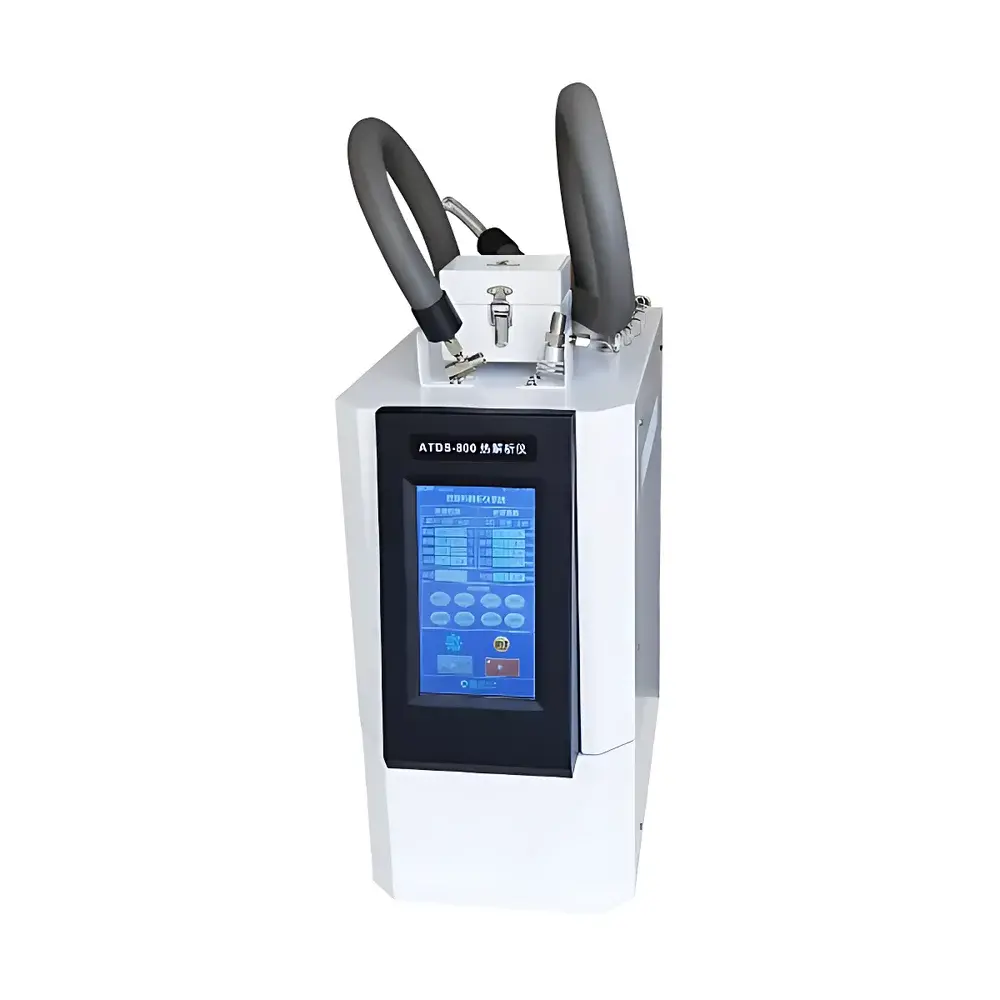
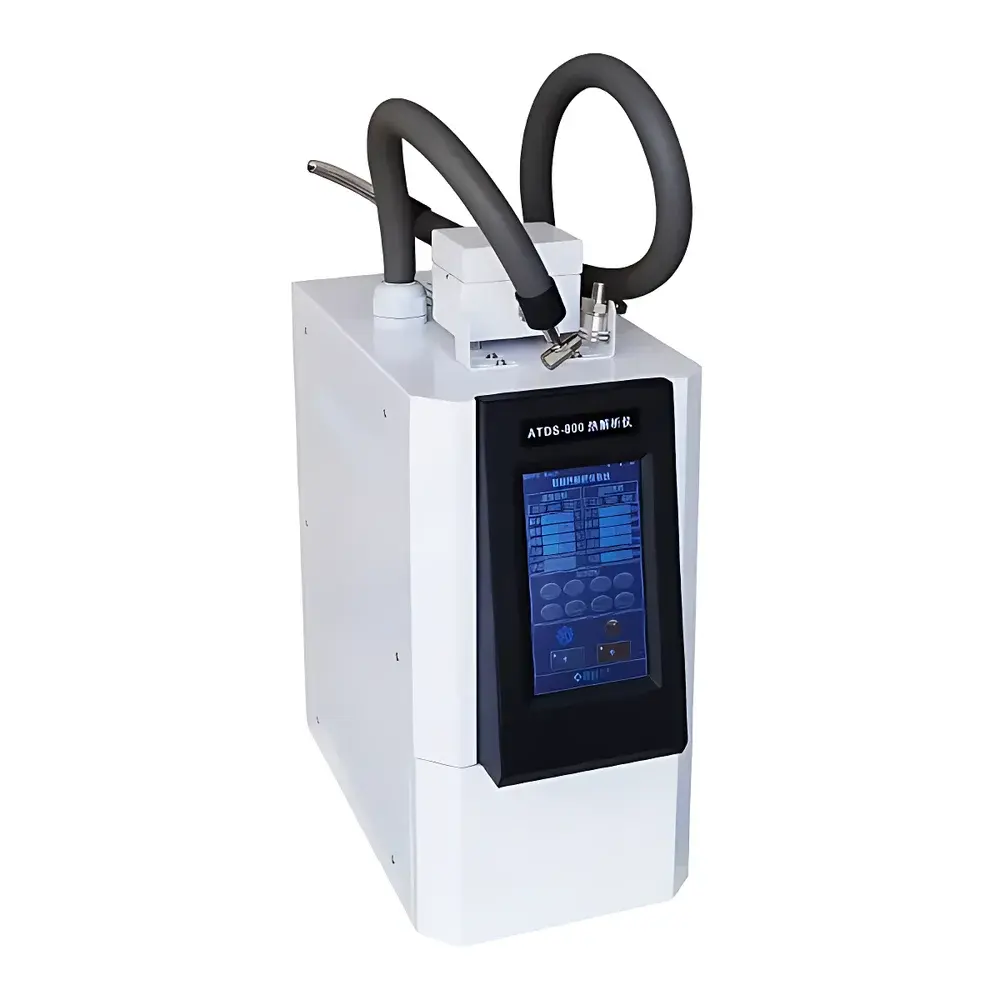
Luchuang ATDS-800 Thermal Desorber
| Brand | Luchuang |
|---|---|
| Origin | Shandong, China |
| Manufacturer Type | Direct Manufacturer |
| Model | ATDS-800 |
| Instrument Type | Single-Stage Thermal Desorber |
| Automation Level | Semi-Automatic |
| Primary Desorption Temperature Range | 50–380 °C |
| Valve Injection Zone Temperature Range | Ambient to 220 °C |
| Transfer Line Temperature Range | Ambient to 220 °C |
| Cold Trap Temperature | −30 °C |
| Temperature Control Accuracy | < ±0.1 °C |
| Desorption Recovery Rate | >99% (compound-dependent) |
| Sample Position Count | 1 |
| Sample Tube Dimensions | ≤6.5 mm OD, ≥120 mm length |
Overview
The Luchuang ATDS-800 Thermal Desorber is a semi-automated, single-stage thermal desorption system engineered for precise, reproducible release of volatile and semi-volatile organic compounds (VOCs and SVOCs) from sorbent tubes prior to gas chromatographic analysis. It operates on the principle of controlled thermal desorption—where analytes adsorbed onto packed or coated sorbent media (e.g., Tenax TA, Carbopack B/C, or multi-bed traps) are thermally volatilized under inert carrier gas flow, transferred quantitatively via heated lines, and injected directly into a GC or GC-MS inlet. Designed for compliance with major environmental monitoring standards—including HJ 644–2013, HJ 583–2010, HJ 734–2014, and GB/T 18883–2002—the ATDS-800 delivers robust performance in ambient air, indoor air, vehicle cabin, and fixed-source emission testing workflows. Its architecture integrates independent temperature control zones, high-inertness fluidic pathways, and programmable time-based sequence logic to ensure minimal analyte degradation, carryover, or cold-spot condensation during transfer.
Key Features
- Triple-zone independent heating: separately controllable primary desorption oven, six-port valve zone (up to 240 °C), and transfer line (up to 220 °C), all maintained within ±0.1 °C stability
- High-inertness sample pathway: entire transport system constructed from imported de-activated fused-silica or silonized stainless-steel tubing to eliminate surface adsorption and cross-contamination
- Motor-driven high-temperature six-port valve: rated for continuous operation up to 240 °C; integrated within the heated enclosure to eliminate uncontrolled cooling points
- Programmable sequence control: automated execution of desorption, valve switching, GC trigger synchronization, back-flush (0–500 mL/min), and tube conditioning—all via intuitive 7-inch touchscreen interface
- Integrated calibration support: built-in simulated sampling mode enables direct generation of calibration curves using standard vapor permeation or liquid spiking protocols
- Universal GC interfacing: configurable hardware adapters for seamless connection to Agilent, Thermo Fisher, Shimadzu, PerkinElmer, and domestic GC platforms; compatible with both split/splitless and PTV inlets
- Low-voltage safety design: 24 V DC power supply for transfer line heating, meeting IEC 61010-1 requirements for laboratory electrical safety
Sample Compatibility & Compliance
The ATDS-800 accepts standard 6.35 mm (¼″) OD sorbent tubes up to 120 mm in length, accommodating common multi-bed configurations (e.g., Carbograph 1TD/Carbopack X/Tenax GR). It supports thermal desorption of compounds with boiling points up to 350 °C, including BTEX, C2–C12 alkanes, chlorinated solvents, carbonyls, and oxygenated VOCs. Method validation data demonstrate ≤2.5% RSD for 0.05 μg benzene in methanol matrix, confirming suitability for regulatory-grade quantitation. The system meets instrumental requirements specified in EPA TO-17 (as implemented in Chinese HJ standards), ISO 16017-1, and ASTM D6196. While not inherently 21 CFR Part 11 compliant, its audit-ready operation log (time-stamped method parameters, run history, and temperature profiles) supports GLP/GMP-aligned laboratory documentation practices when paired with validated LIMS or chromatography data systems.
Software & Data Management
The ATDS-800 employs an embedded ARM-based controller with real-time OS, featuring a full-featured 7-inch capacitive touchscreen interface. All method parameters—including desorption ramp rates, hold times, valve timing, back-flush duration, and temperature setpoints—are defined and stored as named methods. Each run automatically records timestamped thermal profiles, valve actuation events, and operational status flags. Exportable CSV logs contain full thermal history and sequence metadata for traceability. External triggering is supported via TTL-level GC start signal or RS-232 command protocol, enabling synchronized acquisition with third-party data systems. No proprietary PC software is required; however, ASCII-formatted logs integrate natively with LabArchives, Empower, Chromeleon, and OpenLab CDS environments.
Applications
- Regulatory environmental monitoring per HJ 644–2013 (ambient VOCs), HJ 583–2010 (benzene series), and HJ 734–2014 (stack emissions)
- Indoor air quality assessment aligned with GB/T 18883–2002 and GB 50325–2020 (formaldehyde, TVOC, and specific carcinogens)
- In-vehicle air testing per HJ/T 400–2007, including aldehydes and aromatic hydrocarbons released from trim materials
- Workplace exposure evaluation (NIOSH 1501/1600 analogs) using charcoal or silica gel tubes
- Method development for emerging contaminants such as halogenated anisoles, terpenes, and heterocyclic compounds
FAQ
Is the ATDS-800 compatible with GC-MS systems?
Yes—it provides fully heated, inert transfer to both quadrupole and time-of-flight GC-MS inlets, with synchronization signals supporting external start/stop triggers.
Can it be upgraded to support cold trap focusing or secondary desorption?
Yes—optional low-temperature cryo-focusing modules (−30 °C) and dual-stage desorption kits are available as factory-installed accessories.
What maintenance is required for long-term reliability?
Routine inspection of O-rings, valve rotor seal integrity, and sorbent tube alignment is recommended every 200 runs; no consumable heaters or sensors require periodic replacement.
Does it support dynamic dilution or internal standard addition?
Not natively—but external gas-dilution modules or autosampler-integrated IS spiking can be integrated via auxiliary gas ports and TTL synchronization.
How is calibration verified across temperature zones?
Each heating zone includes calibrated PT100 sensors with NIST-traceable offset compensation; users may perform independent verification using metrology-grade dry-block calibrators.
Related Products





