
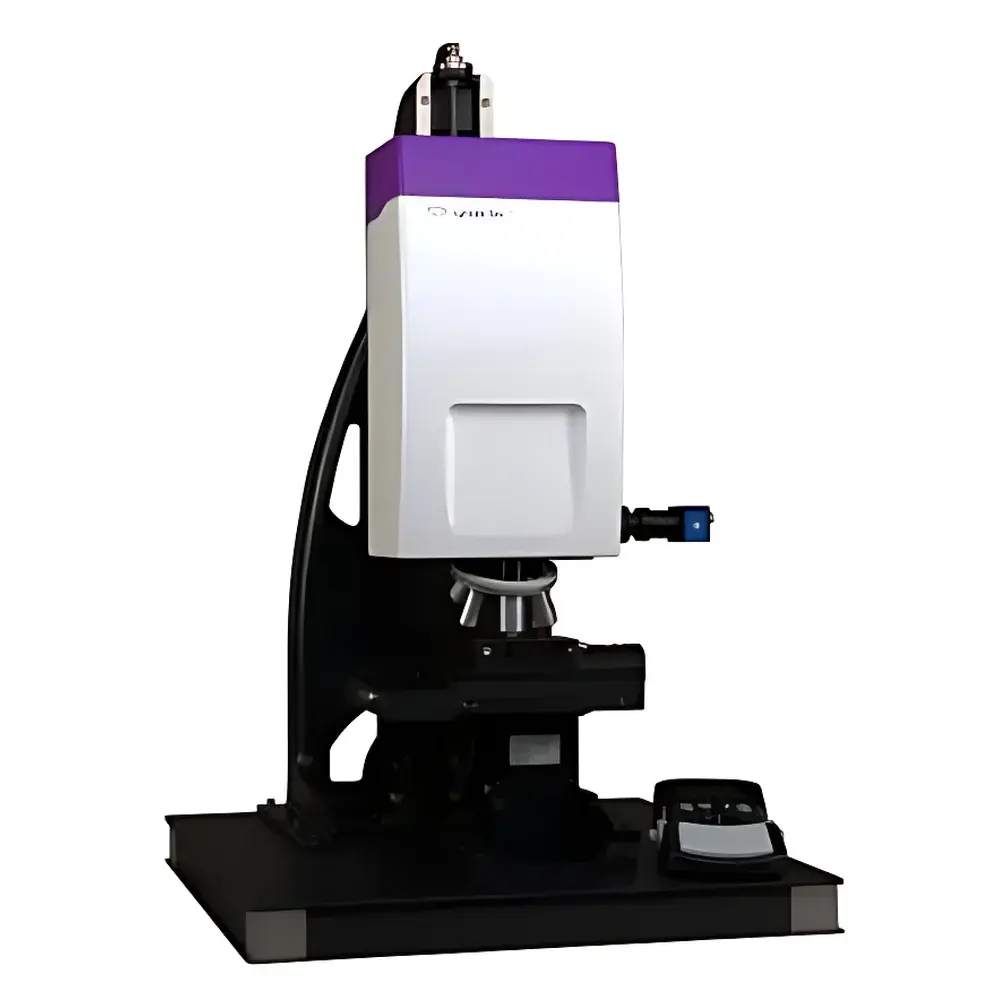
Lyncee Tec DHM-R1000 Reflective Digital Holographic Microscope
| Brand | Lyncee Tec |
|---|---|
| Origin | Switzerland |
| Model | DHM-R1000 |
| Light Source | Single-wavelength laser (666 nm ± 0.1 nm) |
| Vertical Resolution | 0.3 nm |
| Vertical Measurement Range | Up to 200 µm |
| Maximum Step Height (Sharp Edge) | Up to 333 nm |
| Surface Compatibility | Smooth reflective surfaces |
| Frame Rate | Up to 1000 fps (full resolution 1024 × 1024) |
| Response Time | Standard 500 µs, optional 10 µs |
| Horizontal Resolution | Down to 300 nm (objective-dependent) |
| Field of View | 5 µm × 5 µm to 66 µm × 66 µm (objective-dependent) |
| Working Distance | 0.3 mm to 18 mm (objective-dependent) |
| Minimum Sample Reflectivity | <1% |
| Illumination Intensity | As low as 1 µW/cm² |
| Software Platform | Koala (C++/.NET), binary & TIFF export, ASCII-compatible data output |
Overview
The Lyncee Tec DHM-R1000 is a high-precision reflective digital holographic microscope engineered for non-contact, real-time, three-dimensional topography and dynamic vibration analysis of static and moving surfaces. Unlike conventional scanning profilometers or confocal microscopes, the DHM-R1000 operates on the principle of off-axis digital holography—capturing full-field interference patterns in a single camera exposure without mechanical scanning. This enables quantitative phase imaging with sub-nanometer vertical resolution and microsecond temporal response. The system employs a stabilized single-wavelength laser at 666 nm (±0.1 nm), optimized for high-contrast interferometric reconstruction of smooth, reflective samples—including MEMS devices, precision optics, semiconductor wafers, and coated substrates. Its robust optical architecture eliminates focus drift and hysteresis, making it suitable for integration into controlled environments such as cleanrooms, vacuum chambers, or temperature- and humidity-regulated enclosures.
Key Features
- Single-shot, full-field 3D topography acquisition—no point-by-point or line-scan motion required
- Vertical resolution down to 0.3 nm and repeatability of ±0.01 nm under controlled conditions
- Real-time imaging at up to 1000 frames per second (1024 × 1024 pixels), enabling dynamic surface deformation studies
- Ultra-low illumination intensity (as low as 1 µW/cm²), minimizing thermal loading and photodamage on sensitive samples
- Compatibility with standard microscope objectives (1.25×–100×), including high-NA, long-working-distance, and immersion lenses
- Motorized XYZ sample stage (300 mm × 300 mm × 38 mm travel) for large-area metrology and automated inspection routines
- Optional stroboscopic unit for synchronized measurement of periodically excited MEMS structures
- Laser wavelength stability of 0.01 nm/°C at 666 nm ensures long-term measurement fidelity across thermal fluctuations
Sample Compatibility & Compliance
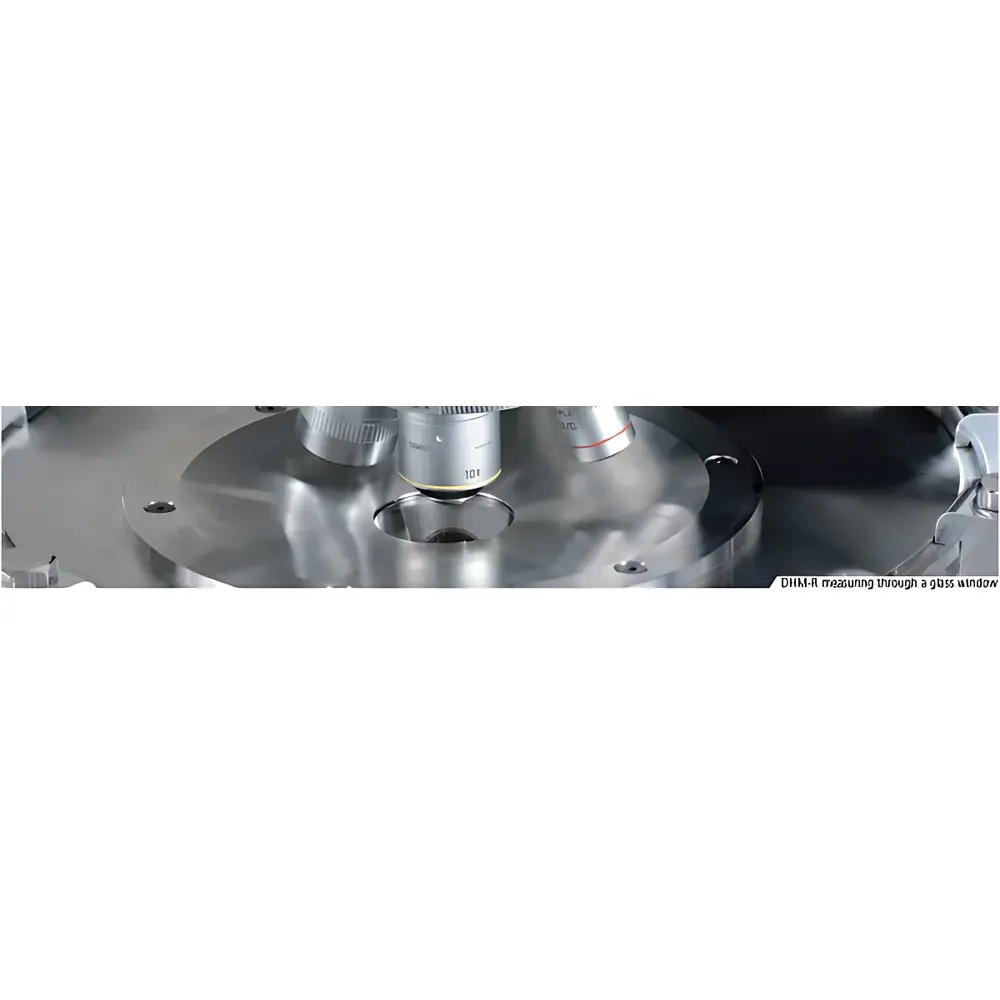
The DHM-R1000 is validated for use with reflective surfaces exhibiting reflectivity as low as 1%, including polished metals, dielectric coatings, silicon wafers, and metallized polymers. It supports environmental integration—optical access through glass viewports, immersion in liquids (e.g., water or oil), operation inside vacuum chambers (down to 10⁻⁶ mbar), and compatibility with climate-controlled stages (temperature range: −20 °C to +80 °C; humidity control: 5–95% RH non-condensing). While not intrinsically certified for regulated industries, the system’s deterministic measurement traceability, audit-ready Koala software logging (with timestamped binary records), and export compliance with ISO 5725 (accuracy and precision of measurement methods) and ISO 25178-2 (areal surface texture parameters) support GLP/GMP-aligned workflows. Data files are stored in vendor-neutral binary formats with optional ASCII (.txt) and TIFF export, facilitating third-party validation and archival per FDA 21 CFR Part 11 requirements when deployed with appropriate electronic signature controls.
Software & Data Management
Control and analysis are performed via Koala—a native C++/.NET application developed by Lyncee Tec specifically for digital holographic reconstruction and quantitative phase analysis. Koala provides real-time hologram recording, GPU-accelerated numerical reconstruction, and comprehensive post-processing tools including height mapping, roughness parameter calculation (Sa, Sq, Sz per ISO 25178), cross-section profiling, and time-series volumetric tracking. All raw holograms and reconstructed topographies are saved in binary format with embedded metadata (wavelength, objective ID, exposure time, environmental tags). Export options include 16-bit TIFF stacks for external image analysis (e.g., MATLAB, Python/OpenCV), ASCII arrays for statistical processing, and CSV reports compliant with laboratory information management systems (LIMS). Optional modules extend functionality to thickness mapping of transparent layers, refractive index estimation, and multi-layer stack analysis—though these require dual- or triple-wavelength configurations (R2100/R2200) beyond the R1000 baseline.
Applications
- MEMS/NEMS device characterization: out-of-plane displacement, resonance frequency mapping, and modal shape extraction at kHz–MHz bandwidths
- Surface finish metrology of precision machined parts, optical components, and microstructured surfaces per ISO 4287 and ISO 25178 standards
- In-process monitoring of thin-film deposition, etching, and annealing processes via time-lapse topography
- Dynamic analysis of thermal expansion, piezoelectric actuation, and electrostatic deflection in micro-devices
- Non-destructive evaluation of coating adhesion, delamination onset, and stress-induced buckling
- Research-grade quantitative phase imaging for soft matter physics, including capillary wave dynamics and interfacial phenomena
FAQ
Does the DHM-R1000 require vibration isolation?
Yes—while the common-path interferometric design offers inherent stability, measurements at sub-nanometer vertical resolution demand passive or active vibration isolation, especially above 100 Hz. A standard optical table with pneumatic isolators is recommended.
Can the DHM-R1000 measure transparent or semi-transparent samples?
No—the R1000 is strictly configured for reflective-mode operation. Transparent sample analysis (e.g., glass slides, polymer films, biological cells) requires the R2200 model with auxiliary illumination and multi-wavelength synthesis.
Is calibration traceable to national standards?
Yes—vertical calibration is performed using NIST-traceable interferometric reference flats and step-height standards. Calibration certificates document uncertainty budgets aligned with ISO/IEC 17025 procedures.
What computing resources are required for real-time 1000 fps reconstruction?
The supplied Dell workstation includes a multi-core Intel Xeon processor, ≥64 GB RAM, and a dedicated NVIDIA RTX GPU with ≥16 GB VRAM—optimized for real-time hologram reconstruction and streaming visualization.
Is remote operation supported?
Yes—Koala supports TCP/IP-based remote control and data streaming via secure LAN/WAN connections, enabling integration into centralized lab automation frameworks and cloud-based analytics pipelines.




