
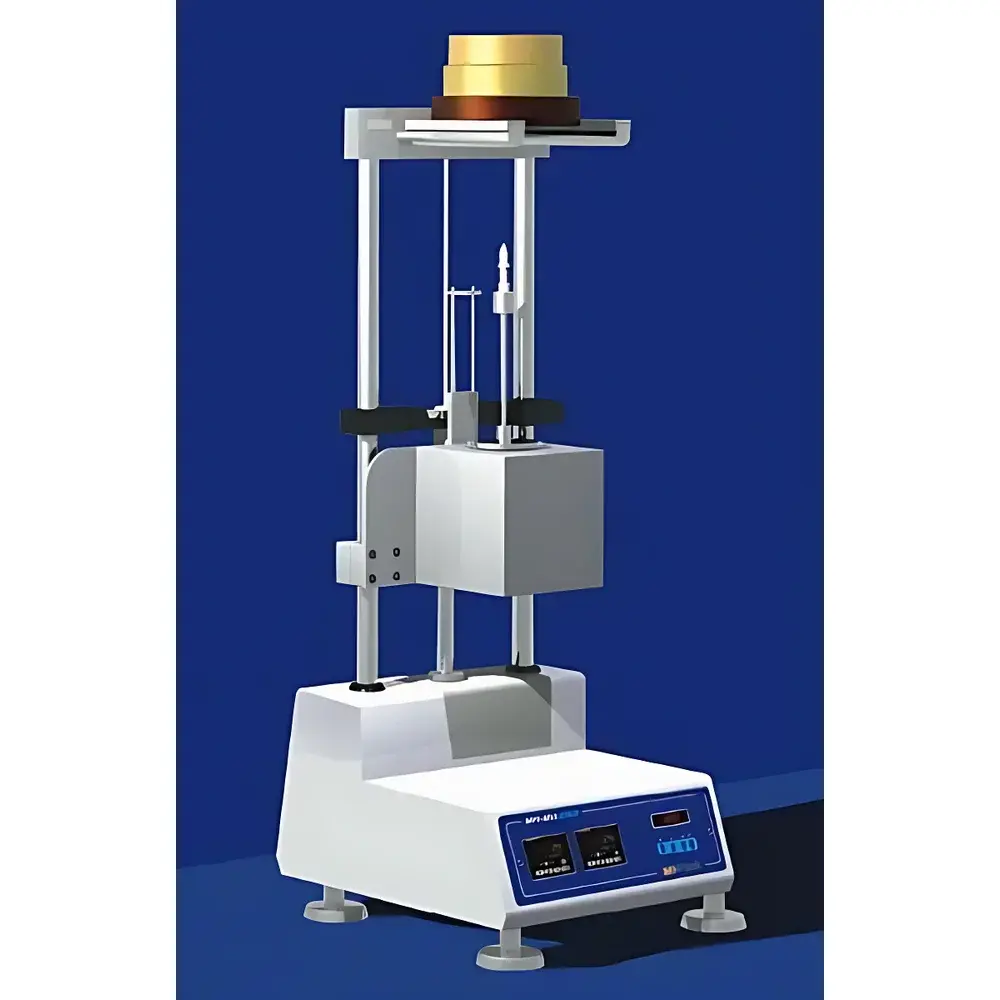
M3350-MFI Melt Flow Indexer
| Origin | Imported |
|---|---|
| Manufacturer Type | Authorized Distributor |
| Model | M3350-MFI |
| Temperature Range | 50–350 °C |
| Calibration Accuracy | ±0.1 °C |
| Temperature Stability | ±0.5 °C |
| Standard Load Masses | 1.2, 2.16, 3.8, 5, 10, 21.6 kg |
| Test Modes | MFR (Melt Flow Rate) and MVR (Melt Volume Rate) |
| Heating Zones | Dual-zone PID-controlled |
| Interface | RS-485 / RS-232 |
| Power Supply | 230 V / 50 Hz |
| Pneumatic Actuation | Dry air, 3 bar |
| Dimensions (L×W×H) | 60×30×40 cm |
| Weight | 15 kg |
| Software Compatibility | Windows 98/ME/2000/XP |
| Compliance | ASTM D1238, ISO 1133, GB/T 3682, USP <661>, DIN 53735 |
Overview
The M3350-MFI Melt Flow Indexer is a precision-engineered instrument designed for the standardized determination of melt flow rate (MFR) and melt volume rate (MVR) of thermoplastic polymers under defined temperature and load conditions. Operating on the principle of extrusion plastometry, it measures the mass or volume of polymer melt extruded through a standardized die (2.095 mm diameter, 8.000 mm length) over a fixed time interval—providing a critical rheological indicator of molecular weight distribution, processability, and batch-to-batch consistency. The system features dual independent PID-controlled heating zones to ensure axial thermal uniformity across the barrel, minimizing temperature gradients that compromise measurement reproducibility. Its robust cast-metal mechanical architecture supports long-term stability in production QC labs and R&D environments where continuous operation and mechanical resilience are essential.
Key Features
- Dual-zone PID temperature control with calibration accuracy of ±0.1 °C and operational stability within ±0.5 °C across the full 50–350 °C range
- Automated test module actuation via integrated pneumatic system (dry air, 3 bar), eliminating manual handling and enabling operator-free cycle initiation and termination
- Pre-heating confirmation with audible tone feedback and programmable pre-heat duration enforcement to ensure thermal equilibrium prior to extrusion
- Simultaneous MFR and MVR calculation with real-time display; supports low-flow, high-flow, and multi-step protocols (including 3- and 9-step sequences)
- Interchangeable load modules compliant with international standards: 1.2 kg, 2.16 kg, 3.8 kg, 5 kg, 10 kg, and 21.6 kg — all traceable to NIST-equivalent reference masses
- Integrated microprocessor-based controller with embedded statistical processing engine for mean, standard deviation, CV%, and outlier detection per test series
- Ergonomic front-panel interface with tactile feedback and visual status indicators; minimal footprint (60×30×40 cm) optimized for benchtop deployment
Sample Compatibility & Compliance
The M3350-MFI accommodates granular, pelletized, and powdered thermoplastics including polyethylene (PE), polypropylene (PP), polycarbonate (PC), ABS, PET, and engineering resins such as PEEK and PPS. It fully conforms to ASTM D1238 (Conditions A–M), ISO 1133-1 and -2 (Methods A and B), GB/T 3682-2018, DIN 53735, and USP for plastic packaging materials. All hardware components—including barrel, piston, die, and load weights—meet dimensional tolerances specified in ISO 1133 Annex A. The instrument’s thermal and mechanical design supports GLP-compliant operation when paired with audit-trail-enabled software (optional Windows-based suite), satisfying requirements for data integrity under FDA 21 CFR Part 11 when configured with electronic signature and user access controls.
Software & Data Management
An optional Windows-compatible software package (compatible with Windows 98 through XP) provides comprehensive test configuration, real-time monitoring, automated report generation (PDF/CSV), and long-term archival. Data exchange occurs via RS-485 or RS-232 serial interface, supporting integration into LIMS environments. The software implements timestamped test logs with operator ID, environmental metadata (ambient temperature/humidity if externally sensed), and full parameter traceability—including actual measured temperature, applied load, extrusion time, and raw mass/volume values. Statistical summaries include up to 99-test batch analysis with Shewhart control charting capability. All data files are digitally signed and checksum-verified to prevent tampering, aligning with ALCOA+ principles for regulated industries.
Applications
This indexer serves as a primary quality control tool in polymer manufacturing, compounding, and recycling facilities—where rapid assessment of melt viscosity informs feedstock acceptance, extrusion line setup, and formulation adjustments. In academic and industrial research laboratories, it supports structure–property correlation studies linking MFR/MVR to GPC-derived molecular weight averages (Mw, Mn) and shear-thinning behavior. Regulatory submissions for medical device packaging (ISO 10993-13), automotive interior materials (SAE J2334), and food-contact plastics (FDA 21 CFR 177) routinely require documented MFI data generated on instruments meeting ISO/IEC 17025 metrological criteria—precisely the performance envelope delivered by the M3350-MFI.
FAQ
What standards does the M3350-MFI comply with?
ASTM D1238, ISO 1133-1/-2, GB/T 3682, DIN 53735, and USP . Calibration procedures follow ISO/IEC 17025 guidelines.
Can the instrument perform both MFR and MVR measurements simultaneously?
Yes—real-time parallel calculation and display of both MFR (g/10 min) and MVR (cm³/10 min) are supported without manual recalibration.
Is pneumatic actuation mandatory, or can manual operation be used?
Pneumatic module lifting/lowering is standard; however, manual override is available for maintenance or emergency use via dedicated mechanical release.
How is temperature uniformity validated across the barrel?
Dual independent PID zones maintain ≤0.3 °C axial gradient (measured per ISO 1133 Annex C using calibrated immersion thermocouples at three axial positions).
Does the system support audit trail and electronic signatures for regulated environments?
When equipped with the optional software suite and configured with role-based user accounts, it meets FDA 21 CFR Part 11 requirements for electronic records and signatures.



