
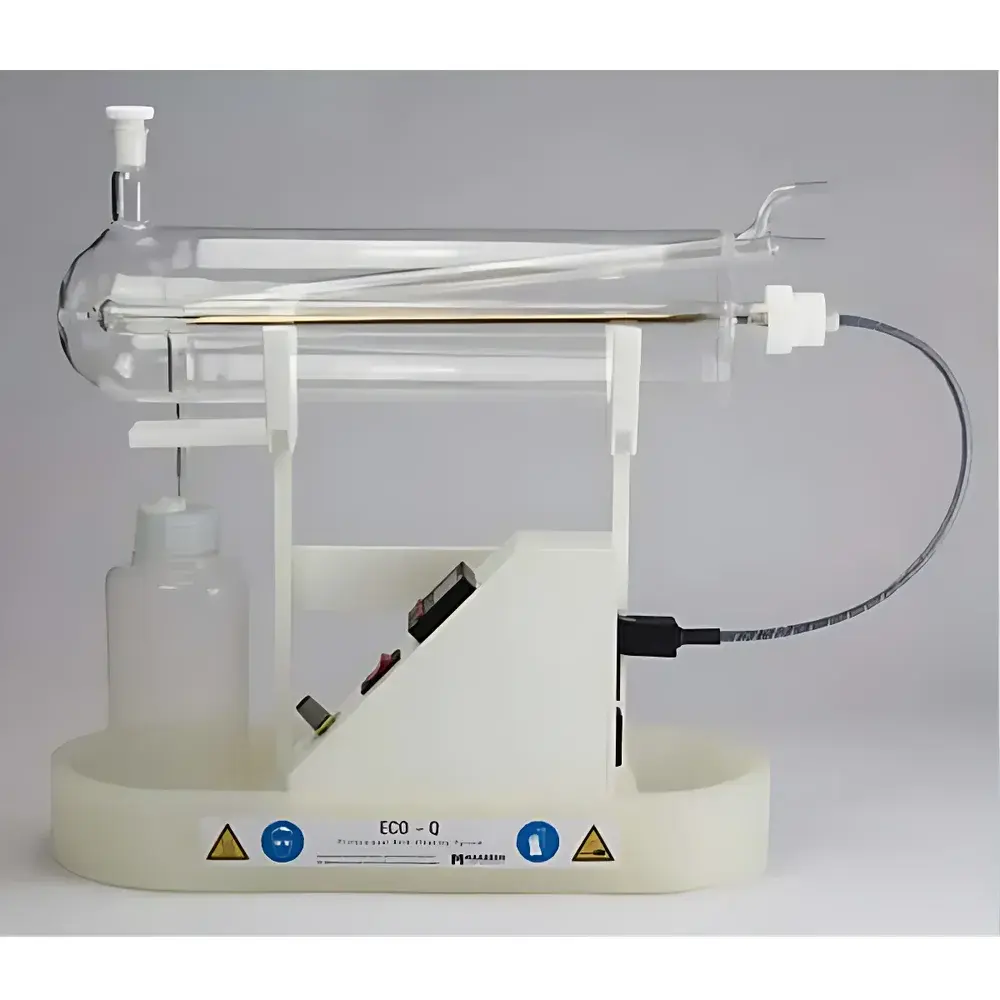
MAASSEN ECO Q Quartz Sub-Boiling Acid Purifier for Sulfuric Acid Applications
| Brand | MAASSEN |
|---|---|
| Origin | Germany |
| Model | ECO Q |
| Instrument Type | Sub-boiling Distillation System |
| Heating Method | Infrared (IR) |
| Cooling Method | Water-cooled |
| Distillation Rate | 3 L per 8 hours |
| Purification Chamber Capacity | 1000 mL quartz |
| Heating Element | IR heating rod(s) |
| Power | 500 W (single heater) / 1000 W (dual heater) |
| Dimensions | 50 × 20 × 42 cm |
| Voltage/Frequency | 220 V / 50 Hz |
| Acid Compatibility | HCl, HNO₃, H₂SO₄, H₂O (excluding HF) |
| Material Contact Zone | All-quartz + PFA/PTFE |
| Safety Features | Overheat protection switch |
| Design | Modular — separate purification and heating units |
| Control Interface | Digital temperature & timer control unit |
| Fluid Path | PTFE tubing with inline filter |
Overview
The MAASSEN ECO Q Quartz Sub-Boiling Acid Purifier is an engineered solution for laboratories requiring ultra-high-purity acids in trace and ultra-trace elemental analysis—particularly for ICP-MS, ICP-OES, GF-AAS, and semiconductor wafer cleaning protocols. Unlike conventional boiling-point distillation, this system operates via sub-boiling evaporation: infrared radiation gently heats the acid sample below its atmospheric boiling point, minimizing volatile impurity carryover and preventing bumping or splashing. The resulting vapor rises through a high-purity fused quartz column, where it contacts a water-cooled quartz condenser and recondenses into droplets collected in inert PFA bottles. This principle—based on differential vapor pressure at controlled sub-boiling temperatures—ensures exceptional removal of metallic cations (e.g., Fe, Al, Cr, Na), anionic contaminants (e.g., sulfate, nitrate residuals), and particulate matter. The entire acid-contact pathway—including evaporation chamber, condenser, and collection interface—is constructed exclusively from fused quartz and fluoropolymer components (PFA/PTFE), eliminating leaching from metals, ceramics, or borosilicate glass.
Key Features
- Fully quartz-based purification chamber (1000 mL capacity) resistant to thermal shock and aggressive oxidizing media including concentrated H₂SO₄, HNO₃, and HCl.
- Dual-configurable IR heating system: selectable single-heater (500 W) or dual-heater (1000 W) mode for optimized energy input and reproducible vapor generation across acid types and volumes.
- Modular architecture separates the quartz purification unit from the electronic heating and control module—preventing acid vapor exposure to sensitive electronics and enabling flexible benchtop layout.
- Top-loading design with sealed quartz lid facilitates rapid acid charging and minimizes ambient contamination during operation.
- Integrated overheat protection switch automatically deactivates heating if liquid level falls below safe operational threshold—critical for unattended overnight runs.
- Digital control panel with adjustable temperature setpoint, real-time status display, programmable timer (up to 99 h), and power-on delay function for scheduled operation.
- Complete fluid path composed of PTFE tubing and inline particulate filters ensures consistent delivery of purified acid without adsorption or extractables.
Sample Compatibility & Compliance
The ECO Q is validated for sub-boiling purification of hydrochloric acid (HCl), nitric acid (HNO₃), sulfuric acid (H₂SO₄), and deionized water—excluding hydrofluoric acid (HF) due to quartz etching risk. Its all-quartz construction meets stringent requirements for Class 1 cleanroom-compatible acid preparation per SEMI F57 and ASTM D1193 Type I specifications. The system supports GLP/GMP-aligned workflows through traceable operation logs (when paired with optional data-logging software), and its metal-free design complies with ISO/IEC 17025 clause 5.5.2 regarding contamination control in reference material preparation. No lubricants, adhesives, or elastomers contact the purified stream—ensuring full compatibility with USP and EP 2.2.48 water purity validation protocols.
Software & Data Management
While the base ECO Q operates via standalone digital controls, optional RS-232 or USB interfaces enable integration with laboratory information management systems (LIMS) or custom SCADA platforms. When configured with MAASSEN’s optional PurifyLog™ software (v3.2+), users gain audit-trail functionality compliant with FDA 21 CFR Part 11—including electronic signatures, user-level access control, and immutable run records documenting start/stop time, temperature profile, and heater duty cycle. All firmware updates are delivered via signed .hex packages verified against SHA-256 checksums to ensure integrity.
Applications
- Preparation of ≤1 ppt metal-grade acids for calibration standard dilution in multi-element ICP-MS analysis.
- Regeneration of contaminated stock acids—reducing consumable waste and lowering cost-per-liter by up to 90% versus commercial ultrapure reagents.
- On-demand generation of matrix-matched high-purity solvents for EPA Method 200.8 and ISO 17294-2 compliance testing.
- Acid digestion blank reduction in environmental soil and biological tissue analysis (e.g., NIST SRM 2711a).
- Supporting ISO/IEC 17025 accredited labs in demonstrating metrological traceability of acid purity claims via documented purification cycles.
FAQ
Can the ECO Q purify hydrofluoric acid (HF)?
No. HF reacts with silica (SiO₂) in quartz at elevated temperatures, causing irreversible etching and structural degradation. HF purification requires specialized fluoropolymer-only systems.
What is the typical metal content of acids purified using the ECO Q?
When operated with certified low-metal starting reagents (e.g., Optima™ grade), final outputs routinely achieve ≤5 ppt Fe, Al, Cr, Ni, Cu, Zn, and Pb—as verified by sector-field ICP-MS after 1:10 dilution in 2% HNO₃.
Is routine maintenance required beyond cleaning the quartz chamber?
Yes. Quarterly inspection of PTFE tubing for microcracking, annual recalibration of the IR heater output (using NIST-traceable thermocouple verification), and replacement of inline filters every 200 L are recommended per MAASSEN Technical Bulletin TB-ECOQ-04.
Does the system support continuous operation?
Yes—provided cooling water flow remains stable (>1.5 L/min) and ambient lab temperature stays within 15–25 °C. Uninterrupted runs exceeding 72 h have been validated under ISO 13485 quality system audits.
How does sub-boiling distillation compare to ion-exchange resin methods for acid purification?
Sub-boiling removes non-volatile metals and particles inherently, whereas resins require frequent regeneration, introduce organic leachables, and fail against silicates or colloidal species. The ECO Q delivers broader contaminant coverage with no consumable replacement costs.



