
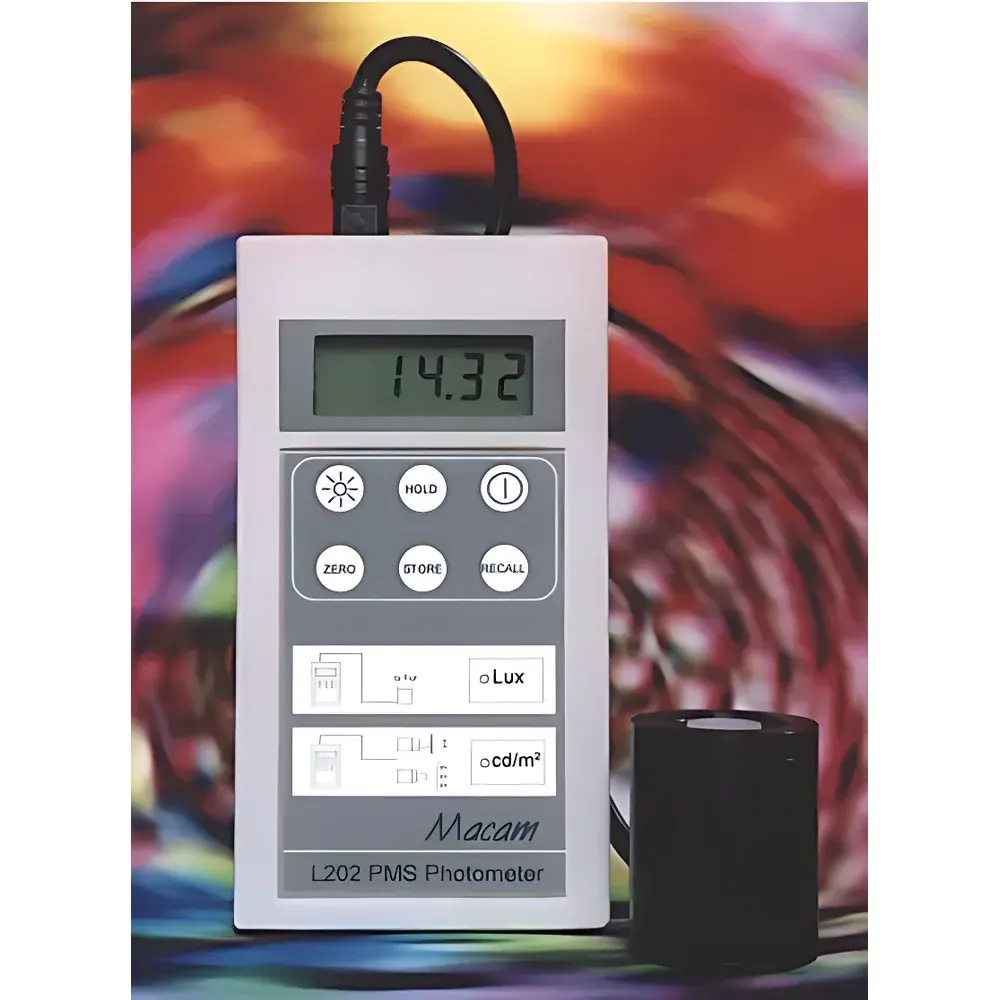
Macam L202 Illuminance and Luminance Meter
| Brand | Macam |
|---|---|
| Origin | United Kingdom |
| Model | L202 |
| Display Unit | L201 |
| Detector | DET201L-Cos |
| Measurement Units | lux (illuminance), cd/m² (luminance) |
| Spectral Match | CIE V(λ) with <1% photopic error |
| Cosine Correction | High-precision acrylic diffuser, deviation <5% up to 70° from normal |
| Accuracy | ±2 digits + 1% linearity (1–20,000 lux), absolute calibration traceable to NPL |
| Operating Temperature | 0–40°C, 80% RH |
| Detector Temp. Coefficient | −0.10%/°C |
| Resolution | 1 lux |
| Display | 4½-digit LCD, 10 mm digit height, backlighted |
| Power | 9 V PP3 battery |
| Dimensions (Display) | 150 × 80 × 45 mm |
| Weight (Display) | 0.35 kg |
| Detector Diameter | 38 mm, Height: 30 mm |
| Interface | 8-pin mini-DIN (detector), RS232 (factory use only) |
Overview
The Macam L202 Illuminance and Luminance Meter is a precision-calibrated, dual-mode photometric instrument engineered for traceable, field-deployable measurement of illuminance (in lux) and luminance (in cd/m²). It operates on the fundamental principles of photometry—converting incident optical power into an electrical signal via a silicon photodiode whose spectral responsivity is rigorously matched to the CIE 1931 photopic luminosity function V(λ). The detector assembly integrates a custom-designed glass filter stack and a high-fidelity acrylate cosine diffuser, enabling compliance with ISO/CIE requirements for angular response (Lambertian behavior up to ±70° off-normal, with <5% deviation). Unlike generic light meters, the L202 employs absolute calibration traceable to the National Physical Laboratory (NPL), UK, ensuring metrological integrity across laboratory, production floor, and outdoor environments. Its microprocessor-controlled architecture (Intel 80C51 core, 3.1684 MHz) manages auto-ranging amplification, unit switching, and real-time signal conditioning—eliminating manual range selection while preserving resolution and repeatability.
Key Features
- True dual-mode operation: seamless toggle between illuminance (lux) and luminance (cd/m²) via detector-mounted mechanical switch, with LED confirmation of active unit
- High-fidelity CIE V(λ) spectral match: <1% photopic mismatch error achieved through multi-layer interference glass filters and thermally stabilized photodiode design
- Optimized cosine correction: proprietary asymmetric acrylic diffuser delivers Lambertian angular response—validated per CIE S 023/E:2013 and IEC 60825-1 Annex D
- Modular probe architecture: detachable DET201L-Cos detector connects via shielded 8-pin mini-DIN cable; enables rapid reconfiguration for contact or remote measurements
- Ruggedized construction: anodized aluminum housing (display unit and detector) provides ESD protection, thermal stability (−20°C to +60°C operating range), and resistance to mechanical shock
- Self-contained portability: integrated 9 V PP3 battery powers >15 hours of continuous operation; backlit 4½-digit LCD ensures readability in low-light industrial settings
Sample Compatibility & Compliance
The L202 is validated for quantitative photometric assessment of diverse light sources—including incandescent, fluorescent, HID, OLED, and LED-based emitters—under both controlled laboratory conditions and uncontrolled ambient environments. Its calibrated spectral response excludes significant UV or NIR contribution, minimizing measurement bias in mixed-spectrum installations. For luminance mode, the optional shadow ring minimizes stray-light contamination during CRT, LCD, or AMOLED display characterization—supporting conformance with ISO 9241-305 (visual display ergonomics) and IEC 62341-6-2 (OLED optical testing). All factory calibrations are documented per ISO/IEC 17025:2017 requirements and include uncertainty budgets referenced to NPL’s primary standard photometer. The instrument meets CE marking criteria under the EU Electromagnetic Compatibility Directive 2014/30/EU and Low Voltage Directive 2014/35/EU.
Software & Data Management
While the L202 operates as a standalone meter, its RS232 interface (restricted to factory configuration and firmware update) supports integration into automated QA/QC workflows when paired with Macam’s legacy data acquisition software (v3.2+). Raw serial output conforms to ASCII protocol with timestamped, comma-delimited lux/cd/m² values and unit identifiers. Though not natively compliant with FDA 21 CFR Part 11, audit trails and calibration records can be maintained externally in accordance with GLP/GMP documentation practices. Firmware updates preserve calibration constants and support user-defined averaging intervals (1–10 s), enhancing reproducibility in fluctuating ambient conditions.
Applications
- Workplace lighting validation per EN 12464-1 (lighting of indoor workplaces) and IESNA RP-1
- Display manufacturing QC: uniformity mapping, contrast ratio verification, and luminance drift monitoring over time
- Architectural daylighting analysis: spatial illuminance distribution modeling for LEED v4.1 credit MRc1
- Automotive interior lighting certification: compliance with UNECE R112 and SAE J1383
- Educational photometry labs: hands-on instruction in V(λ) matching, cosine law validation, and radiometric-to-photometric conversion
- Museum and gallery conservation: non-invasive monitoring of exhibit illumination levels to prevent photochemical degradation (per ISO 11799)
FAQ
Is the L202 suitable for measuring LED lighting with narrow spectral peaks?
Yes—the V(λ)-matched filter stack compensates for the inherent mismatch error common in broadband silicon detectors when used with blue-pump phosphor-converted white LEDs, delivering <±2% deviation relative to spectroradiometric reference measurements.
Can the detector be recalibrated independently of the display unit?
No—calibration is performed as an integrated system (display + detector + cable). Replacement detectors must be paired and re-characterized with the host L201 unit to maintain traceability.
What is the maximum measurable luminance in contact mode?
The DET201L-Cos probe supports luminance measurements up to 10,000 cd/m² when used with the shadow ring and proper thermal stabilization; higher intensities require neutral density filtration (not supplied).
Does the instrument comply with ASTM E308 or CIE 15:2018?
While not certified to these standards as a test method, its spectral and angular performance satisfies the instrumental requirements specified in Clause 5.2 of CIE 15:2018 and Section 7.3 of ASTM E308-23 for Class L photometers.
How often should field recalibration be performed?
Annual recalibration against NPL-traceable standards is recommended for ISO/IEC 17025-accredited laboratories; biannual verification using a stable reference lamp is sufficient for routine industrial use.







