
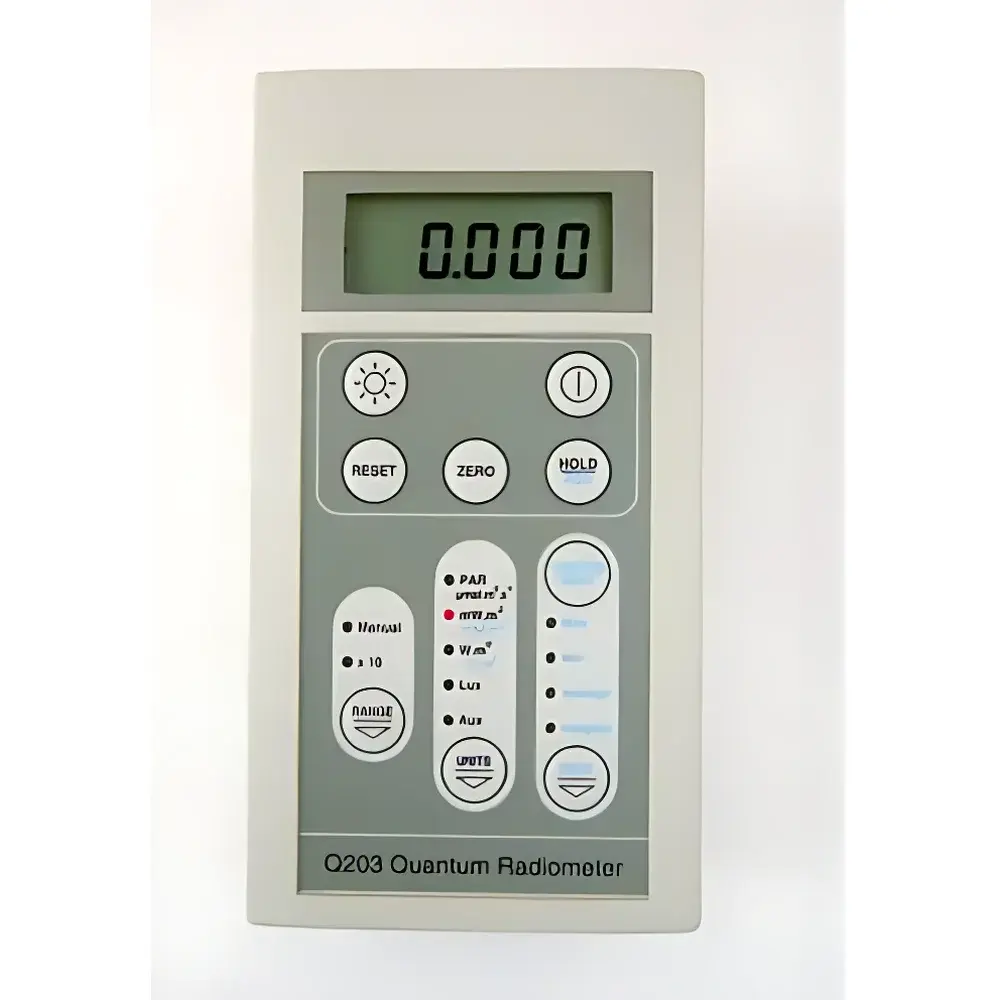
Macam Q203 Quantum PAR Radiometer
| Brand | Macam |
|---|---|
| Origin | United Kingdom |
| Model | Q203 |
| Measurement Range (PAR) | 1.9999–19999 μmol·m⁻²·s⁻¹ |
| Spectral Range (PAR) | 400–700 nm |
| Spectral Range (Irradiance) | 400–1000 nm (configurable) |
| Units | μmol·m⁻²·s⁻¹, lux, W·m⁻² |
| Detector | Si photodiode (33 mm²) |
| Cosine Error | ≤ ±3.5° (0–70° from normal) |
| Display | 4½-digit LCD, 10 mm digits, LED backlight |
| Interface | RS232 (4800 baud, 3-wire) |
| Power | 9 V PP3 battery (~50 h operation, no backlight) |
| Operating Temp. | 0–40 °C (detector: –10–+60 °C) |
| Weight | ~350 g |
Overview
The Macam Q203 Quantum PAR Radiometer is a precision-engineered, portable optical measurement system designed for quantitative assessment of photosynthetically active radiation (PAR) in the 400–700 nm spectral band. It operates on the principle of calibrated silicon photodiode detection coupled with spectrally selective, cosine-corrected optical filtering—ensuring accurate quantification of photon flux density in units of μmol·m⁻²·s⁻¹ (micromoles of photons per square meter per second). Unlike broadband radiometers relying on uncorrected spectral response, the Q203 integrates physically characterized optical filters—including PAR-Cos, RFF-Cos, RFF-Vis-Cos, and CIE-Cos—that conform to internationally recognized spectral weighting functions (e.g., CIE V(λ) for photopic luminance and standardized PAR action spectra). Its architecture follows photometric best practices defined in ISO/CIE 19476:2015 and ASTM E2919–22, enabling traceable, repeatable measurements under variable angular incidence and environmental lighting conditions.
Key Features
- Modular detector head with detachable, field-replaceable cosine-corrected filter rings—enabling rapid reconfiguration between PAR, irradiance (W·m⁻²), and illuminance (lux) modes
- High-fidelity cosine response: ≤ ±3.5% deviation from ideal Lambertian behavior across 0–70° incident angles, validated per IEC 62471 Annex D and ISO 11664-3
- Microprocessor-controlled signal conditioning with auto/manual gain selection (10³–10⁹ V/A range), 17-bit A/D conversion, and 0.33 s integration time for low-noise, high-stability readings
- Onboard non-volatile RAM storing calibration coefficients, user settings, and instrument configuration—preserving metrological integrity across power cycles
- RS232 serial interface compliant with ANSI/TIA/EIA-232-F, supporting bidirectional data logging, remote triggering, and firmware diagnostics
- Ruggedized handheld unit (150 × 80 × 45 mm, ~350 g) with IP54-rated enclosure, LED-backlit 4½-digit LCD display (10 mm character height), and low-power operation (<20 mA typical)
Sample Compatibility & Compliance
The Q203 supports both terrestrial and aquatic applications via optional submersible detector variants (e.g., DET203QR-H2O), making it suitable for limnological profiling, greenhouse canopy analysis, and vertical farming light mapping. All factory calibrations are traceable to the UK’s National Physical Laboratory (NPL) and British Standards Institution (BSI), with certificates issued per ISO/IEC 17025 requirements. The instrument meets electromagnetic compatibility standards EN 61326-1:2013 and safety standard EN 61010-1:2010. Its optical design adheres to CIE S 023/E:2013 for PAR instrumentation and supports GLP-compliant workflows through timestamped, non-erasable measurement logs when interfaced with validated third-party data acquisition software.
Software & Data Management
While the Q203 operates as a standalone, direct-read instrument, its RS232 interface enables integration into laboratory information management systems (LIMS) and automated monitoring networks. Raw ASCII-formatted output includes measurement value, unit identifier, timestamp (when externally synchronized), and status flags (e.g., overload, low battery, filter ID). When used with Macam-provided or third-party terminal emulators (e.g., Tera Term, PuTTY), users can configure automatic data capture at programmable intervals, generate CSV-compatible reports, and apply post-acquisition corrections using NIST-traceable correction factors. Audit trails—including calibration history, operator ID, and environmental metadata—can be maintained in alignment with FDA 21 CFR Part 11 requirements when paired with compliant electronic record systems.
Applications
- Plant physiology research: Quantifying PAR distribution within growth chambers, phytotrons, and controlled-environment agriculture (CEA) facilities
- Agricultural light management: Optimizing supplemental LED/HPS lamp placement and daily light integral (DLI) calculations for crop yield modeling
- Ecological field studies: Measuring underwater PAR attenuation in freshwater and marine ecosystems for primary productivity estimation
- Lighting engineering: Validating spectral power distribution (SPD) and photobiological safety of horticultural LEDs per IEC TR 62778
- Photostability testing: Monitoring UV-A/visible irradiance during accelerated aging of pharmaceuticals and polymers per ICH Q1B and ISO 11341
- Phototherapy device validation: Verifying spectral output consistency of medical-grade light sources used in dermatology and neonatology
FAQ
Is the Q203 calibrated for absolute quantum measurement, and what is its uncertainty budget?
Yes—the Q203 undergoes absolute spectral responsivity calibration against NPL-standard reference lamps. Total expanded uncertainty (k=2) is ±3% for PAR mode and ±7.5% for RFF/CIE modes, inclusive of cosine error, linearity, temperature drift, and calibration transfer uncertainty.
Can the detector be used underwater, and what depth rating does it support?
Standard DET203QR is not submersible; however, Macam offers the DET203QR-H2O variant rated to 10 m depth with pressure-compensated housing and marine-grade cable insulation.
Does the instrument comply with FDA 21 CFR Part 11 for electronic records in regulated environments?
The Q203 itself does not include built-in electronic signature or audit trail functionality—but its RS232 output is fully compatible with Part 11–compliant LIMS platforms that implement required controls for data integrity, access restriction, and change history.
How often should recalibration be performed to maintain traceability?
Annual recalibration is recommended under routine use; more frequent verification (e.g., quarterly) is advised in high-precision applications or after mechanical shock, extreme thermal cycling, or filter replacement.
Are custom filter configurations available for specialized spectral bands beyond the standard PAR, RFF, and CIE options?
Yes—Macam provides OEM filter design services for client-defined action spectra (e.g., cryptochrome activation, UV-B plant stress response), subject to minimum order quantities and optical feasibility review.
Related Products







