
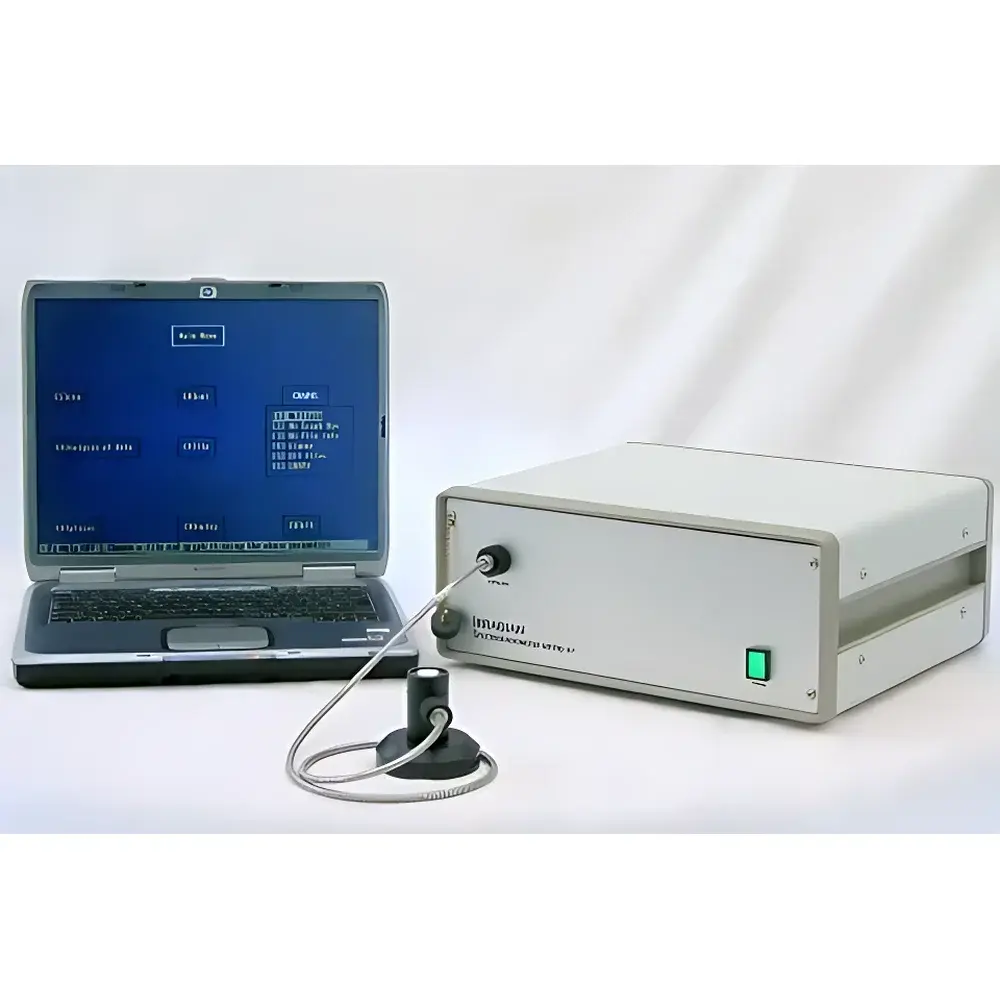
Macam SR9910 Underwater Spectroradiometer
| Brand | Macam |
|---|---|
| Origin | United Kingdom |
| Model | SR9910 |
| Optical Input Channels | 2 |
| Spectral Range | 240–800 nm |
| Detector Type | UV-enhanced CCD array |
| Calibration Traceability | NPL-traceable irradiance calibration |
| Sensor Compatibility | Spherical and planar irradiance sensors |
| UV Measurement Capability | Simultaneous UVA (315–400 nm) and UVB (280–315 nm) irradiance |
| Typical Applications | In-water radiometric profiling, aquatic photobiology, optical oceanography, satellite validation, water quality parameter inversion |
Overview
The Macam SR9910 Underwater Spectroradiometer is a field-deployable, high-fidelity optical instrument engineered for quantitative in-situ measurement of underwater spectral irradiance. It operates on the principle of calibrated spectroradiometry—capturing absolute spectral photon flux per unit area across a broad 240–800 nm range using a thermoelectrically stabilized, UV-optimized CCD detector array. Unlike broadband photometers or filtered radiometers, the SR9910 delivers full spectral resolution (typically ≤2.5 nm FWHM), enabling rigorous characterization of underwater light fields critical to phytoplankton photoacclimation, CDOM absorption modeling, and remote sensing algorithm development. Its dual-channel architecture supports simultaneous acquisition from two independent optical inputs—enabling concurrent measurement of upwelling and downwelling irradiance (Eu and Ed) or scalar irradiance (E0)—without temporal misalignment. The system is designed for deployment from R/Vs, AUVs, moorings, or handheld profiling frames, with pressure-rated housings rated to 600 m depth (optional).
Key Features
- Dual optical input ports accepting standardized fiber-optic couplings (SMA 905), permitting synchronized acquisition from spherical (scalar) and planar (vector) irradiance sensors
- UV-extended spectral response (240–800 nm) with enhanced quantum efficiency below 320 nm, validated via NPL-traceable irradiance calibration certificates
- Simultaneous UVA (315–400 nm) and UVB (280–315 nm) irradiance quantification—critical for assessing UV photoinhibition and DNA damage potential in marine organisms
- Integrated thermal stabilization (±0.1 °C) and dark-current compensation to ensure spectral stability during extended deployments
- Ruggedized titanium or stainless-steel pressure housing (standard 300 m; optional 600 m rating) with O-ring-sealed optical windows (fused silica, AR-coated)
- Onboard non-volatile memory (8 GB) and real-time data logging at user-selectable intervals (1 Hz to 1 min), with time synchronization via GPS or internal RTC
Sample Compatibility & Compliance
The SR9910 interfaces exclusively with Macam-certified irradiance sensors—including the SR-Sph-100 spherical collector for scalar irradiance (E0) and the SR-Pln-50 planar diffuser for directional irradiance (Ed, Eu). All sensors comply with ISO 17025-accredited calibration protocols and are supplied with individual NPL-traceable calibration files (including angular response corrections and stray-light matrices). The instrument meets IEC 60529 IP68 ingress protection requirements and conforms to ASTM E275–22 (Standard Practices for Describing and Measuring Performance of UV Radiometers) and ISO 17123–7 (Optics and optical instruments — Field procedures for testing geodetic and surveying instruments — Part 7: Spectroradiometers). Data output formats (NetCDF-4, ASCII CSV) support interoperability with NASA’s SeaDAS, ESA’s SNAP, and NOAA’s IOOS metadata standards.
Software & Data Management
Acquisition and post-processing are supported by Macam SpectraView v4.x—a cross-platform application (Windows/macOS/Linux) compliant with FDA 21 CFR Part 11 for audit trail, electronic signature, and data integrity controls. SpectraView provides real-time spectral visualization, automatic dark/reference subtraction, sensor-specific responsivity correction, and export of calibrated spectral irradiance (µW cm⁻² nm⁻¹) or photosynthetically active radiation (PAR, 400–700 nm) integrals. Raw spectra include embedded EXIF-style metadata (GPS position, depth, timestamp, sensor ID, calibration epoch). Data packages are structured to meet FAIR principles (Findable, Accessible, Interoperable, Reusable) and integrate natively with LTER, GOOS, and EMODnet data portals.
Applications
- Validation of ocean color satellite products (e.g., Sentinel-3 OLCI, MODIS-Aqua) through match-up analysis of in-situ Ed(λ)/Eu(λ) ratios
- Quantifying spectral attenuation coefficients (Kd(λ)) for bio-optical modeling and chlorophyll-a retrieval algorithm refinement
- Assessing UV penetration depth and photolytic rates of trace contaminants (e.g., nitrate, DOM) in coastal and inland waters
- Monitoring diel and seasonal variability in underwater light climate for benthic photobiology and coral reef resilience studies
- Supporting GLP-compliant environmental impact assessments (EIAs) requiring traceable, auditable radiometric data under ISO/IEC 17025 frameworks
FAQ
What calibration standards apply to the SR9910 system?
The SR9910 and its sensors are calibrated against NPL (National Physical Laboratory, UK) reference irradiance standards, with full uncertainty budgets provided per ISO/IEC 17025. Calibration validity is 12 months under normal use.
Can the SR9910 operate autonomously on a mooring?
Yes—when paired with Macam’s SR-PowerPack (lithium-thionyl chloride battery module) and SR-Comms (RS-485/SDI-12 interface), it supports unattended operation for >6 months at 10-min logging intervals.
Is software included with hardware purchase?
Yes—SpectraView v4.x is bundled with perpetual license and includes annual technical updates and calibration file management tools.
Does the system support real-time telemetry?
Via optional SR-Telem module (Iridium Short Burst Data or LTE-M), enabling near-real-time spectral upload to secure cloud repositories with TLS 1.3 encryption.
How is stray light corrected in UV measurements?
Each calibration certificate includes an empirically derived stray-light matrix; SpectraView applies pixel-wise correction using the method described in Wernand & van der Woerd (2003, Applied Optics).
Related Products







