
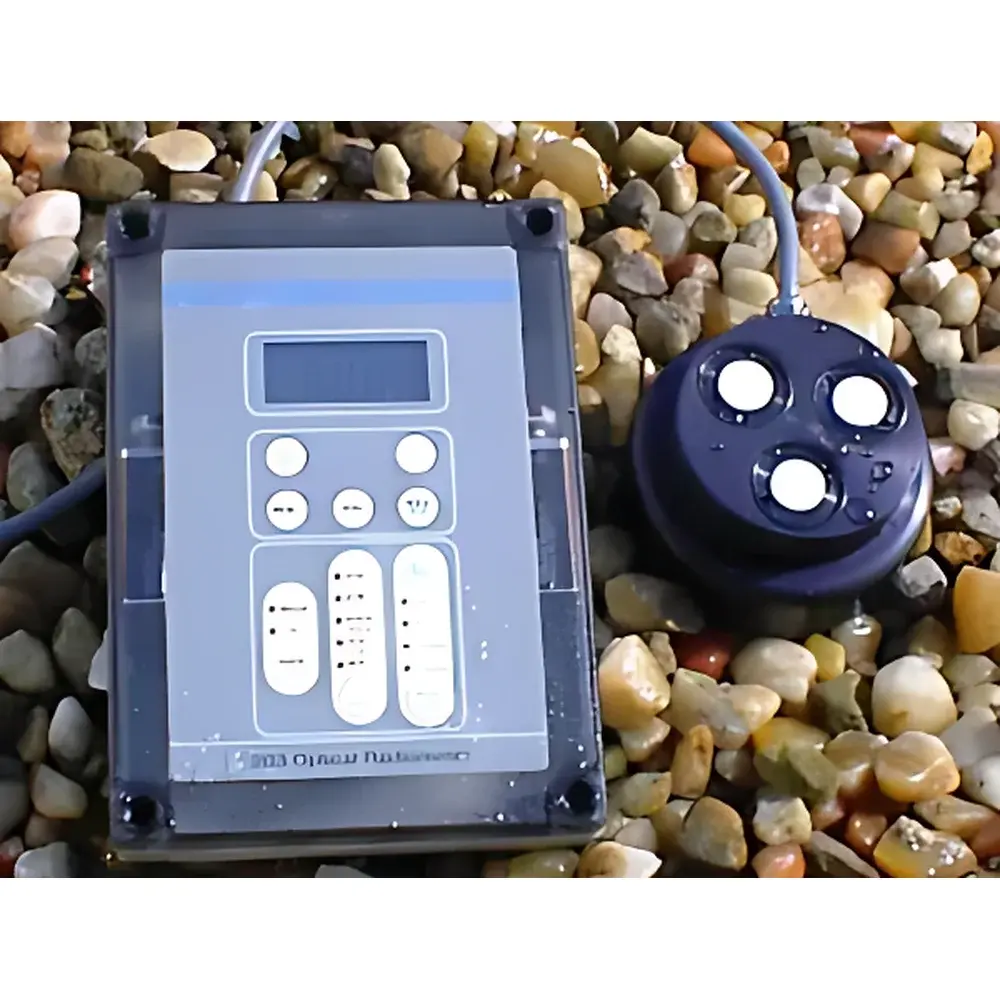
Macam UV203/3 Underwater UV Radiometer
| Brand | Macam |
|---|---|
| Origin | United Kingdom |
| Model | UV203/3 |
| Detector Configuration | Triple-channel (UVA, UVB2, RFF-Vis) |
| Submersible Depth Rating | 10 m |
| Display | 4½-digit LCD (10 mm digit height) |
| Microprocessor | 80C51-based, 3.1684 MHz clock |
| Memory | Onboard non-volatile RAM for calibration coefficients and settings |
| Gain Control | Auto/manual selectable per channel |
| Integration Time | 0.33 s |
| ADC Resolution | 17-bit |
| Accuracy | ±1 digit, linearity error < 1% |
| Cosine Response Error | ≤ ±3% (0–70° from normal incidence) |
| Operating Temperature | 0–40 °C, 80% RH |
| IP Rating | IP67 |
| Power | Two 9 V PP3 batteries (~150 h typical life, no RS232 active) |
| Interface | 3-wire RS232 (4800 baud, no parity, 1 stop bit) |
| Connectors | 8-pin circular screw-lock (detector), 5-pin (RS232), 3-pin (external power) |
| Detector Housing | Anodized aluminum |
| Detector Type | High-stability silicon (UVA, RFF-Vis) and GaAs (UVB2) photodiodes with individual low-noise, high-gain amplifiers and digital signal generators |
| Spectral Calibration | Traceable to NPL standards |
| Measurement Modes | Instant irradiance, min/max during averaging, integrated radiant exposure (mJ/m² or J/m²) |
| Zeroing | Background zero measurement with auto-store on power-off |
Overview
The Macam UV203/3 Underwater UV Radiometer is a precision field-deployable instrument engineered for quantitative in situ measurement of spectral irradiance across three biologically and photochemically relevant wavebands: UVA (peak ~369 nm), UVB2 (peak ~311 nm), and the photosynthetically active radiation (PAR)-aligned RFF-Vis channel (400–700 nm). Designed explicitly for aquatic environments, the system employs a dual-unit architecture comprising a handheld microprocessor-controlled display unit and a fully submersible triple-detector probe connected via a 10-meter armored coaxial cable. Its core measurement principle relies on calibrated photodiode detection with spectrally selective interference filters, coupled with cosine-corrected diffusers to ensure angular response fidelity per CIE 1931 and ISO/CIE 17166:2022 requirements. Each detector channel—UVA (33 mm² Si), UVB2 (21 mm² GaAs), and RFF-Vis (33 mm² Si)—features an independent high-gain, low-noise transimpedance amplifier and onboard digital signal generation, ensuring only robust digital signals propagate over the interconnect cable. This architecture eliminates analog signal degradation and noise coupling, critical for reliable underwater deployment where electromagnetic interference and cable capacitance are significant concerns.
Key Features
- Fully submersible detector head rated to 10 m depth, constructed from anodized aluminum for corrosion resistance and mechanical durability in marine and freshwater environments.
- Triple-channel spectral discrimination using matched photodiode/filter assemblies: UVA (λpeak = 369 ± 2 nm, FWHM = 37 ± 2 nm), UVB2 (λpeak = 311 ± 1 nm, FWHM = 19 ± 2 nm), and RFF-Vis (broadband 400–700 nm with >10⁵ rejection from 400–1000 nm).
- Optimized cosine response with error ≤ ±3% from 0° to 70° off-normal incidence, validated against Lambert’s cosine law and compliant with ISO 17166:2022 for radiometric angular characterization.
- Microprocessor-controlled display unit featuring 4½-digit LCD (10 mm character height), auto/manual gain selection per channel, real-time background zeroing, and hold function for stable readings.
- Integrated radiant exposure calculation (mJ/m² or J/m²) with user-selectable averaging periods; min/max values recorded during integration interval.
- Onboard non-volatile RAM stores calibration coefficients, user settings, and background zero offset—retained across power cycles without battery backup dependency.
- RS232 serial interface (4800 baud, 8N1) enables direct data logging to external PCs or dataloggers; all connectors use rugged circular screw-lock types (8-pin detector, 5-pin RS232, 3-pin auxiliary power).
Sample Compatibility & Compliance
The UV203/3 is compatible with direct immersion in natural waters—including seawater, estuarine, lacustrine, and riverine systems—as well as controlled mesocosms and aquaculture tanks. Its detector head requires no housing modification for operation at depths up to 10 m, and its IP67-rated display unit withstands splashing, humidity, and temporary submersion. The instrument complies with IEC 60529 for ingress protection and meets mechanical robustness criteria outlined in ISO 9001-compliant manufacturing practices. Calibration is traceable to the National Physical Laboratory (NPL) UK through primary standard lamps and monochromators; absolute spectral irradiance accuracy is certified at ±7.5% across all channels. For regulatory and quality assurance workflows, the system supports GLP-aligned documentation: calibration certificates include uncertainty budgets, reference standards used, environmental conditions, and technician signatures. While not FDA 21 CFR Part 11–certified out-of-the-box, audit trails (zero history, calibration logs, timestamped measurements) can be exported via RS232 for integration into validated laboratory information management systems (LIMS).
Software & Data Management
No proprietary software is bundled with the UV203/3; instead, it operates as a standards-compliant serial device compatible with industry-standard terminal emulators (e.g., Tera Term, PuTTY) and scripting environments (Python pySerial, MATLAB serial interface). ASCII-formatted output includes channel identifier, irradiance value, units, timestamp (if host-supplied), and status flags (e.g., overload, low battery). Raw data streams support post-acquisition processing in Excel, R, or Python for spectral weighting (e.g., erythemal action spectrum, DNA damage weighting), dose accumulation, and time-series interpolation. Calibration coefficients are stored internally and applied in real time; users may load alternative coefficient sets via RS232 for multi-site or multi-instrument harmonization. Firmware updates are not field-upgradable—calibration integrity is preserved by design through hardware-bound coefficient storage.
Applications
- Marine photobiology studies: quantifying UV penetration depth profiles, estimating photoinhibition thresholds in phytoplankton, and validating radiative transfer models (e.g., Hydrolight, EcoLight).
- Aquaculture monitoring: assessing UV stress on larval fish and crustaceans, optimizing UV-C disinfection dosing in recirculating aquaculture systems (RAS) while avoiding collateral damage.
- Environmental phototoxicity assessment: measuring solar UV exposure in ecotoxicological bioassays involving Daphnia, coral symbionts, or benthic macroalgae under controlled irradiance regimes.
- Instrument intercomparison campaigns: serving as a transfer standard in field validation exercises against hyperspectral radiometers or satellite-derived surface irradiance products.
- Water treatment process control: verifying spectral output stability of submerged UV lamps in ballast water treatment units per IMO G8 guidelines.
FAQ
What is the maximum operational depth of the detector head?
The detector head is rated for continuous operation at depths up to 10 meters in freshwater or seawater.
Can the UV203/3 measure actinic flux or scalar irradiance?
No—it measures plane (vector) irradiance only; scalar irradiance requires isotropic collectors or multi-angle sensor arrays.
Is NIST traceability available for calibration?
Calibration is traceable to the UK’s National Physical Laboratory (NPL), which maintains mutual recognition agreements (MRA) with NIST under the ILAC framework.
How often should recalibration be performed?
Annual recalibration is recommended for routine environmental monitoring; more frequent calibration (e.g., quarterly) is advised when used in high-UV-exposure or abrasive sediment-laden waters.
Does the instrument support external power during extended deployments?
Yes—via the dedicated 3-pin circular screw-lock connector; external 9–15 V DC input disables battery drain while maintaining full functionality.







