
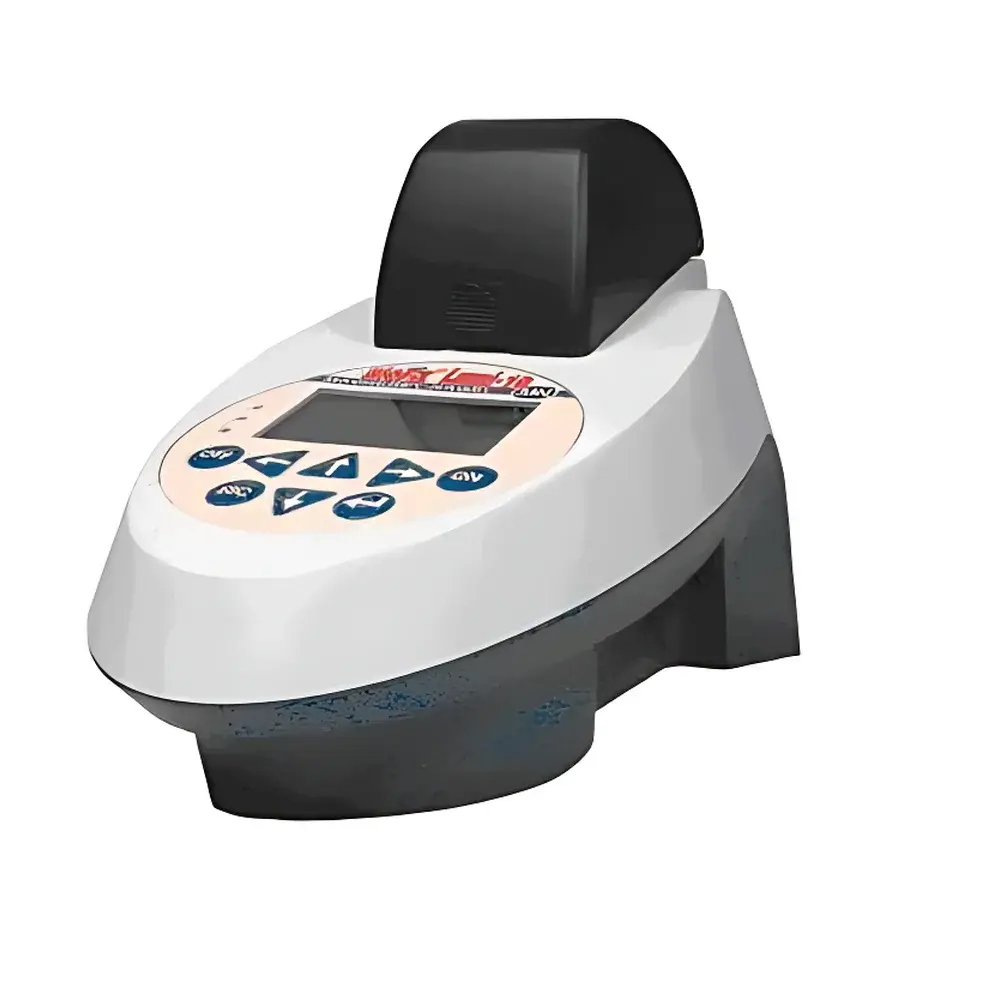
Macherey-Nagel BioFix® Lumi-10 Portable Bioluminescence-Based Water Toxicity Analyzer
| Brand | Macherey-Nagel |
|---|---|
| Origin | Germany |
| Model | BioFix® Lumi-10 |
| Instrument Type | Portable |
| Biological Agent | *Aliivibrio fischeri* (formerly *Vibrio fischeri*) bioluminescent bacteria |
| Operating Temperature Range | 15–30 °C (recommended), functional range: 0–40 °C |
| Reagent Storage & Use Temperature | 0–40 °C |
| Coefficient of Variation (CV) | <10% |
| Photon Detection Speed | 5,000 photons per 0.1 s |
| Assay Duration | Default 10 s (adjustable from 0.5–20 s) |
| Detector | Fast single-photon-counting photomultiplier tube (PMT) |
| Wavelength Sensitivity | 380–630 nm |
| Display | LED, 128 × 64 pixels |
| Data Storage Capacity | 2,000 measurement records |
| Power Supply | 3× rechargeable Ni-Cd batteries or AC adapter (230 V/50 Hz or 115 V/60 Hz) |
| Dimensions (H×W×D) | 170 × 150 × 280 mm |
| Weight | 2.0 kg (including batteries) |
| Compliance | Low Voltage Directive 73/23/EEC, EMC Directive 89/336/EEC (incl. amendment 92/31/EEC) |
Overview
The Macherey-Nagel BioFix® Lumi-10 is a field-deployable, bioluminescence-based water toxicity analyzer engineered for rapid, standardized assessment of acute aquatic toxicity. It quantifies inhibition of light emission from the marine bacterium Aliivibrio fischeri — a well-established ISO 11348-3 and DIN 38412-L33-compliant biological indicator organism. Upon exposure to toxicants, metabolic disruption in the bacteria reduces ATP-dependent bioluminescence, enabling quantitative correlation between photon count suppression and sample toxicity. The instrument operates on the principle of photonic signal decay kinetics, delivering reproducible endpoint measurements within seconds. Designed for regulatory monitoring, wastewater compliance verification, and emergency response, the Lumi-10 delivers laboratory-grade reliability in a rugged, battery-operated platform suitable for on-site use in municipal treatment plants, industrial effluent discharge points, and environmental field surveys.
Key Features
- Portable, handheld design (2.0 kg total mass) with integrated ergonomic housing and shock-absorbing casing for field durability
- Dual power operation: supports 3× rechargeable Ni-Cd batteries (≥8 hours continuous use) or universal AC input (115/230 V, 50/60 Hz)
- High-sensitivity single-photon-counting photomultiplier tube (PMT) optimized for the 380–630 nm bioluminescent emission spectrum of A. fischeri
- Adjustable assay duration (0.5–20 s) with default 10 s protocol aligned with ISO 11348-3 standard incubation timing
- Onboard microcontroller with six pre-programmed test templates covering common regulatory protocols (e.g., blank normalization, serial dilution, reference control validation)
- LED display (128 × 64 pixels) with real-time photon count visualization and intuitive menu navigation in English or German
- RS-232 serial interface (9-pin) for direct data export to PC-based LIMS or spreadsheet applications; supports ASCII-formatted output with timestamp, location ID, and sample metadata
- Internal memory stores up to 2,000 complete assay records, each including sample ID, test template used, ambient temperature, detection time, raw photon counts, and inhibition percentage
Sample Compatibility & Compliance
The BioFix® Lumi-10 accepts aqueous samples across a broad matrix range, including surface water, groundwater, treated wastewater, industrial process water, and eluates from solid waste leaching tests. Sample preparation follows ISO 11348-3 guidelines: reconstitution of lyophilized A. fischeri cells in saline buffer, followed by 15-minute exposure to sample at 15–30 °C. The system accommodates turbid or colored samples via built-in background subtraction logic and optional dilution series integration. Regulatory alignment includes full conformance with ISO 11348-3:2018 (Water quality — Determination of the inhibitory effect of water samples on the light emission of *Vibrio fischeri* — Part 3: Method using freeze-dried bacteria), DIN 38412-L33, and OECD Test Guideline 201. Electrical safety and electromagnetic compatibility are certified per EU directives 73/23/EEC (Low Voltage Directive) and 89/336/EEC (EMC Directive, as amended by 92/31/EEC). No FDA 21 CFR Part 11 or GLP audit trail functionality is embedded; however, exported ASCII data files support traceability in GMP-aligned environmental QA/QC workflows.
Software & Data Management
The Lumi-10 features embedded firmware with no external software dependency. All test execution, calculation, and storage occur onboard. Each measurement record captures user-defined fields: sampling location (alphanumeric code), sample ID, date/time stamp (real-time clock), operator ID, and selected template. Inhibition (%) is calculated as [(Icontrol – Isample) / Icontrol] × 100, where I = integrated photon count over defined duration. Data retrieval occurs via RS-232 connection using standard terminal emulation (e.g., PuTTY, Tera Term) or custom LabVIEW/Python scripts. Exported files include header metadata and tab-delimited values compatible with Excel, R, or validated LIMS platforms. While the device does not provide cryptographic signing or electronic signature capability, its deterministic data logging and immutable timestamping meet baseline requirements for ISO/IEC 17025-accredited environmental laboratories conducting routine toxicity screening.
Applications
- Routine compliance monitoring of wastewater discharge permits (e.g., EU Urban Wastewater Treatment Directive, US EPA NPDES)
- Emergency spill response and rapid hazard identification following chemical accidents or pipeline ruptures
- Validation of tertiary treatment efficacy in municipal and industrial wastewater facilities
- Ecotoxicological screening of leachates from landfills, construction materials, or recycled aggregates (per EN 12457 series)
- Quality assurance of drinking water distribution systems post-disinfection
- Academic and research applications in aquatic toxicology, requiring standardized, high-throughput bioassays
FAQ
What organism is used in the BioFix® Lumi-10 assay?
The system employs freeze-dried *Aliivibrio fischeri* (formerly *Vibrio fischeri*) — a non-pathogenic, marine luminescent bacterium standardized in ISO 11348-3.
Can the Lumi-10 be used for saline or brackish water samples?
Yes; the assay buffer is isotonic and compatible with salinity up to 35 g/L NaCl. For hypersaline matrices (>35 g/L), dilution with sterile saline is recommended per ISO guidance.
Is calibration required before each test?
No daily calibration is needed. The PMT gain is factory-set and stable; performance verification uses supplied control standards (e.g., 3,5-dichlorophenol reference toxin) prior to critical campaigns.
How is data integrity ensured during field deployment?
Each record includes hardware-generated timestamps, operator-assigned identifiers, and checksum-verified ASCII export. Battery-backed memory retains data during power interruption.
Does the instrument support GLP-compliant audit trails?
It does not generate electronic signatures or user-action logs. However, exported data files—when archived with associated SOPs and raw printouts—support GLP documentation requirements for non-clinical environmental studies.







