
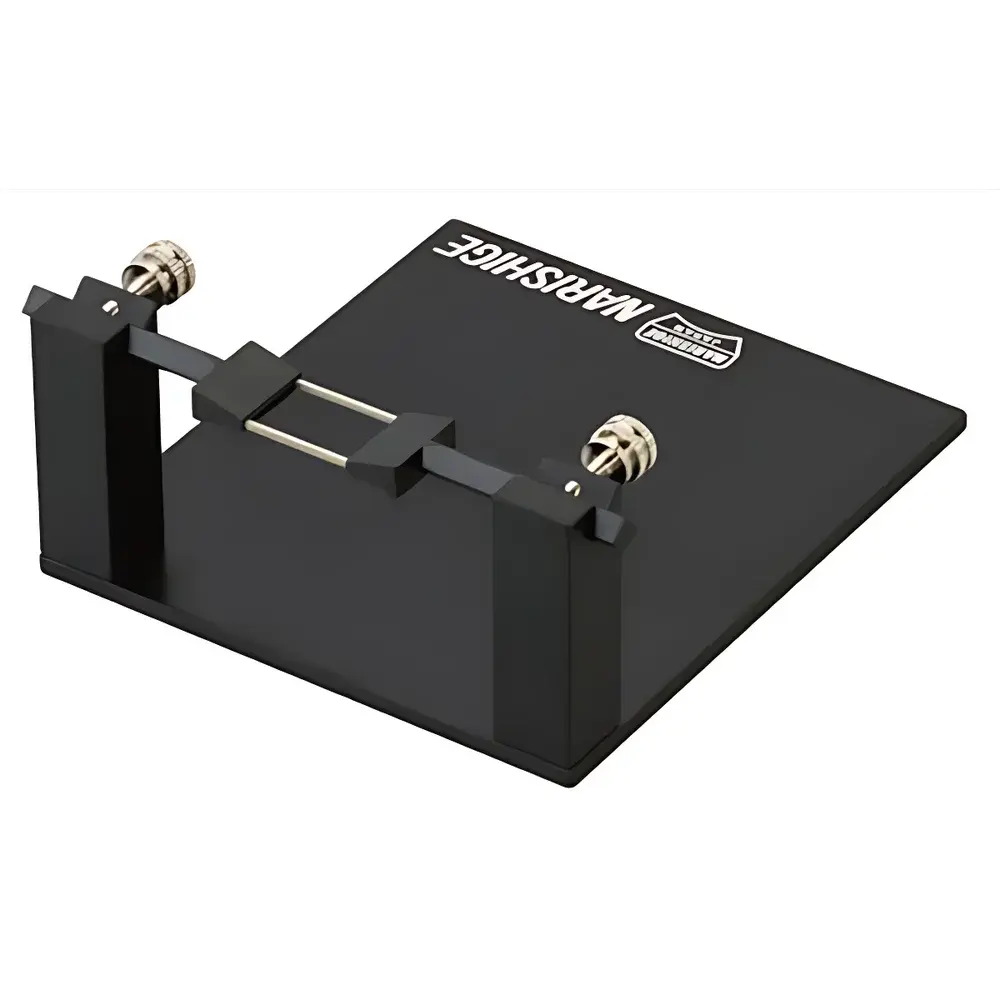
MAG-1 Compact Headplate Mounting Adapter for Stereotactic Surgery
| Brand | NARISHIGE |
|---|---|
| Origin | Japan |
| Model | MAG-1 |
| Dimensions (W×D×H) | 96 × 84 × 42 mm |
| Weight | Approx. 102 g |
Overview
The MAG-1 Compact Headplate Mounting Adapter is an engineered mechanical interface designed to facilitate post-surgical, high-precision in vivo optical imaging and electrophysiological experimentation in rodent neuroscience. Developed by NARISHIGE—a Japanese manufacturer with decades of expertise in micromanipulation and stereotactic instrumentation—the MAG-1 enables seamless transition of a surgically implanted cranial chamber from the SR-9M-HT stereotactic frame to downstream observation platforms. Its function is grounded in mechanical reproducibility: by maintaining fixed spatial registration between the implanted headplate and the chamber base, the MAG-1 preserves the coordinate integrity established during stereotactic alignment. This ensures that regions of interest (ROIs) targeted during surgery—such as cortical layers, thalamic nuclei, or hippocampal subfields—can be re-located with sub-millimeter consistency across multiple experimental sessions, including two-photon microscopy, confocal imaging, or patch-clamp recordings.
Key Features
- Compact footprint (96 × 84 × 42 mm) optimized for integration beneath objective lenses of upright two-photon microscopes and stereo microscopes without obstructing optical paths or stage travel.
- Lightweight aluminum alloy construction (approx. 102 g) minimizes mechanical load on microscope stages while ensuring dimensional stability under thermal drift conditions typical in long-duration imaging experiments.
- Direct compatibility with the NARISHIGE SR-9M-HT stereotactic frame and its associated headplate mounting system, enabling rapid transfer without manual realignment or recalibration.
- Included CF-10 chamber holder provides standardized, repeatable fixation for 3–5 mm diameter cranial windows or chronic imaging chambers, accommodating both glass coverslip-sealed and polymer-based implants.
- Tool-free, snap-fit mechanical coupling design reduces setup time and eliminates torque-induced misalignment risks common with screw-based adapters.
Sample Compatibility & Compliance
The MAG-1 supports standard mouse and rat craniotomy preparations using commercially available headplates (e.g., custom-machined titanium or stainless-steel plates with M2.6 or M3 threaded inserts). It is validated for use with widely adopted cranial window configurations—including 3 mm and 5 mm circular glass coverslips sealed with dental cement or biocompatible adhesives—and compatible with agarose/Kwik-Cast sealing protocols for acute or chronic preparations. While the device itself carries no active regulatory classification, its mechanical design aligns with GLP-compliant workflow principles for preclinical neuroimaging: traceable mounting repeatability, minimal operator-induced variability, and compatibility with ISO 13485-aligned surgical instrumentation ecosystems. It does not incorporate electronic components or software; therefore, it falls outside FDA 21 CFR Part 11 or IEC 62304 scope.
Software & Data Management
The MAG-1 is a passive mechanical adapter and contains no embedded firmware, sensors, or connectivity interfaces. Consequently, it requires no driver installation, calibration software, or data logging functionality. Its role is strictly physical: to preserve spatial fidelity between surgical targeting coordinates and imaging coordinates. Experimental metadata—including implant date, animal ID, stereotactic coordinates (AP/ML/DV), and chamber orientation—should be recorded manually or imported into LIMS-compatible databases (e.g., LabArchives, Quartzy) alongside imaging datasets. When used in conjunction with NARISHIGE’s digital stereotactic controllers (e.g., SM-15 or MO-10), coordinate logs generated during surgery may be cross-referenced with post-transfer imaging fields of view to validate positional retention within ±25 µm tolerance—consistent with published benchmarks for chronic cranial window reacquisition.
Applications
- Longitudinal two-photon calcium imaging of neuronal ensembles across days to weeks.
- Chronic in vivo patch-clamp recordings requiring precise electrode trajectory alignment relative to previously mapped dendritic arbors.
- Optogenetic stimulation combined with simultaneous volumetric imaging in awake, head-fixed preparations.
- Post-surgical verification of cannula or optic fiber placement via epifluorescence or infrared differential interference contrast (IR-DIC) microscopy.
- Validation of stereotactic injection spread using fluorescent tracers imaged at multiple depths through cleared or intact skull preparations.
FAQ
Is the MAG-1 compatible with stereotactic frames other than the SR-9M-HT?
No—it is mechanically dimensioned and threaded specifically for the SR-9M-HT’s headplate interface. Adapting it to alternative frames (e.g., David Kopf or Stoelting models) would require custom machining and void warranty.
Does the MAG-1 include a headplate or cranial chamber?
No—only the adapter body and the CF-10 chamber holder are included. Headplates, chambers, and surgical accessories must be sourced separately.
Can the MAG-1 be sterilized for repeated use?
Yes—autoclaving at 121 °C for 20 minutes is supported; however, repeated thermal cycling may affect long-term tolerance of the CF-10 holder’s snap-fit mechanism. Ethanol wipe disinfection is recommended for routine use.
What is the maximum working distance clearance beneath the MAG-1 when mounted on a standard microscope stage?
With the CF-10 holder installed, minimum clearance between the chamber base and the adapter’s lower surface is 12.5 mm—sufficient for most 40× water-immersion objectives with ≥2 mm working distance.
Is technical documentation available in English?
Yes—NARISHIGE provides bilingual (JP/EN) operation manuals, dimensional drawings, and compatibility matrices on their global support portal; no registration is required to access PDF downloads.



