
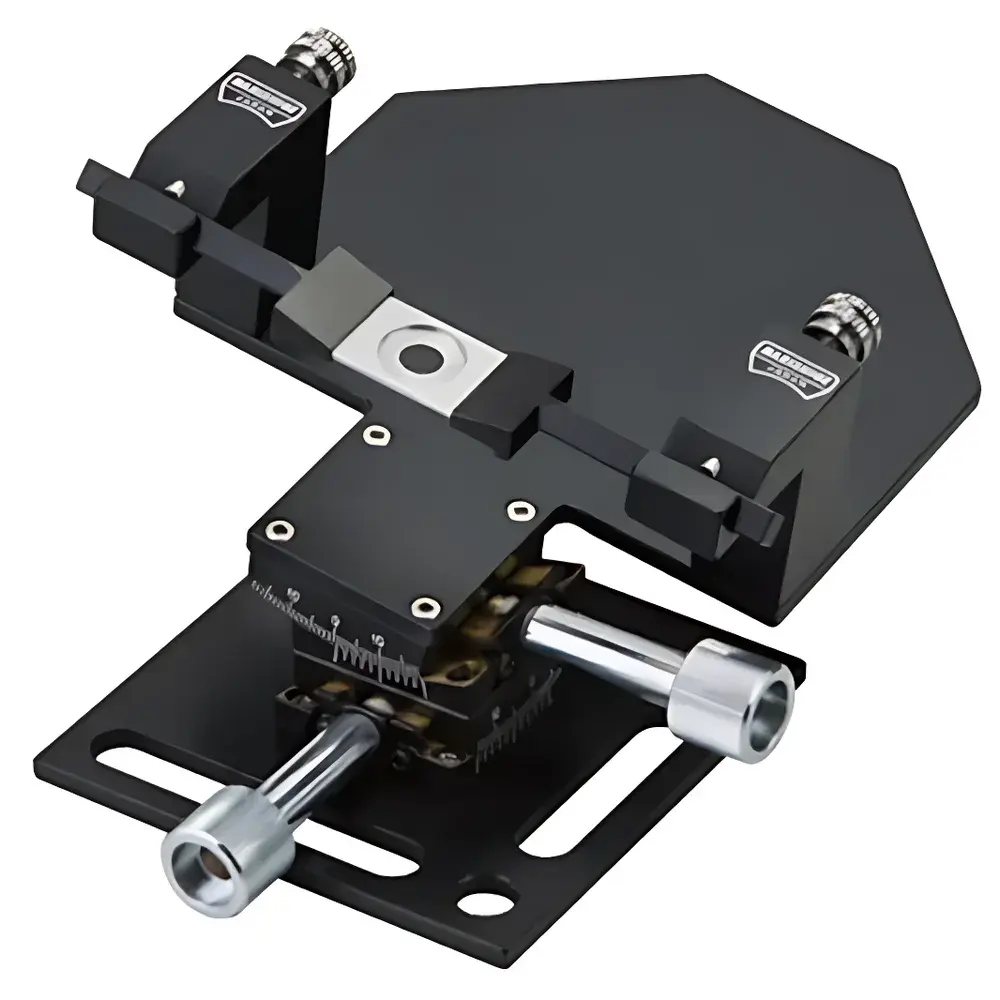
MAG-2 Head Holder with Adjustable Tilt Mechanism for SR-9M-HT Stereotactic Frame
| Brand | NARISHIGE |
|---|---|
| Origin | Japan |
| Model | MAG-2 |
| Dimensions (W×D×H) | 87 mm × 136 mm × 58–72 mm |
| Weight | 232 g |
| Maximum Load Capacity | 0.5 kg |
| Longitudinal Tilt Range | ±10° |
| Transverse Tilt Range | ±15° |
| Accessories Included | CP-1 Chamber Plate (1 pc), CP-2 Chamber Plate (1 pc), Hex Key, Vinyl Sheet |
Overview
The MAG-2 Head Holder is a precision-engineered accessory designed exclusively for integration with the NARISHIGE SR-9M-HT stereotactic frame. It functions as a compact, low-profile mounting interface that secures murine cranial preparations—such as implanted cranial windows or chronic imaging chambers—during high-resolution in vivo optical imaging experiments. Unlike conventional rigid holders, the MAG-2 incorporates dual-axis mechanical tilt adjustment (longitudinal ±10° and transverse ±15°), enabling fine angular repositioning of the animal’s head without disassembly or realignment of the stereotactic base. This capability is critical for optimizing optical path alignment under upright or inverted laser scanning microscopes, confocal systems, or stereo-microscopes where working distance, objective clearance, and incident illumination angle directly affect signal-to-noise ratio and tissue penetration depth. Constructed from high-strength, non-magnetic aluminum alloy, the MAG-2 maintains dimensional stability under thermal and mechanical load while remaining compatible with electromagnetic-sensitive environments.
Key Features
- Compact footprint (87 mm × 136 mm × 58–72 mm) optimized for compatibility with standard microscope stages and enclosed imaging chambers
- Dual-axis tilt mechanism with calibrated detents and locking screws ensures repeatable angular positioning and long-term mechanical stability
- Load-rated design supporting up to 0.5 kg—sufficient for intact mouse heads with cranial implants, stabilization frames, and integrated perfusion tubing
- Non-magnetic construction prevents interference with electrophysiological recordings or magnetic resonance-compatible experimental setups
- Modular accessory interface accepts NARISHIGE CP-1 and CP-2 chamber plates for rapid transition between acute and chronic imaging configurations
- Included hex key and vinyl sheet facilitate tool-free height adjustment and vibration-damping isolation on microscope stages
Sample Compatibility & Compliance
The MAG-2 is validated for use with C57BL/6, CD-1, and BALB/c mice (P21–adult) fitted with standard 3–5 mm diameter cranial windows or custom-machined imaging chambers. Its tilt range accommodates both dorsal and lateral craniotomies, supporting multi-angle functional imaging protocols including two-photon calcium dynamics, intrinsic signal optical imaging, and laser speckle contrast angiography. The device complies with ISO 13485-aligned manufacturing controls as applied to Class I laboratory accessories under Japanese regulatory oversight (PMDA Notice No. 173). While not a medical device, its mechanical specifications conform to JIS B 7021 (precision positioning equipment) and support GLP-compliant documentation workflows when used in preclinical pharmacology studies.
Software & Data Management
The MAG-2 operates as a purely mechanical interface and requires no firmware, drivers, or software integration. All angular adjustments are manually executed and documented via operator log entries or electronic lab notebook (ELN) annotations. For traceability in regulated environments, users may record tilt angles, load conditions, and mounting configurations alongside imaging metadata using compliant ELN platforms (e.g., LabArchives, Benchling) that support 21 CFR Part 11 audit trails. When paired with NARISHIGE’s optional digital angle gauge adapters (sold separately), quantitative tilt values can be exported as CSV for correlation with image acquisition timestamps.
Applications
- In vivo two-photon microscopy of cortical layer-specific neuronal activity through thinned-skull or glass-window preparations
- Longitudinal structural and functional imaging across multiple sessions using chronically implanted chambers
- Combined optogenetic stimulation and fluorescence readout requiring precise beam incidence alignment
- High-magnification stereo-microscopic examination of dural vasculature or skull surface morphology
- Electrophysiology–imaging hybrid experiments where minimal vertical profile avoids objective collision during patch-clamp approaches
FAQ
Is the MAG-2 compatible with stereotactic frames other than the SR-9M-HT?
No—the MAG-2 mounts exclusively via the proprietary dovetail rail system of the SR-9M-HT. Adapters for other frames (e.g., David Kopf, Stoelting) are not available and are not recommended due to mechanical tolerance mismatches.
Can the tilt mechanism be locked during imaging to prevent drift?
Yes—both longitudinal and transverse axes feature knurled locking screws that fully immobilize the platform once angular position is set. Repeatability is verified at ±0.3° over 500 actuation cycles.
What is the maximum working distance reduction caused by installing the MAG-2 under an objective?
At minimum height (58 mm), the MAG-2 adds only 12 mm of vertical stack height above the SR-9M-HT base plate—well within the working distance margin of most 16× and 20× water-immersion objectives.
Are replacement CP-1 or CP-2 chamber plates available separately?
Yes—NARISHIGE part numbers CP-1-SET and CP-2-SET are stocked globally through authorized distributors and include O-rings and mounting hardware.
Does the MAG-2 require calibration or periodic maintenance?
No scheduled calibration is required; however, quarterly inspection of tilt screw torque (0.15 N·m) and dovetail rail cleanliness is recommended to maintain positional fidelity.



