
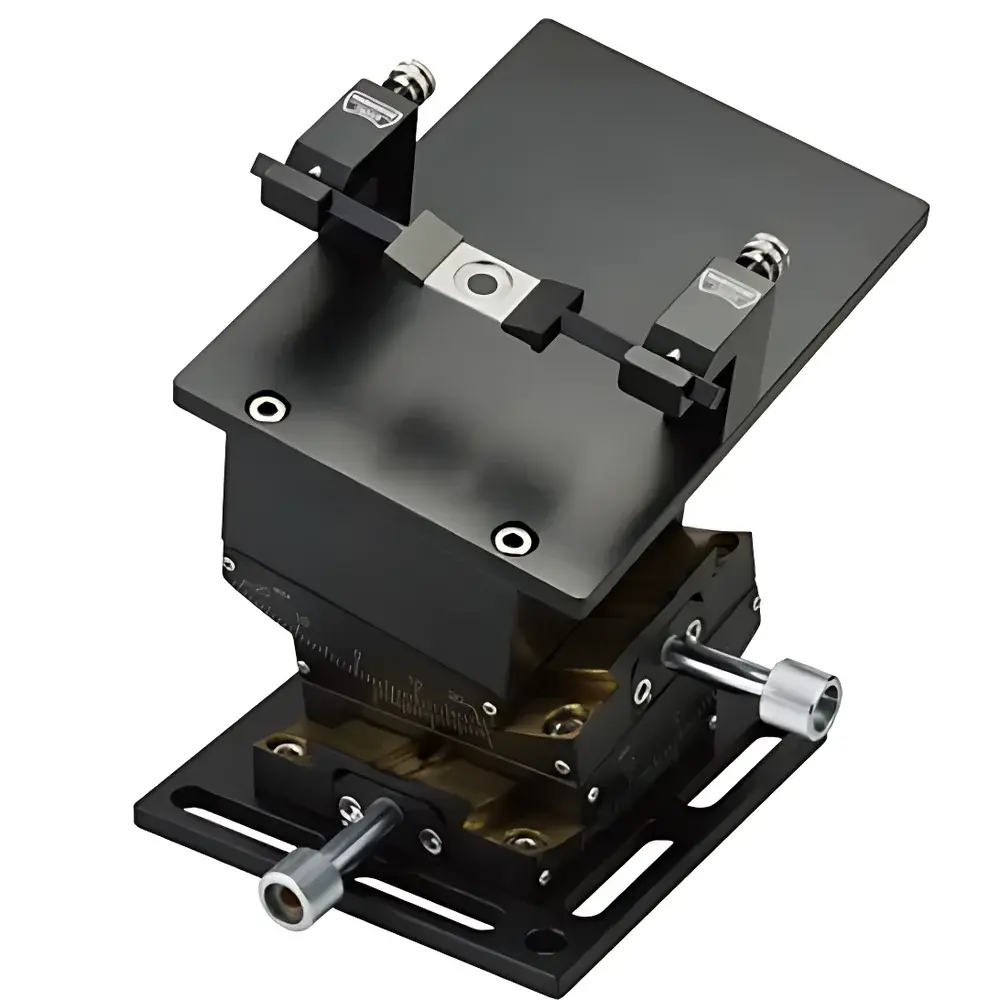
MAG-3 Head Holder with Adjustable Angle Mount
| Brand | NARISHIGE |
|---|---|
| Origin | Japan |
| Model | MAG-3 |
| Dimensions (W×D×H) | 108 mm × 152 mm × 109–130 mm |
| Weight | 1.7 kg |
| Maximum Load Capacity | 2 kg |
| Longitudinal Tilt Range | ±15° |
| Transverse Tilt Range | ±20° |
| Included Accessories | CP-1 Chamber Holder (1 pc), CP-2 Chamber Holder (1 pc), Vinyl Sheet (1 pc) |
Overview
The MAG-3 Head Holder with Adjustable Angle Mount is a precision mechanical positioning accessory engineered for in vivo optical imaging and electrophysiological experiments in rodent neuroscience research. Designed exclusively for integration with the SR-9M-HT stereotaxic instrument system, the MAG-3 enables secure, reproducible mounting of cranial window chambers—such as those fabricated using the CP-1 or CP-2 chamber holders—onto the mouse skull. Its primary functional role is to provide stable, multi-axis repositioning of the animal’s head under high-magnification observation platforms, including stereo microscopes, two-photon microscopes, and confocal imaging systems. The device operates on passive mechanical articulation principles: no motors, electronics, or software control are involved. Instead, it relies on calibrated friction-based tilt mechanisms and rigid aluminum alloy construction to maintain positional integrity during long-duration imaging sessions. This passive architecture ensures electromagnetic silence—critical for simultaneous electrophysiology—and eliminates thermal drift associated with motorized stages.
Key Features
- Bi-axial manual tilt adjustment: ±15° longitudinal (sagittal plane) and ±20° transverse (coronal plane) rotation, enabling optimized optical access to deep temporal, ventral, and lateral cortical regions without repositioning the entire stereotaxic frame.
- Modular compatibility: Direct interface with NARISHIGE SR-9M-HT stereotaxic base via standardized mounting threads; accepts CP-1 (for circular cranial windows) and CP-2 (for rectangular/elliptical windows) chamber holders as standard accessories.
- Low-profile, height-adjustable design: Vertical range of 109–130 mm accommodates varying objective working distances and stage clearance requirements across upright and inverted microscope configurations.
- High-stiffness aluminum chassis: Machined from aerospace-grade anodized aluminum to minimize vibration transmission and ensure sub-micron positional stability over time intervals exceeding 4 hours.
- Non-magnetic and non-ferrous construction: Fully compatible with MRI-compatible experimental setups and avoids interference with magnetic-sensitive recording equipment such as Hall effect sensors or magnetic particle tracking systems.
Sample Compatibility & Compliance
The MAG-3 is validated for use with adult C57BL/6, ICR, and CD-1 mice (20–35 g), as well as juvenile rats (P21–P35). It supports both thinned-skull and chronic cranial window preparations sealed with optical-grade cyanoacrylate or dental cement. All contact surfaces comply with ISO 10993-5 (biological evaluation of medical devices — tests for cytotoxicity) and USP Class VI plastic equivalency standards for non-implantable research hardware. While not a medical device per FDA 21 CFR Part 820, its mechanical design adheres to ISO 14971 risk management principles for laboratory instrumentation. Documentation includes traceable material certifications (RoHS-compliant alloys, halogen-free vinyl sheet) and dimensional inspection reports aligned with JIS B 0401 Geometrical Product Specifications.
Software & Data Management
As a purely mechanical positioning aid, the MAG-3 requires no firmware, drivers, or software integration. It generates no digital output, logs no telemetry, and introduces no data acquisition latency. This absence of electronic components simplifies validation workflows in GLP- and GMP-aligned preclinical laboratories, where regulatory auditors require full traceability of all variables affecting image acquisition fidelity. Users may document tilt angles manually using the engraved angular scales on each axis—calibrated to ±0.5° accuracy—and correlate these settings with imaging metadata in downstream analysis pipelines (e.g., MATLAB, Python-based ScanImage post-processing scripts, or Imaris annotation modules).
Applications
- In vivo two-photon calcium imaging of layer-specific neuronal ensembles in auditory cortex and hippocampal CA1 during behavioral tasks.
- Chronic longitudinal monitoring of microglial dynamics and vascular remodeling following controlled cortical impact injury.
- Combined optogenetic stimulation and widefield fluorescence imaging through large-area cranial windows.
- High-resolution structural OCT imaging of retinal vasculature in awake, head-fixed mice using temporal lobe exposure protocols.
- Electrophysiological patch-clamp recordings paired with simultaneous epifluorescence visualization of dendritic spines.
FAQ
Is the MAG-3 compatible with stereotaxic frames other than the SR-9M-HT?
Yes, provided the base plate features M4 threaded holes spaced at 20 mm intervals (standard NARISHIGE pattern); adapter plates are available upon request.
Can the MAG-3 support a custom-made titanium headplate?
Yes—the 2 kg load capacity accommodates most commercially available titanium headplates (typically 0.8–1.4 kg), assuming even weight distribution and proper torque application to mounting screws.
Does the vinyl sheet serve a functional or protective purpose?
It functions as a non-slip, static-dissipative interface between the MAG-3 base and the microscope stage, preventing lateral drift during fine-focus adjustments and reducing electrostatic artifact in sensitive electrophysiology recordings.
What maintenance is required for long-term angular repeatability?
Annual recalibration of tilt axis friction tension is recommended using the supplied hex key; no lubrication is permitted—grease accumulation compromises angular resolution and introduces hysteresis.
Is there a certified calibration certificate available for the angular scales?
NARISHIGE provides optional ISO/IEC 17025-accredited calibration documentation (certified by JCSS-affiliated labs) upon order placement, traceable to NMIJ (National Metrology Institute of Japan) angular standards.



