
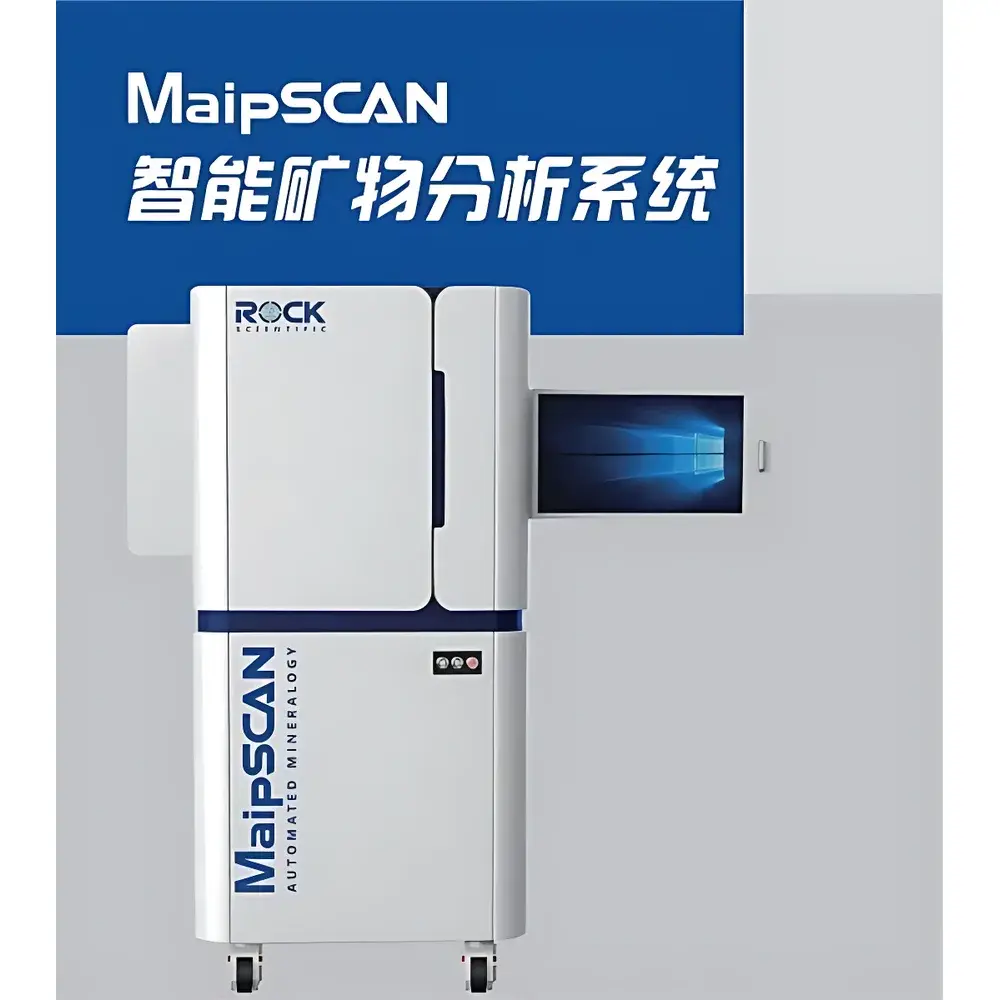
MaipSCAN Intelligent Mineralogy Analysis System by ROCK
| Brand | ROCK |
|---|---|
| Origin | Hong Kong, China |
| Model | MaipSCAN |
| Instrument Type | Floor-standing SEM |
| Electron Source | Tungsten Filament |
| Secondary Electron Resolution | 3.0 nm @ 30 kV (SE and W) |
| Magnification Range | 7× – 1,000,000× |
| Accelerating Voltage | 0.2 – 30 kV |
| Backscattered Electron Resolution | 4.0 nm @ 30 kV (VP mode with BSD) |
Overview
The MaipSCAN Intelligent Mineralogy Analysis System is a purpose-built, floor-standing scanning electron microscope (SEM) platform engineered for integrated quantitative mineralogical, elemental, microstructural, and petrophysical characterization of geological samples. Unlike conventional analytical workflows that require sequential use of XRD, XRF, optical microscopy, and nuclear magnetic resonance—each introducing sampling bias, time lag, and data misalignment—MaipSCAN unifies high-resolution imaging, energy-dispersive X-ray spectroscopy (EDS), and AI-driven mineral phase identification within a single vacuum chamber and synchronized acquisition framework. Its core measurement principle combines backscattered electron (BSE) contrast imaging with real-time EDS spectral mapping, enabling simultaneous pixel-level correlation between atomic number (Z-contrast), elemental composition, and crystalline phase distribution. Designed specifically for upstream geoscience applications, MaipSCAN operates under variable pressure (VP) mode to accommodate non-conductive, uncoated rock specimens—including drill cuttings, core plugs, and thin sections—without compromising spatial resolution or quantitative fidelity.
Key Features
- High-stability tungsten thermionic electron source delivering consistent beam current over extended acquisition sessions, optimized for routine field-deployable operation in non-laboratory environments (e.g., rig sites, core logging units).
- Dual-mode imaging capability: high-resolution secondary electron (SE) imaging at 3.0 nm @ 30 kV and variable-pressure backscattered electron (BSE) imaging at 4.0 nm @ 30 kV with integrated backscattered detector (BSD), enabling robust topographic and compositional contrast on heterogeneous, porous, and low-conductivity samples.
- Wide accelerating voltage range (0.2–30 kV) supports both surface-sensitive low-kV analysis (e.g., clay morphology, organic matter distribution) and deep-penetration high-kV quantification (e.g., heavy mineral identification, bulk matrix composition).
- Integrated hardware-software co-design: synchronized EDS spectrum acquisition with BSE/SE image capture ensures strict pixel-to-spectrum registration, eliminating spatial drift artifacts common in post-acquisition correlative workflows.
- Ruggedized mechanical architecture compliant with ISO 14644-1 Class 8 cleanroom standards and equipped with active vibration damping, enabling stable operation in mobile labs, offshore containers, and active drilling facilities.
Sample Compatibility & Compliance
MaipSCAN accepts uncoated, non-conductive geological specimens without metallization—eliminating sample preparation bottlenecks associated with traditional SEM. It accommodates drill cuttings (≥50 µm fragments), whole-round core segments (up to Ø10 cm × 25 cm), polished thin sections (standard 27 mm × 46 mm), and sidewall core plugs. All analytical protocols are traceable to ASTM D7928 (Standard Test Method for Particle-Size Distribution of Soil Using Laser Diffraction), ISO 13322-2 (Particle size analysis — Image analysis methods), and USP (Analytical Instrument Qualification). Data acquisition and reporting modules comply with ALCOA+ principles and support audit trails required for GLP and GMP-aligned workflows per FDA 21 CFR Part 11 when deployed in regulated reservoir evaluation laboratories.
Software & Data Management
The MaipSCAN software suite comprises three interoperable modules: Inspector (acquisition control), RockSTDManager (mineral library curation and AI classification), and iCustomer (quantitative analytics and reporting). Inspector enables rapid parameter presetting for standardized workflows—including automated stage navigation, multi-region-of-interest (ROI) stitching, and live EDS map preview. RockSTDManager hosts a proprietary mineral identification engine trained on >12,000 reference spectra from the International Centre for Diffraction Data (ICDD) and regional sedimentary basins; it supports user-defined mineral libraries, adaptive thresholding for smectite/illite differentiation, and uncertainty-aware phase assignment. iCustomer delivers end-to-end digital rock physics processing: grain boundary detection, pore-throat network extraction, mineral-specific elastic modulus estimation via Voigt-Reuss-Hill averaging, and brittleness index calculation per API RP 19B. All modules generate FAIR-compliant (Findable, Accessible, Interoperable, Reusable) HDF5 datasets with embedded metadata, compatible with Petrel, Techlog, and internal reservoir simulation platforms.
Applications
- Geological Interpretation: High-fidelity mineral maps enable lithofacies classification, provenance analysis, diagenetic sequence reconstruction, and sweet spot delineation using combined quartz/feldspar/clay ratios, carbonate cement abundance, and authigenic clay texture.
- Well Log Calibration: Quantitative mineral volumes serve as ground-truth constraints for neutron-density crossplots and improve inversion accuracy of sonic and resistivity logs in unconventional shale plays.
- Geomechanical Modeling: Microstructure-derived parameters—including crack density (weak-plane index), pore aspect ratio distribution, and mineral stiffness heterogeneity—are directly input into discrete element modeling (DEM) and finite element analysis (FEA) for borehole stability assessment and hydraulic fracture propagation simulation.
- Reservoir Quality Prediction: Pore network topology metrics (e.g., coordination number, throat radius distribution, tortuosity) correlate with permeability anisotropy and capillary pressure behavior, supporting static-dynamic model integration.
FAQ
Can MaipSCAN analyze uncoated drill cuttings without carbon or gold sputtering?
Yes. Its variable-pressure (VP) mode allows imaging and EDS acquisition on native, non-conductive cuttings at water vapor pressures up to 200 Pa, eliminating coating artifacts and preserving surface chemistry integrity.
Does the system support batch processing of multiple core samples?
Yes. iCustomer’s workflow automation engine enables unattended multi-sample sequencing—including stage positioning, focus optimization, EDS map acquisition, and phase segmentation—with configurable quality-control checkpoints.
How does MaipSCAN ensure mineral identification accuracy for mixed-layer clays?
RockSTDManager applies a multi-spectral deconvolution algorithm that resolves overlapping Kα peaks (e.g., Al-Kα/Si-Kα interference) and incorporates crystallographic symmetry constraints from ICDD PDF-4+ database entries to assign probable polytype configurations.
Is remote operation supported for field deployment?
Yes. The system includes secure TLS-encrypted VNC-based remote desktop access, real-time telemetry streaming, and role-based user permissions aligned with ISO/IEC 27001 information security standards.
What calibration standards are supplied with the instrument?
ROCK provides NIST-traceable Si, Cu, and Co reference materials for EDS energy calibration, certified Fe–Ni alloy standards for quantitative ZAF correction, and certified alumina/silica particle size standards for resolution verification per ISO 13322-2 Annex A.





