
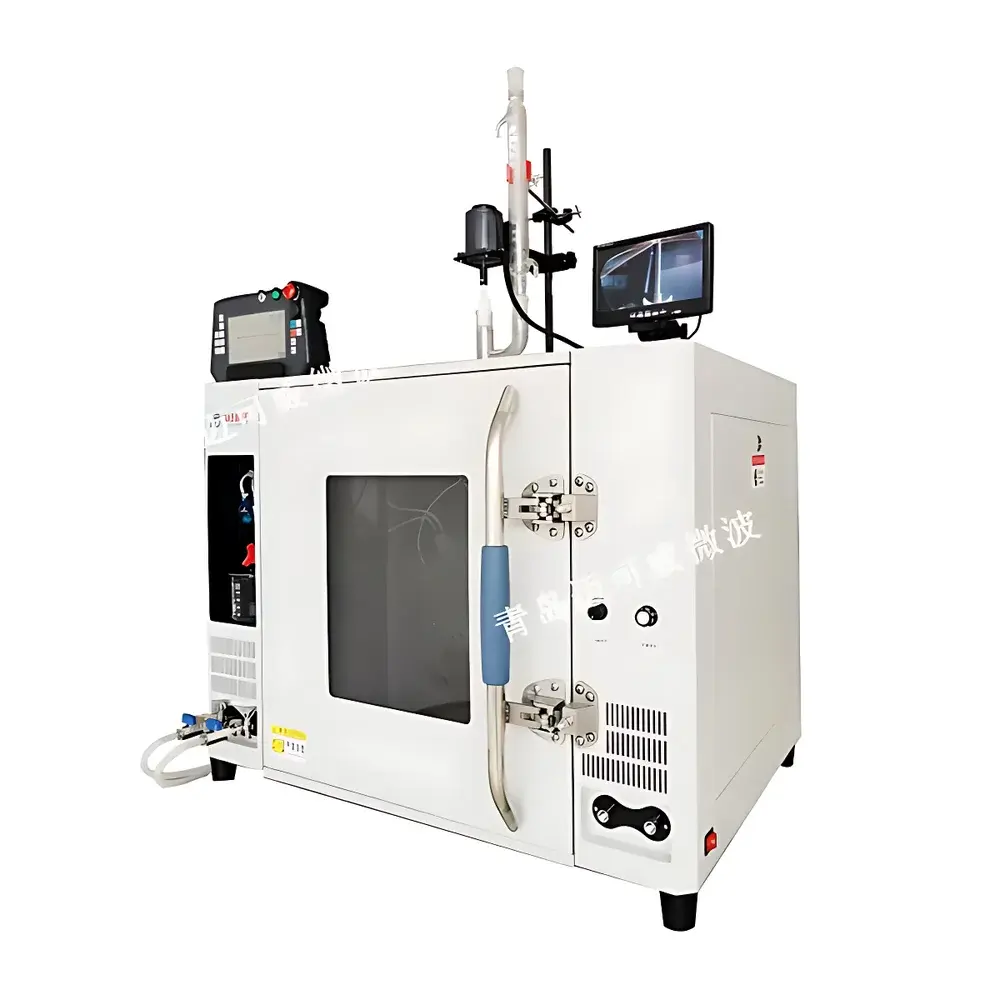
MakeWave MKD-H4C1 Large-Volume Open-Mode Microwave Chemical Reactor
| Brand | MakeWave |
|---|---|
| Origin | Shandong, China |
| Manufacturer Type | Direct Manufacturer |
| Country of Origin | China |
| Model | MKD-H4C1 |
| Price Range | USD 14,000–21,000 (FOB) |
| Usable Volume | 80 L |
| Construction Material | 304 Stainless Steel |
| Operating Pressure | Atmospheric (0.1 MPa nominal) |
| Vacuum Capability | Not applicable (open-mode design) |
| Microwave Frequency | 2450 MHz |
| Rated Microwave Power | 4000 W (continuously adjustable, non-pulsed) |
| Max. Operating Temperature | 300 °C |
| Cooling Requirement | External chilled water supply for condenser |
| Safety Compliance | Microwave leakage < 5 mW/cm² (per GB 10436 & IEC 61000-3-2) |
| Weight | 100 kg |
| Dimensions (Main Unit) | 900 × 920 × 600 mm (W × H × D) |
| Top Support Frame Height | +500 mm |
| Certifications | ISO 9001 certified |
Overview
The MakeWave MKD-H4C1 is an engineered open-mode microwave chemical reactor designed for scalable, atmospheric-pressure synthesis and extraction under controlled microwave irradiation. Unlike sealed-vessel systems, this platform operates exclusively at ambient pressure—eliminating risks associated with high-pressure containment while enabling direct integration of standard laboratory glassware (e.g., 10 L three-neck flasks), reflux condensers, sampling lines, and external cooling circuits. Its core principle relies on dielectric heating: microwave energy (2450 MHz, up to 4000 W continuous output) couples directly with polar molecules and ionic species in the reaction mixture, inducing rapid, volumetric thermal activation. This mechanism accelerates reaction kinetics, reduces required thermal setpoints, improves selectivity in multistep transformations, and facilitates reactions inaccessible via conventional conductive heating—particularly in heterogeneous catalysis, solid–liquid extractions, and thermally sensitive biomolecule modifications.
Key Features
- 80 L open reaction chamber: Constructed from welded 304 stainless steel with multi-layer PTFE coating for corrosion resistance against strong acids, bases, and oxidants; internal dimensions 410 × 480 × 410 mm (H = 480 mm accommodates tall-neck vessels and vertical condenser assemblies).
- Dual-mode agitation: Simultaneous mechanical (PTFE-coated anchor impeller, variable-speed motor) and magnetic stirring (PTFE-encapsulated stir bar) ensures homogeneous mixing across high-viscosity or particulate-laden media.
- Integrated reflux and circulation: Compatible with external condensers for solvent recovery; built-in peristaltic pump enables continuous internal recirculation—critical for uniform temperature distribution and real-time homogenization in large-volume batches.
- In-process sampling capability: Sterile, leak-tight sampling port allows non-interruptive withdrawal during active irradiation—enabling kinetic profiling, intermediate analysis, and yield estimation without process termination.
- Real-time monitoring suite: LED cavity illumination + high-resolution color video camera (mounted behind quartz observation window) provides visual confirmation of boiling behavior, phase separation, precipitation, or foam formation.
- PLC-based intelligent control: Touchscreen HMI displays synchronized time–temperature–power curves; supports up to 20 programmable protocols with independent ramp/hold segments, data logging (CSV export), and audit-trail-ready parameter history.
Sample Compatibility & Compliance
The MKD-H4C1 accepts standard borosilicate glass reactors (up to 10 L capacity), including round-bottom flasks, jacketed vessels, and custom-fitted multi-port assemblies. It is routinely deployed in organic synthesis (cross-coupling, esterification, cyclization), inorganic nanomaterial synthesis (metal oxide nanoparticles, MOFs), natural product extraction (polyphenols, alkaloids), polymer grafting, and agrochemical formulation development. The system complies with ISO 9001:2015 quality management standards and meets national electromagnetic safety limits (GB 10436-2008) with verified microwave leakage < 5 mW/cm² at 5 cm distance. While not intrinsically rated for hazardous area use (ATEX/IECEx), it incorporates dual interlock door switches, λ/4 choke joint shielding, and emergency venting fans—satisfying baseline lab safety requirements per ANSI Z9.5 and EU Directive 2014/30/EU (EMC).
Software & Data Management
Control firmware implements deterministic PLC logic with timestamped event logging—including power modulation events, temperature deviations (>±2 °C threshold), door status transitions, and alarm triggers. All operational data (time-stamped temperature, actual microwave output %, stir speed, video timestamps) are stored locally on industrial-grade SD card and exportable via USB interface. The system supports CSV-formatted datasets compatible with MATLAB, OriginLab, and JMP for kinetic modeling and DOE analysis. Though not FDA 21 CFR Part 11–compliant out-of-the-box, optional validation packages (IQ/OQ documentation, electronic signature modules, and audit trail encryption) are available upon request for GLP/GMP-regulated environments.
Applications
- High-throughput catalyst screening under microwave-assisted conditions
- Solvent-free or low-solvent oxidative degradation studies of polymers and composites
- Scale-up feasibility testing for pharmaceutical API synthesis (non-GMP pilot stage)
- Continuous-flow assisted batch extraction of heat-labile phytochemicals
- Hydrothermal carbonization of biomass feedstocks (lignocellulose, algae)
- Surface functionalization of metal oxides for sensor and battery electrode development
- Educational demonstration of non-thermal microwave effects in radical chemistry
FAQ
Can the MKD-H4C1 operate under vacuum or inert gas?
No—it is strictly an open-mode, atmospheric-pressure system. For inert atmosphere work, users must integrate external nitrogen/vacuum manifolds upstream of the reactor vessel; however, no built-in gas purging or vacuum pumping is provided.
Is the 80 L volume usable for liquid reaction mass?
The 80 L refers to internal cavity volume—not maximum liquid fill. Maximum recommended working volume is 10 L (in standard glassware) or up to 30 L with optional custom reactor configurations; overfilling compromises microwave coupling uniformity and safety margins.
What cooling infrastructure is required?
A dedicated chilled water circuit (5–15 °C, ≥20 L/min flow rate) must be connected to the external condenser. The unit itself does not include a chiller; only water inlet/outlet ports are provided.
Does the system support remote operation or network connectivity?
Standard configuration includes local touchscreen control only. Ethernet or RS-485 Modbus RTU interfaces can be added as factory options for SCADA integration.
What maintenance intervals are recommended?
PTFE cavity coating inspection every 6 months; stir motor lubrication annually; microwave waveguide gasket replacement every 2 years or after 2000 operating hours—whichever occurs first.



