
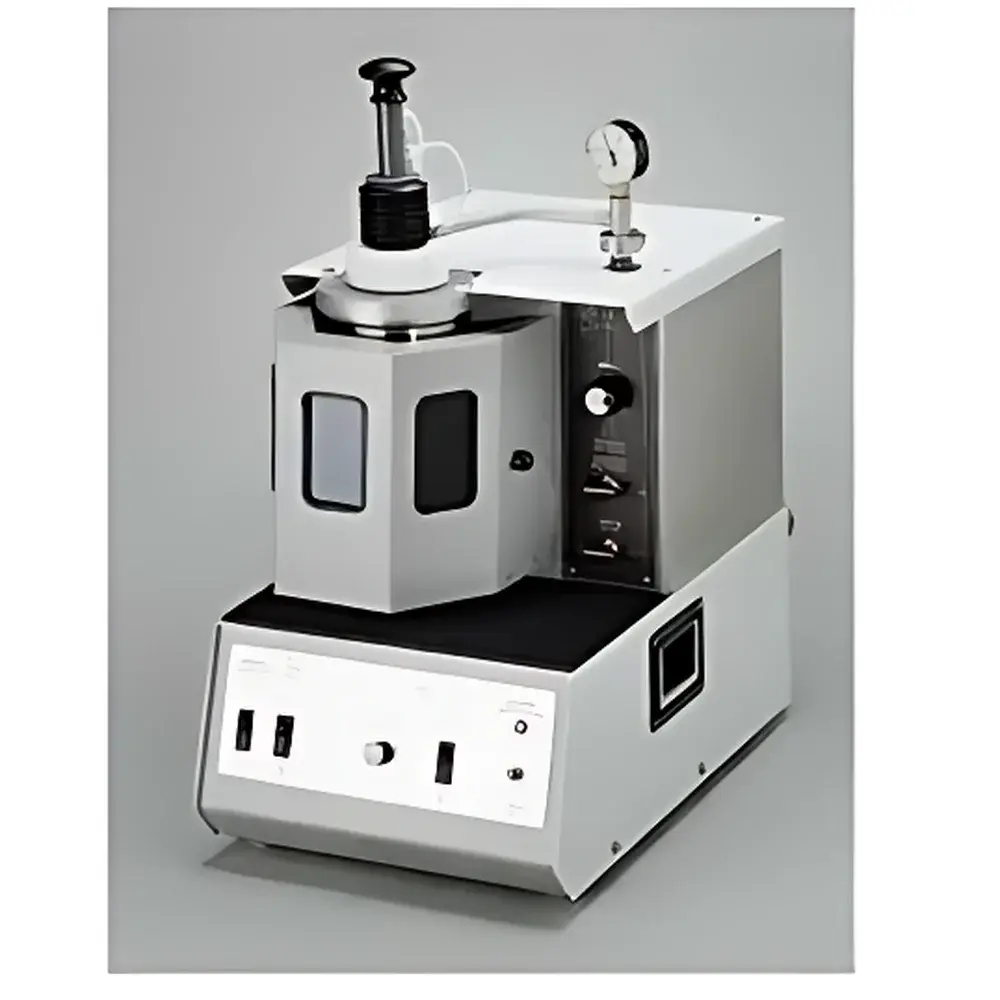
MAM High-Temperature Arc Melting Furnace
| Origin | Germany |
|---|---|
| Manufacturer Type | Distributor |
| Origin Category | Imported |
| Model | MAM |
| Pricing | Upon Request |
Overview
The MAM High-Temperature Arc Melting Furnace is a precision-engineered, vacuum-compatible arc melting system designed for controlled synthesis and homogenization of refractory metals, intermetallics, and ceramic compounds under inert atmosphere. Based on direct-current (DC) arc discharge between a water-cooled tungsten electrode and a copper crucible base, the furnace generates localized plasma temperatures up to 4000 °C—enabling full melting of high-melting-point materials including TiAl, TiZrNiCu, V–Mo alloys, and even Al₂O₃-based ceramics. Its robust architecture supports both research-scale alloy development and routine quality control in metallurgy, nuclear materials, and advanced functional material laboratories. The system operates within a sealed, argon-purged chamber (up to 1.3 bar overpressure), with integrated vacuum capability down to 5 × 10⁻⁴ mbar—ensuring minimal oxidation and high compositional fidelity during melt processing.
Key Features
- DC arc power supply with adjustable current range from 3 A to 180 A (max. 200 A continuous), delivering stable, reproducible plasma initiation and sustained melting energy;
- Water-cooled tungsten electrode and detachable water-cooled copper crucible plate—designed for thermal stability, rapid cooldown, and ease of sample loading/cleaning;
- Integrated safety interlocks: automatic arc shutdown upon exceeding preset crucible temperature threshold or opening of the protective viewing shield;
- High-integrity vacuum chamber (1.1 dm³ volume) with KF16 flange interface, leak rate ≤1 × 10⁻⁶ mbar·L/s, and operational pressure range from 0 to 2000 mbar (vacuum to overpressure);
- Compact footprint (650 × 400 × 770 mm) and modular design—facilitating integration into ISO-classified labs or glovebox-coupled workflows;
- Onboard vacuum pump (1.8 m³/h nominal pumping speed, ultimate vacuum 1.5 × 10⁻³ mbar) with dedicated slow-blow fuse protection (16 A) and three-phase 380 V/50 Hz input (5.3 kVA max);
- Multiple crucible configurations included: one Ø25 mm, three Ø8 mm, and one rectangular 8 × 30 mm—supporting diverse sample geometries and batch sizes (10–20 g per melt);
- Open-circuit DC voltage of 85 V ensures reliable arc ignition via brief tungsten-to-copper contact—eliminating need for high-voltage starters or complex gas pre-ionization.
Sample Compatibility & Compliance
The MAM furnace accommodates reactive, oxygen-sensitive, and ultra-high-melting materials—including but not limited to titanium aluminides, zirconium-nickel-copper intermetallics, vanadium–molybdenum solid solutions, and oxide ceramics. Its argon-purged environment (with optional gas flow regulation) meets ASTM E885-22 requirements for inert-atmosphere metal melting and complies with ISO 15510:2021 (stainless steels—chemical composition) for compositional homogeneity verification post-melt. The system’s vacuum integrity, pressure monitoring, and thermal cutoffs align with IEC 61000-6-2/6-4 electromagnetic compatibility standards and support GLP-compliant documentation when paired with external data loggers. While not FDA-certified as standalone equipment, its design enables traceable process parameters required for GMP-aligned R&D in medical implant alloy development.
Software & Data Management
The MAM furnace operates as a manually controlled analog system without embedded firmware or digital HMI. All process parameters—including arc current (monitored via shunt resistor), chamber pressure (via analog Bourdon gauge and needle valve), cooling water flow (1.5 L/min minimum, verified by inline flowmeter), and elapsed melt time—are recorded externally using calibrated lab instrumentation. For audit-ready workflows, users may integrate third-party data acquisition systems (e.g., National Instruments DAQmx or LabVIEW) to log current, temperature (via optional thermocouple feedthrough), and pressure signals with timestamped CSV export. This architecture satisfies 21 CFR Part 11 requirements when configured with electronic signature-capable software and secure audit trails.
Applications
- Synthesis of prototype intermetallic alloys for aerospace turbine components;
- Preparation of master alloy ingots for subsequent casting or additive manufacturing feedstock;
- Homogenization of multi-element powder blends prior to XRD or SEM-EDS analysis;
- Rapid screening of phase formation in refractory high-entropy alloys (HEAs);
- Melting and consolidation of ceramic–metal composites under controlled redox conditions;
- Recovery and reprocessing of spent nuclear fuel simulants in shielded hot-cell environments (when adapted with remote handling interfaces).
FAQ
What is the maximum recommended single-melt duration?
Typical melt cycles are limited to ≤3 minutes to prevent excessive thermal stress on the copper crucible and maintain electrode geometry integrity.
Can the system operate under vacuum only—without inert gas backfill?
Yes; the furnace achieves base vacuum down to 5 × 10⁻⁴ mbar and supports melt processing in high vacuum, though inert gas purging is strongly recommended for reactive metals.
Is the tungsten electrode replaceable—and what is its typical service life?
Electrodes are user-replaceable consumables; lifetime depends on current density and melt frequency—typically 50–100 melts at ≤120 A before noticeable tip erosion affects arc stability.
Does the system include vacuum pump oil and coolant specifications?
The integrated pump uses standard mineral-based rotary vane oil (ISO VG 68); cooling water must be deionized with ≤50 µS/cm conductivity and maintained at 10–25 °C ambient inlet temperature.
Are custom crucible geometries available beyond the standard set?
Yes; bespoke water-cooled copper crucibles—including rod-shaped “cold crucibles” for directional solidification—can be supplied as optional accessories upon engineering review.



