
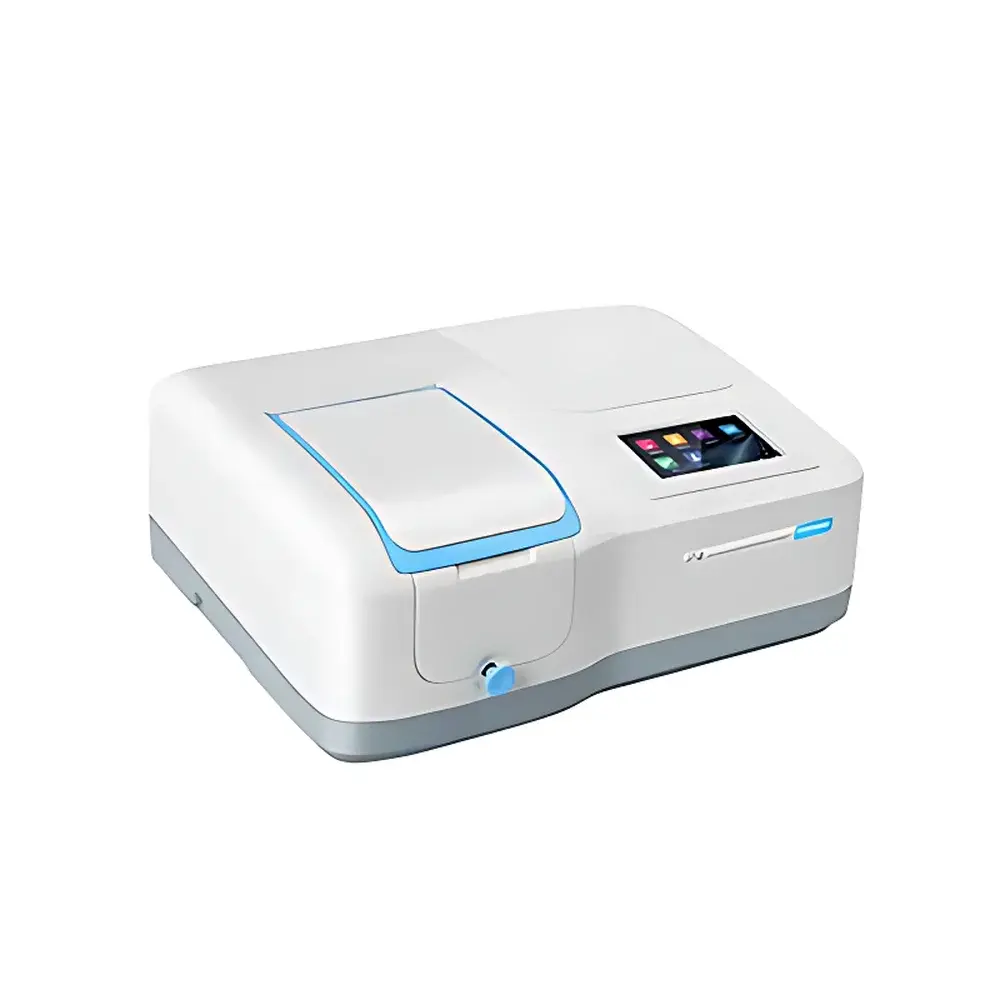
Mapada P4 Single-Beam Ultraviolet-Visible Spectrophotometer
| Brand | Mapada |
|---|---|
| Origin | Shanghai, China |
| Manufacturer Type | Original Equipment Manufacturer (OEM) |
| Product Origin | Domestic (China) |
| Model | P4 |
| Price Range | USD 2,800 – 4,200 (FOB Shanghai) |
| Optical Configuration | Single-Beam |
| Detector Type | Silicon Photocell |
| Wavelength Range | 190 – 1100 nm |
| Wavelength Scanning Mode | Motorized Automatic Wavelength Drive |
| Spectral Bandwidth | 2 nm |
| Wavelength Accuracy | ±0.5 nm |
Overview
The Mapada P4 Single-Beam Ultraviolet-Visible Spectrophotometer is an entry-level yet robust analytical instrument engineered for routine quantitative and qualitative analysis in academic teaching laboratories, quality control environments, and small-scale R&D settings. It operates on the fundamental principle of Beer–Lambert law-based absorbance measurement, utilizing a single-beam optical architecture with a fixed-path monochromator to isolate discrete wavelengths across the ultraviolet (190 nm), visible (400–700 nm), and near-infrared (700–1100 nm) spectral regions. The system employs a high-stability tungsten-halogen lamp for visible/NIR output and a deuterium arc lamp for UV emission, ensuring continuous spectral coverage from 190 nm to 1100 nm without manual lamp switching. Its 2 nm spectral bandwidth provides sufficient resolution for standard applications such as concentration determination of nucleic acids, proteins, dyes, and pharmaceutical intermediates, while maintaining signal-to-noise performance suitable for classroom instruction and basic compliance testing.
Key Features
- Motorized automatic wavelength scanning with precision stepper-motor-driven grating positioning, enabling reproducible spectral acquisition without manual adjustment.
- Integrated dual-lamp source system (deuterium + tungsten-halogen) with automatic lamp selection logic based on set wavelength — no user intervention required during cross-UV/VIS/NIR measurements.
- Silicon photocell detector offering stable responsivity, low dark current, and adequate dynamic range for transmittance (0–100%T) and absorbance (0–3.0 A) measurements.
- Dedicated firmware with built-in calibration routines including wavelength verification using holmium oxide or didymium filters (per ISO 6326-1 and ASTM E275), and photometric linearity validation via neutral density filters.
- Compact benchtop design (320 × 320 × 180 mm) with front-panel keypad and LCD display; supports direct operation without external PC connection.
- Compliance-ready architecture: All calibration events, zero/baseline corrections, and measurement logs are timestamped and stored internally — supporting GLP documentation requirements in regulated educational and industrial labs.
Sample Compatibility & Compliance
The P4 accommodates standard 10 mm pathlength quartz or glass cuvettes (including matched pairs for reference/blank compensation), with optional holders available for micro-volume cells (50–500 µL) and solid-sample reflectance accessories. It meets core performance criteria outlined in ISO 9001-certified manufacturing processes and conforms to electromagnetic compatibility (EMC) standards IEC 61326-1 for laboratory equipment. While not FDA 21 CFR Part 11–certified out-of-the-box, its audit trail functionality (via internal memory export to USB) facilitates integration into GMP-aligned workflows when paired with validated SOPs and controlled document management systems. The instrument satisfies common university-level curriculum requirements aligned with ACS Committee on Professional Training (CPT) guidelines for undergraduate spectroscopy instruction.
Software & Data Management
The P4 includes Mapada’s proprietary SpectraView™ PC software (Windows 10/11 compatible), which enables full spectral scanning, kinetic time-course profiling, multi-wavelength quantitation, and derivative spectra generation. Raw absorbance/transmittance data are exported in CSV and TXT formats for downstream processing in MATLAB, OriginLab, or Excel. Software supports user-defined method templates, password-protected parameter locking, and export of PDF reports containing instrument ID, operator name, date/time stamp, and measurement metadata — essential for traceability in teaching lab grading or QC recordkeeping. Internal memory stores up to 200 spectra or 500 single-point readings, accessible via USB flash drive for offline archival.
Applications
- Quantitative analysis of biomolecules (e.g., DNA at 260 nm, protein at 280 nm) using preloaded extinction coefficient libraries.
- Colorimetric assay validation (e.g., Bradford, Lowry, BCA) in life science and food safety labs.
- Water quality assessment (e.g., nitrate, phosphate, COD via colorimetric reagents) per APHA Standard Methods.
- Pharmaceutical excipient purity screening and dissolution profile monitoring (UV-VIS method development).
- Teaching fundamental concepts: absorption spectra, molar absorptivity, baseline correction, stray light estimation, and photometric accuracy verification.
FAQ
Does the P4 support kinetic measurements?
Yes — the instrument offers time-scan mode with user-selectable intervals (0.1 s to 60 s), enabling enzyme kinetics, reaction rate studies, and stability testing.
Can it be used for turbid samples?
It is not optimized for highly scattering suspensions; however, absorbance measurements at longer wavelengths (>700 nm) with appropriate blank subtraction may yield acceptable results for low-turbidity colloids.
Is wavelength calibration traceable to NIST standards?
While the P4 does not include factory-installed NIST-traceable calibration certificates, its wavelength accuracy (±0.5 nm) is verified using certified reference materials (e.g., Holmium oxide filter SRM 2034), and users may perform in-house traceable calibration following ISO/IEC 17025 procedures.
What maintenance is required?
Annual lamp replacement (deuterium lamp ~1,000 h lifetime; tungsten-halogen ~2,000 h), periodic cleaning of cuvette compartment optics with lens-grade tissue and isopropanol, and biannual verification of photometric linearity and wavelength accuracy.
Is remote operation supported?
Yes — SpectraView™ software supports USB-connected remote control, real-time data streaming, and script-based batch acquisition via COM port commands (documentation provided).



