
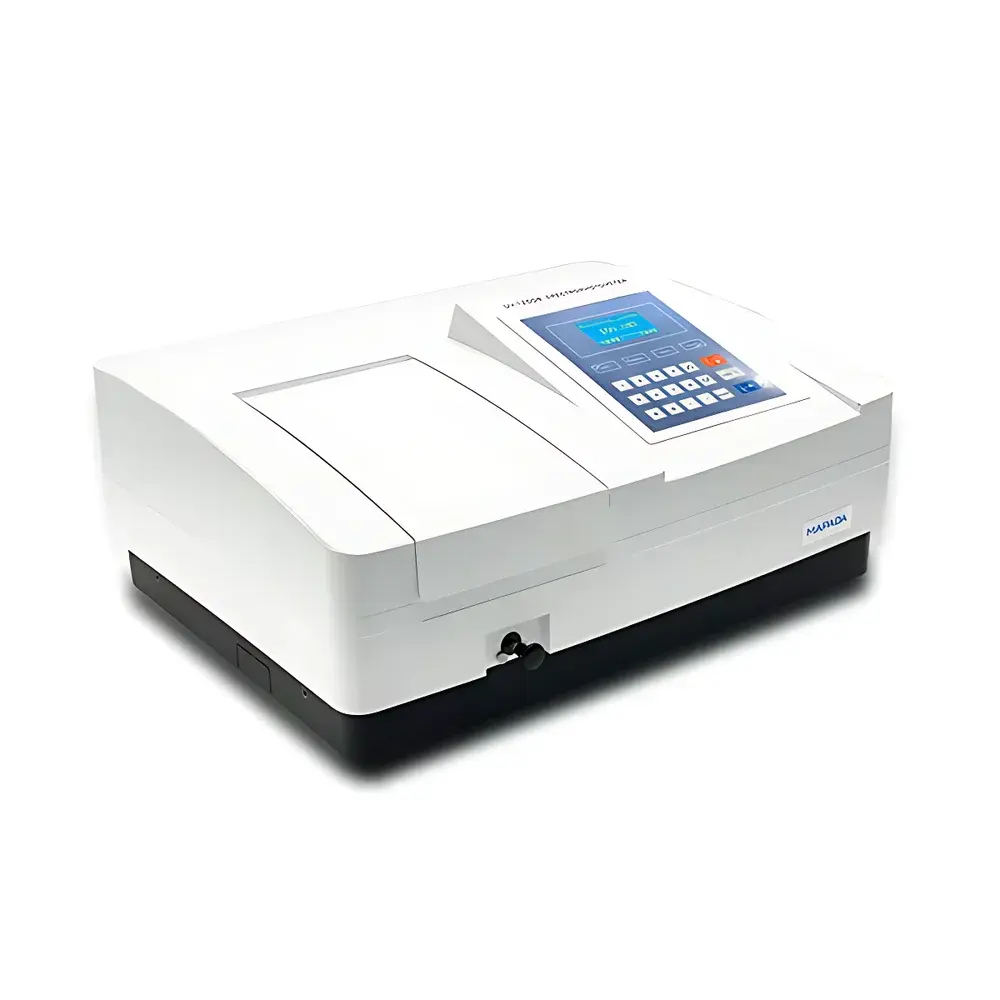
Mapada UV-1800 Ultraviolet-Visible Spectrophotometer
| Brand | Mapada |
|---|---|
| Origin | Shanghai, China |
| Manufacturer Type | Original Equipment Manufacturer (OEM) |
| Instrument Architecture | Pseudo-Double-Beam |
| Detector | Silicon Photodiode |
| Wavelength Range | 190–1100 nm |
| Wavelength Accuracy | ±0.5 nm |
| Spectral Bandwidth | 2 nm |
| Wavelength Setting | Motorized Auto-Scanning |
| Display | 128×64 Dot-Matrix LCD |
| Photometric Modes | Transmittance (T%), Absorbance (A), Concentration (C), Energy (E) |
| Photometric Range | 0–200% T, –0.3 to 3.0 A |
| Data Interface | USB 2.0 |
| Print Interface | Parallel Port |
| Power Supply | AC 220 V/50 Hz or AC 110 V/60 Hz |
| Dimensions (W×D×H) | 490 × 360 × 240 mm |
| Net Weight | 14 kg |
Overview
The Mapada UV-1800 Ultraviolet-Visible Spectrophotometer is a precision optical instrument engineered for routine and research-grade quantitative and qualitative analysis in the UV–Vis spectral region (190–1100 nm). Based on pseudo-double-beam optical architecture, it employs a high-efficiency Czerny–Turner monochromator equipped with a 1200-line/mm holographic grating, ensuring stable spectral resolution and minimal stray light. The system utilizes a dynamically switched dual-light-source configuration—deuterium lamp for deep-UV (190–350 nm) and tungsten-halogen lamp for visible–NIR (350–1100 nm)—with automatic lamp selection synchronized to wavelength scanning. This design minimizes photometric drift and enhances long-term baseline stability, critical for regulatory-compliant absorbance measurements in pharmaceutical, environmental, and academic laboratories.
Key Features
- Pseudo-double-beam optical path with real-time reference beam compensation, delivering improved photometric reproducibility across extended measurement sessions.
- Motorized wavelength drive enabling fully automated scanning, calibration, and source switching—no manual intervention required during method execution.
- High-stability silicon photodiode detector with low-noise signal conditioning circuitry, optimized for linear response over the full specified absorbance range (–0.3 to 3.0 A).
- Integrated lamp-hour monitoring system that logs cumulative operating time for both deuterium and tungsten lamps, supporting preventive maintenance scheduling per ISO/IEC 17025 and GLP requirements.
- Modular lamp housing with plug-in socket design—lamp replacement requires no optical realignment, reducing downtime and technician dependency.
- Large sample compartment accommodating cuvettes from 5 mm to 100 mm pathlength, compatible with standard quartz, glass, and plastic cells—including matched pairs for ratio-based measurements.
- Embedded 128×64 dot-matrix LCD with intuitive menu navigation; displays real-time spectra, calibration curves, kinetic traces, and up to 200 stored data sets directly on instrument interface.
Sample Compatibility & Compliance
The UV-1800 supports liquid-phase analysis of transparent, low-turbidity samples in standardized cuvettes. It complies with core performance criteria outlined in ASTM E275, ISO 6223, and USP for spectrophotometric instrumentation validation. Its ±0.5 nm wavelength accuracy and 2 nm spectral bandwidth meet the minimum specification thresholds for routine QC testing in pharmaceutical manufacturing (e.g., assay of active pharmaceutical ingredients per USP ). The instrument’s firmware architecture supports audit-trail-enabling software extensions (via optional Mapada Professional Scan Software), facilitating alignment with FDA 21 CFR Part 11 requirements when deployed in GMP environments. All optical components are factory-aligned and sealed against dust ingress, ensuring consistent performance under ISO Class 8 cleanroom-adjacent lab conditions.
Software & Data Management
The UV-1800 interfaces natively via USB 2.0 with Windows-based Mapada Professional Scan Software—a validated application supporting full-featured spectral acquisition, multi-point calibration, kinetic time-course modeling, DNA/protein quantification (using built-in ε₂₈₀ and ε₂₆₀ algorithms), and multi-wavelength kinetics. Raw absorbance and transmittance data are exported in CSV and XML formats for traceable integration into LIMS or ELN platforms. The software enforces user-level access control, electronic signature capture, and immutable audit trails—including timestamps for method creation, parameter modification, and result export—supporting ALCOA+ data integrity principles. Local storage retains up to 100 calibration curves and 200 measurement records without external PC dependency.
Applications
- Quantitative determination of analytes via Beer–Lambert law-based calibration curves (e.g., nitrate in water per EPA Method 353.2, iron in serum using phenanthroline complexation).
- Enzyme kinetics monitoring (e.g., NADH oxidation at 340 nm) with time-resolved absorbance tracking at user-defined intervals.
- Spectral characterization of nanomaterials (e.g., gold nanoparticle surface plasmon resonance between 520–580 nm).
- Quality control of dyes, pigments, and UV filters in cosmetics and coatings industries per ISO 105-J03.
- DNA/RNA and protein concentration assessment using preloaded extinction coefficients and dilution-aware calculation workflows.
- Verification of filter performance and solvent cutoff wavelengths in analytical method development.
FAQ
Does the UV-1800 support GLP-compliant data handling?
Yes—when used with Mapada Professional Scan Software, it provides electronic signatures, audit trails, and user-access logging aligned with GLP Annex 11 and FDA 21 CFR Part 11 expectations.
Is lamp alignment required after replacement?
No—the plug-in socket design ensures mechanical and optical registration; zero recalibration is needed post-lamp exchange.
What cuvette pathlengths are supported?
Standard rectangular cells from 5 mm to 100 mm, including matched quartz pairs for high-precision ratio measurements.
Can the instrument perform spectral scanning without a connected PC?
Yes—the embedded LCD enables standalone scanning, peak identification, and basic curve fitting; full analysis requires optional software.
How is wavelength accuracy verified and maintained?
The system includes automated self-calibration using internal holmium oxide and didymium filters; verification reports comply with ISO/IEC 17025 Clause 6.4.10.





