
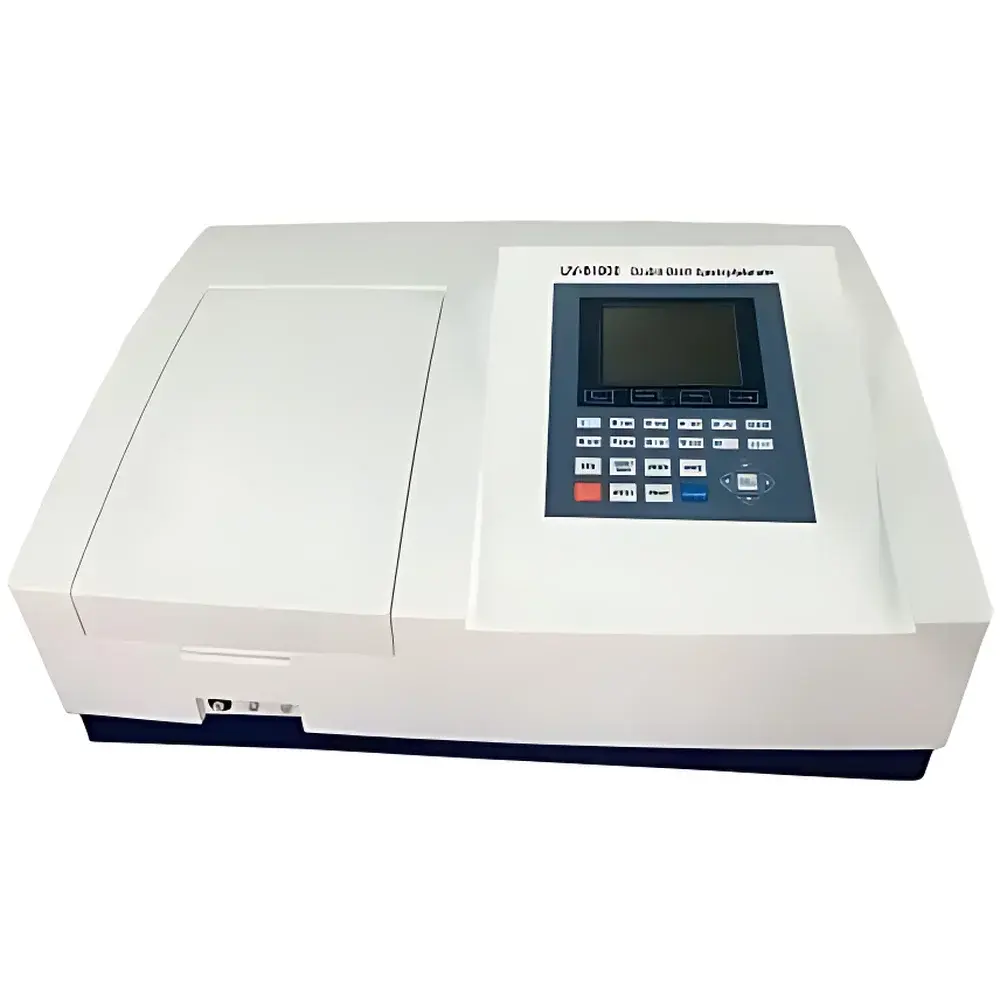
Mapada UV-6100BS Dual-Beam Ultraviolet-Visible Spectrophotometer
| Brand | Mapada |
|---|---|
| Origin | Shanghai, China |
| Model | UV-6100BS |
| Optical System | Dual-beam |
| Detector | Photodiode Array (PDA) |
| Wavelength Range | 190–1100 nm |
| Wavelength Accuracy | ±0.3 nm |
| Wavelength Repeatability | ≤0.1 nm |
| Spectral Bandwidth | 0.5 / 1 / 2 / 4 / 5 nm (selectable) |
| Stray Light | ≤0.03% T at 220 nm and 360 nm |
| Photometric Accuracy | ±0.2% T (0–100% T), ±0.002 A (0–0.5 A), ±0.004 A (0.5–1 A) |
| Photometric Repeatability | ≤0.15% T (0–100% T), ±0.001 A (0–0.5 A), ±0.002 A (0.5–1 A) |
| Baseline Flatness | ±0.001 A |
| Drift | ±0.0003 A/h at 500 nm |
| Noise | ±0.0003 A |
| Scan Speed | Up to 3800 nm/min (high mode) |
| Display | 5-inch LCD (320 × 240 pixels) |
| Data Interface | USB port |
| Dimensions | 590 × 420 × 260 mm |
| Weight | 26 kg |
Overview
The Mapada UV-6100BS is a high-performance dual-beam ultraviolet-visible (UV-Vis) spectrophotometer engineered for precision quantitative and qualitative analysis across academic research laboratories, pharmaceutical quality control (QC), environmental testing, and industrial R&D environments. Its optical architecture employs a double-beam configuration with real-time reference beam compensation—minimizing errors caused by source intensity drift, detector instability, or environmental fluctuations during extended measurements. The instrument utilizes a 1200 lines/mm holographic grating for high spectral resolution and efficiency, coupled with a photodiode array (PDA) detector that enables rapid, simultaneous acquisition across the full 190–1100 nm wavelength range. This design supports high-fidelity absorbance, transmittance, concentration, and kinetic measurements while maintaining compliance with core spectroscopic performance criteria outlined in ISO 8579, ASTM E275, and USP <857>.
Key Features
- Dual-beam optical path with automatic beam balancing ensures superior baseline stability and long-term photometric reproducibility (≤0.15% T).
- Selectably variable spectral bandwidths (0.5, 1, 2, 4, or 5 nm) allow optimization for resolution vs. signal-to-noise trade-offs per application—critical for narrow peak resolution in multicomponent analysis.
- High-intensity, low-ozone-emission deuterium lamp and long-life tungsten-halogen lamp provide stable UV and visible output; both lamps feature integrated usage-hour monitoring for predictive maintenance and GLP traceability.
- Plug-and-play lamp module design eliminates post-replacement optical alignment—reducing downtime and operator dependency on service technicians.
- Large sample compartment accommodates cuvettes from 5 mm to 100 mm pathlength, including standard 10 mm quartz, glass, or plastic cells, supporting diverse sample matrices and dilution strategies.
- 5-inch monochrome LCD display (320 × 240 pixels) renders real-time spectra, calibration curves, kinetic plots, and multi-wavelength overlays without external hardware.
- Onboard GLP self-validation function performs automated wavelength accuracy and photometric linearity verification against internal standards, generating timestamped compliance reports for audit readiness.
Sample Compatibility & Compliance
The UV-6100BS is compatible with liquid-phase samples in standard cuvette formats (10 mm, 20 mm, 50 mm, and 100 mm pathlengths), as well as flow cells and microvolume adapters (optional). It meets essential regulatory expectations for analytical instrumentation used in GMP and GLP environments: full support for electronic record integrity via timestamped data logging, user-access-level controls (via software), and audit-trail-capable operation when paired with Mapada’s validated scanning software. While the instrument itself does not carry FDA 21 CFR Part 11 certification out-of-the-box, its data export architecture (USB-based raw ASCII/CSV output) enables integration into validated LIMS or ELN systems compliant with ICH M7, USP <1058>, and ISO/IEC 17025 requirements.
Software & Data Management
Controlled via Mapada’s proprietary PC-based scanning software (included), the UV-6100BS supports full instrument parameterization—including method-driven scan protocols, multi-point calibration, kinetic time-course definition, and derivative spectral processing. All acquired data—including absorbance, transmittance, concentration, and time-resolved traces—are stored in open-format files (.txt, .csv) for interoperability with MATLAB, OriginLab, or Python-based analytical pipelines. Internal memory retains up to 200 methods and 500 spectra, while continuous USB streaming allows real-time acquisition logging during prolonged experiments. Print functionality supports direct output to parallel-port printers for hard-copy archiving of validation reports and QC records.
Applications
- Pharmaceutical assay development and release testing (e.g., dissolution profiling, excipient compatibility, API quantification per USP <857>).
- Environmental water quality analysis (nitrate, phosphate, COD, heavy metal chelates) per EPA Method 365.2 and ISO 15705.
- Food and beverage quality assurance (colorants, preservatives, antioxidant capacity via DPPH assay).
- Nanomaterial characterization (gold nanoparticle size estimation via plasmon resonance peak analysis).
- Enzyme kinetics (NADH/NADPH oxidation/reduction at 340 nm) and protein quantification (Bradford, Lowry, BCA).
- Academic teaching labs requiring robust, intuitive platforms for fundamental spectroscopy instruction and method validation exercises.
FAQ
Does the UV-6100BS support compliance with FDA 21 CFR Part 11?
It does not include built-in electronic signature or audit trail modules required for standalone Part 11 compliance. However, its data export structure and software-controlled access enable integration into validated enterprise systems meeting those requirements.
What is the minimum detectable absorbance change under optimal conditions?
With 0.5 nm bandwidth and high-sensitivity mode, the instrument achieves a noise level of ±0.0003 A—enabling reliable detection of sub-0.001 A absorbance changes in controlled environments.
Can the PDA detector be calibrated using NIST-traceable standards?
Yes. The onboard GLP self-test routine accepts user-loaded NIST SRM reference materials (e.g., SRM 930e for photometric accuracy) to generate traceable calibration certificates.
Is thermal stabilization available for temperature-sensitive measurements?
No integrated Peltier cell or external bath interface is provided. For temperature-dependent studies, users must employ externally thermostatted cuvettes or accessory holders.
What is the expected lifetime of the deuterium and tungsten lamps?
Rated at ≥2000 hours for the deuterium lamp and ≥5000 hours for the tungsten lamp under typical usage—monitored continuously and displayed in hours on the main interface.
Related Products




