
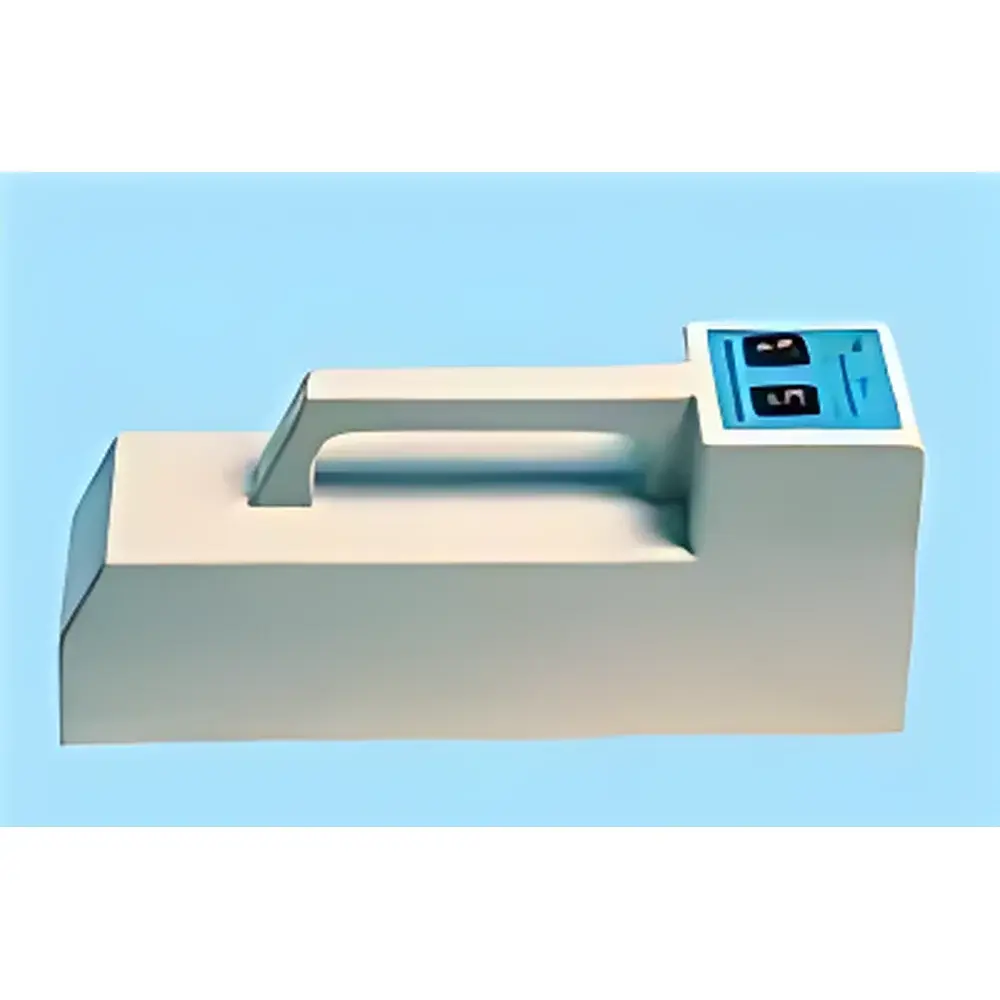
ZiQi ZF-5S Portable Dual-Wavelength UV Transilluminator
| Brand | ZiQi |
|---|---|
| Origin | Shanghai, China |
| Manufacturer Type | Direct Manufacturer |
| Product Category | Domestic (China-Made) |
| Model | ZF-5S Portable |
| Instrument Type | Portable (Handheld) |
| Wavelength Configuration | Dual-Wavelength (254 nm and 365 nm) |
| UV Lamp Count | 2 × 6 W tubes |
| UV Filter Dimensions | 150 × 50 mm |
| Effective UV Transmission Area | 140 × 40 mm |
| Input Power | AC 220 V ±10%, 50 Hz |
Overview
The ZiQi ZF-5S Portable Dual-Wavelength UV Transilluminator is an engineered solution for rapid, on-site fluorescence visualization of nucleic acids, proteins, and other UV-excitable compounds. Designed around the principle of ultraviolet-induced fluorescence, the instrument emits discrete spectral bands at 254 nm (short-wave UV) and 365 nm (long-wave UV), enabling selective excitation of common fluorophores—including ethidium bromide (EtBr), SYBR® Safe, GFP derivatives, and aromatic biomolecules—without requiring external power sources beyond standard mains supply. Its compact, handheld architecture integrates two low-power, high-stability UV lamps within a lightweight ABS housing, making it suitable for field applications, teaching laboratories, forensic mobile units, and quality control checkpoints where benchtop transilluminators are impractical. Unlike continuous-spectrum sources, the ZF-5S delivers narrowband irradiance with minimal infrared emission, reducing thermal degradation of sensitive gels and samples during short-duration inspection.
Key Features
- Dual-wavelength UV output (254 nm and 365 nm) optimized for differential excitation of DNA/RNA stains and native fluorophores
- Two independent 6 W UV lamps with stable radiometric output over extended operational cycles
- Integrated 150 × 50 mm UV-transmissive filter glass with 140 × 40 mm uniform illumination area
- Compact, ergonomic handheld design weighing under 1.8 kg; no external stand or cooling fan required
- AC 220 V ±10% input compatibility with built-in current regulation to maintain consistent lamp intensity
- UV-shielded viewing window and optional safety goggles support compliance with IEC 62471 (Photobiological Safety of Lamps)
Sample Compatibility & Compliance
The ZF-5S supports direct visual inspection of agarose and polyacrylamide gels stained with EtBr, GelRed™, GelGreen™, and similar intercalating dyes. It is routinely employed in post-electrophoresis analysis for band localization, gel documentation pre-scanning, and rapid QC checks in pharmaceutical raw material screening (e.g., vitamin B2, riboflavin, and tetracycline derivatives). The device conforms to general laboratory safety standards for Class 3B UV radiation equipment: users must observe exposure limits per ACGIH TLVs® and implement engineering controls (e.g., UV-blocking eyewear, sample shielding) as mandated under OSHA 1910.133. While not certified to ISO/IEC 17025 or GLP for quantitative reporting, its repeatability supports qualitative pass/fail assessments aligned with USP endotoxin testing workflows and ASTM D7213–17 for fluorescent additive detection in polymers.
Software & Data Management
As a standalone optical visualization tool, the ZF-5S does not incorporate embedded firmware, digital imaging, or data logging capabilities. It operates exclusively in analog mode—lamp activation is manual via front-panel switch—and generates no electronic records. This architecture eliminates regulatory complexity associated with FDA 21 CFR Part 11 compliance, making it suitable for environments where audit-trail requirements are absent or fulfilled by downstream documentation systems (e.g., lab notebooks, LIMS entries, or camera-based image capture platforms). Users integrating the ZF-5S into validated workflows should define standard operating procedures covering lamp warm-up time (recommended ≥2 min), filter cleaning frequency (using lint-free wipes and ethanol), and periodic intensity verification using NIST-traceable UV radiometers.
Applications
- Molecular biology: Real-time visualization of DNA/RNA bands in electrophoretic gels; verification of PCR product size and purity
- Pharmaceutical QA: Rapid screening of fluorescent impurities in APIs, excipients, and herbal extracts per USP monographs
- Food safety: Detection of aflatoxin B1 in grains and nuts using immunoaffinity column–based fluorometric assays
- Forensics: Latent fingerprint development with cyanoacrylate fuming followed by rhodamine 6G staining
- Materials science: Identification of UV-stabilizers, optical brighteners, and counterfeit polymer additives in textiles and plastics
- Agricultural diagnostics: Field-level assessment of fungal metabolites in stored cereals and legumes
FAQ
Is the ZF-5S suitable for quantitative densitometry?
No. It is designed for qualitative fluorescence observation only. Quantitative analysis requires calibrated CCD or CMOS imaging systems with background subtraction and pixel-intensity calibration.
Can the unit be used with ethidium bromide–stained gels under ambient light?
Yes, but optimal contrast is achieved in low-ambient-light conditions. The 254 nm channel provides higher sensitivity for EtBr; the 365 nm channel reduces photodamage to DNA during prolonged exposure.
What maintenance is required for the UV filter glass?
Wipe gently with 70% ethanol and lint-free lens tissue after each use. Avoid abrasives, metal contact, or excessive pressure to prevent microscratches that scatter UV irradiance.
Does the ZF-5S meet CE or UL safety certification?
It complies with general electrical safety principles per IEC 61010-1 but lacks formal CE/UL marking. Institutions requiring certified devices should verify local regulatory acceptance prior to deployment.
Is battery operation supported?
No. The ZF-5S requires AC 220 V mains power and does not include internal batteries or DC conversion circuitry.



