
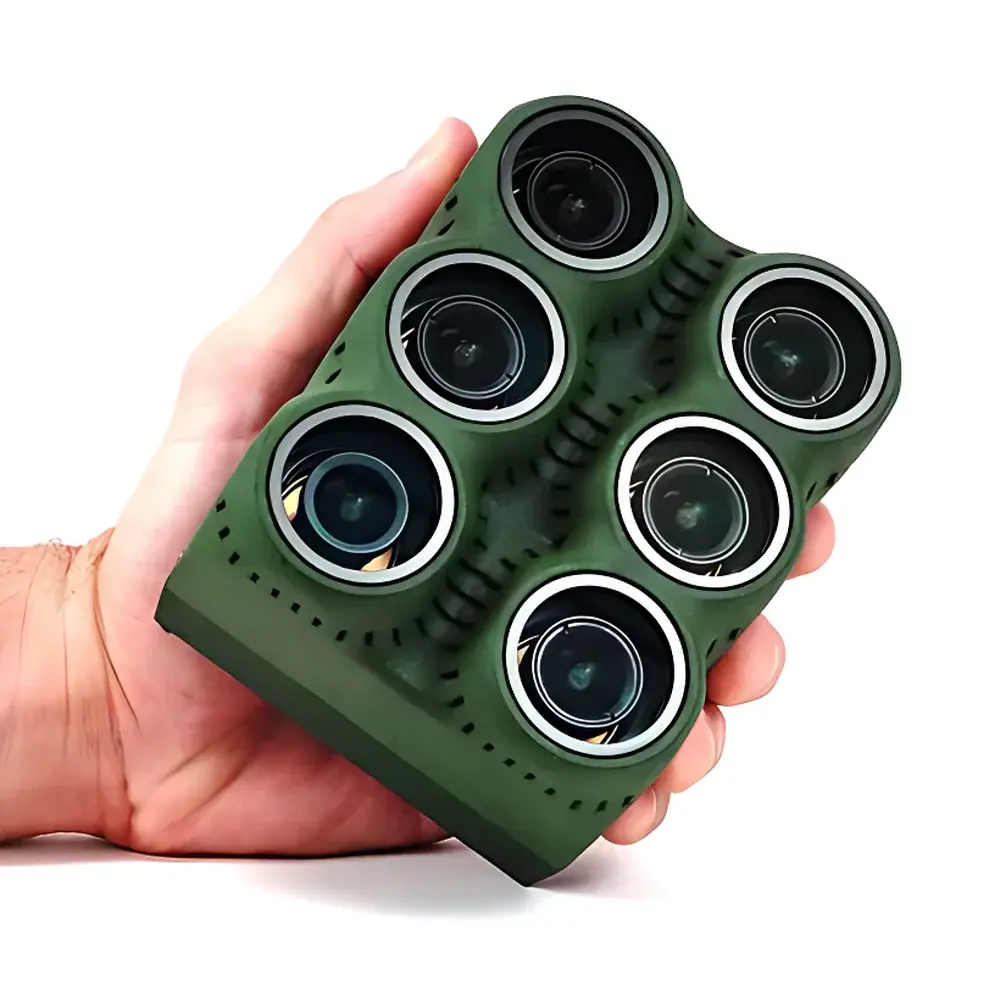
MapIR K6 Ten-Channel Multispectral Imaging System
| Brand | MapIR |
|---|---|
| Origin | USA |
| Manufacturer Type | Authorized Distributor |
| Import Status | Imported |
| Model | K6 |
| Operating Principle | Filter-Based Multispectral Imaging |
| Imaging Method | Discrete Bandpass Filter Wheel (Fixed-Filter Array) |
| Platform Integration | UAV-Mounted (Fixed-Wing & Multirotor Compatible) |
| Total Field of View (TFOV) | 87° or 41° Horizontal FOV |
| Instantaneous Field of View (IFOV) | 4.3 cm/pixel @ 120 m AGL (3.2 MP mode), 2.0 cm/pixel @ 120 m AGL (14.4 MP mode) |
| Frame Rate | 2 fps (3.2 MP RAW), 1 fps (14.4 MP RAW) |
| Onboard Processing | Dual-Core ARM Cortex-A9 i.MX6 SoC (1.2 GHz) |
| Sensor Configurations | Two Detector Options — Global Shutter Monochrome (13.2 MP, 3.45 µm pixel pitch) or Bayer Color (14.4 MP, 1.4 µm pixel pitch) |
| Trigger Interface | PWM, Relay (Voltage Pulse), UAVCAN (via GNSS/Flight Controller) |
| Image Format | 12-bit RAW per channel, 16-bit TIFF export |
| Storage | Removable microSD card (up to 128 GB) |
| Power | 5.0 VDC, 4.0 W per module |
| Spectral Flexibility | Interchangeable 10-channel filter sets (user-selectable center wavelengths & bandwidths) |
Overview
The MapIR K6 Ten-Channel Multispectral Imaging System is a field-deployable, UAV-integrated remote sensing instrument engineered for high-fidelity spectral data acquisition in precision agriculture, environmental monitoring, ecological research, and geospatial asset management. Unlike continuous-spectrum hyperspectral systems, the K6 employs a discrete-band, filter-based architecture—utilizing ten independently configurable narrowband interference filters mounted in a rigid optical train. Each spectral channel operates with dedicated hardware synchronization, enabling simultaneous capture of spatially registered multispectral bands without temporal misalignment. The system integrates two detector options: a global-shutter monochrome sensor (13.2 MP, 3.45 µm pixels) optimized for radiometric stability and low-noise NIR/SWIR band acquisition, and a high-resolution Bayer color sensor (14.4 MP, 1.4 µm pixels) suited for visible-band vegetation indices requiring fine spatial detail. All processing—including real-time metadata stamping, exposure control, and frame buffering—is executed on the onboard Freescale i.MX6 dual-core ARM Cortex-A9 SoC (1.2 GHz), eliminating dependency on ground station computation during flight.
Key Features
- Modular 10-channel spectral design with user-swappable interference filter sets—supporting custom center wavelength selection across 400–1000 nm (e.g., blue, green, red, red edge, NIR, SWIR sub-bands)
- Dual-sensor architecture: selectable global-shutter monochrome (13.2 MP) or Bayer-pattern RGB/NIR (14.4 MP) configurations for application-specific SNR vs. resolution trade-offs
- Hardware-synchronized triggering via PWM, relay voltage pulse, or UAVCAN protocol—enabling precise geo-referenced image capture synchronized with GNSS timestamps and IMU data streams
- Onboard Linux-based firmware with deterministic real-time scheduling—guaranteeing consistent exposure timing and metadata integrity under variable UAV dynamics
- 128 GB removable microSD storage with wear-leveling and journaling file system (ext4), supporting lossless 12-bit RAW per channel and post-processed 16-bit TIFF exports
- Optimized optical path with fixed focal length lens options delivering either 87° or 41° horizontal field of view—calibrated for stable MTF performance at operational altitudes (120 m / 400 ft AGL)
Sample Compatibility & Compliance
The K6 is designed exclusively for aerial deployment on certified commercial UAV platforms—including fixed-wing aircraft (recommended for surveys >1 km²) and multirotor systems compliant with FAA Part 107 / EASA UAS regulations. Its mechanical and electrical interface meets IP52 environmental rating standards for dust resistance and limited water ingress during typical outdoor flight operations. While the K6 itself does not carry formal ISO/IEC 17025 accreditation, its raw output format and embedded metadata structure (including UTC timestamp, GPS coordinates, altitude, roll/pitch/yaw, and exposure parameters) are fully compatible with downstream photogrammetric processing pipelines compliant with ASPRS Positional Accuracy Standards and ASTM E2843-22 (Standard Practice for Georeferencing Aerial Imagery). Data provenance is preserved through immutable timestamping and non-volatile onboard logging—supporting GLP-aligned field data collection workflows.
Software & Data Management
Raw data from the K6 is structured as a time-stamped sequence of 12-bit per-channel binary frames, each accompanied by a JSON-formatted sidecar file containing full sensor configuration, GPS/IMU telemetry, and radiometric calibration coefficients. MapIR provides open-source Python-based calibration and stitching utilities (licensed under MIT) that support conversion to ENVI-compatible BIL format and integration with QGIS, ArcGIS Pro, and Agisoft Metashape. The system supports optional integration with cloud-based analytics platforms via RESTful API hooks—enabling automated NDVI, NDRE, CIrededge, and other index derivation aligned with USDA CropScape or ESA Sentinel-2 spectral response functions. All firmware updates are delivered over secure HTTPS with SHA-256 signature verification, and audit logs of configuration changes are retained in non-volatile memory for traceability in regulated environments.
Applications
- Precision agriculture: In-field quantification of chlorophyll content, nitrogen status, water stress, and early disease detection using calibrated vegetation indices
- Wetland and riparian zone mapping: Discrimination of invasive species (e.g., Phragmites australis) and native flora via spectral signature clustering
- Post-wildfire recovery assessment: Burn severity classification (dNBR) using pre- and post-event multispectral composites
- Archaeological prospection: Detection of subsurface features through subtle variations in soil moisture and vegetation health
- Urban heat island studies: Surface emissivity estimation via thermal-adjacent NIR/SWIR band ratios (when paired with co-mounted thermal sensors)
FAQ
What spectral bands are available in standard K6 configurations?
Standard filter sets include combinations targeting common agricultural and ecological indices—e.g., 475 nm (blue), 550 nm (green), 660 nm (red), 710 nm (red edge), 760 nm (NIR), and 850 nm (NIR). Custom filter sets can be specified with ±2 nm center wavelength tolerance and 10–25 nm FWHM bandwidths.
Is radiometric calibration included with the system?
Yes—each K6 unit ships with factory-acquired dark current, flat-field, and relative spectral response (RSR) calibration data. Users may perform field-based reflectance calibration using licensed Spectralon panels traceable to NIST SRM 2019.
Can the K6 operate autonomously without ground telemetry?
Yes—the onboard Linux runtime executes fully autonomous missions when triggered via PWM or UAVCAN; all image and metadata are stored locally and require no real-time downlink.
Does the K6 comply with FDA 21 CFR Part 11 requirements?
While the K6 is not a medical device, its audit trail capabilities (immutable timestamps, firmware version logging, and write-once storage) align with foundational Part 11 principles for electronic records in environmental monitoring applications subject to EPA or USDA oversight.






