
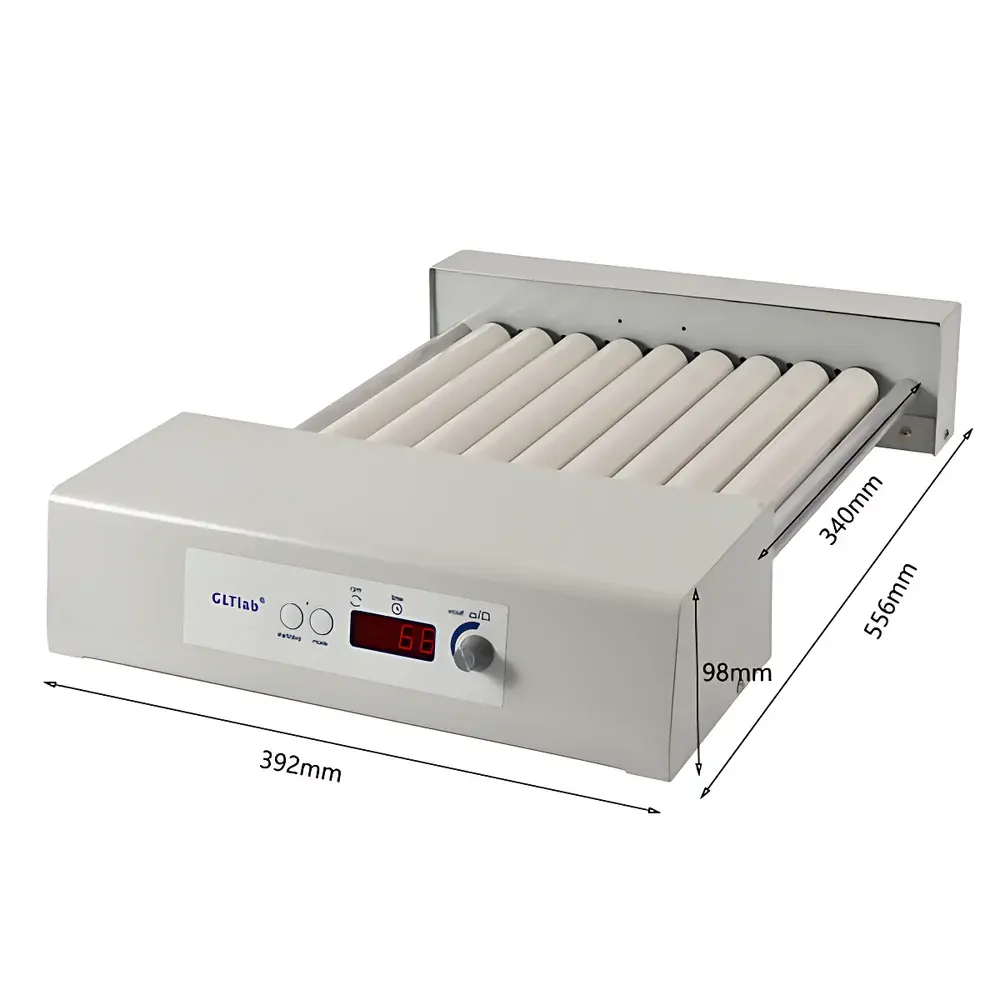
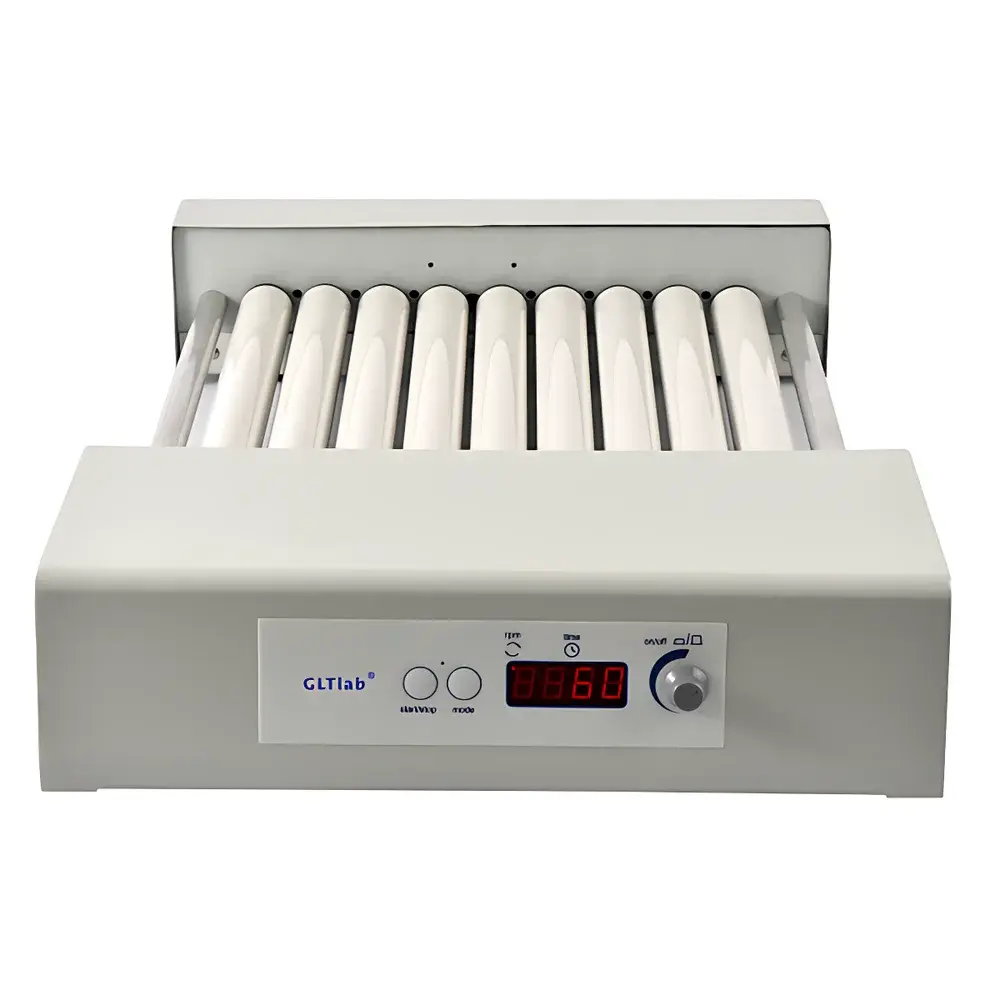
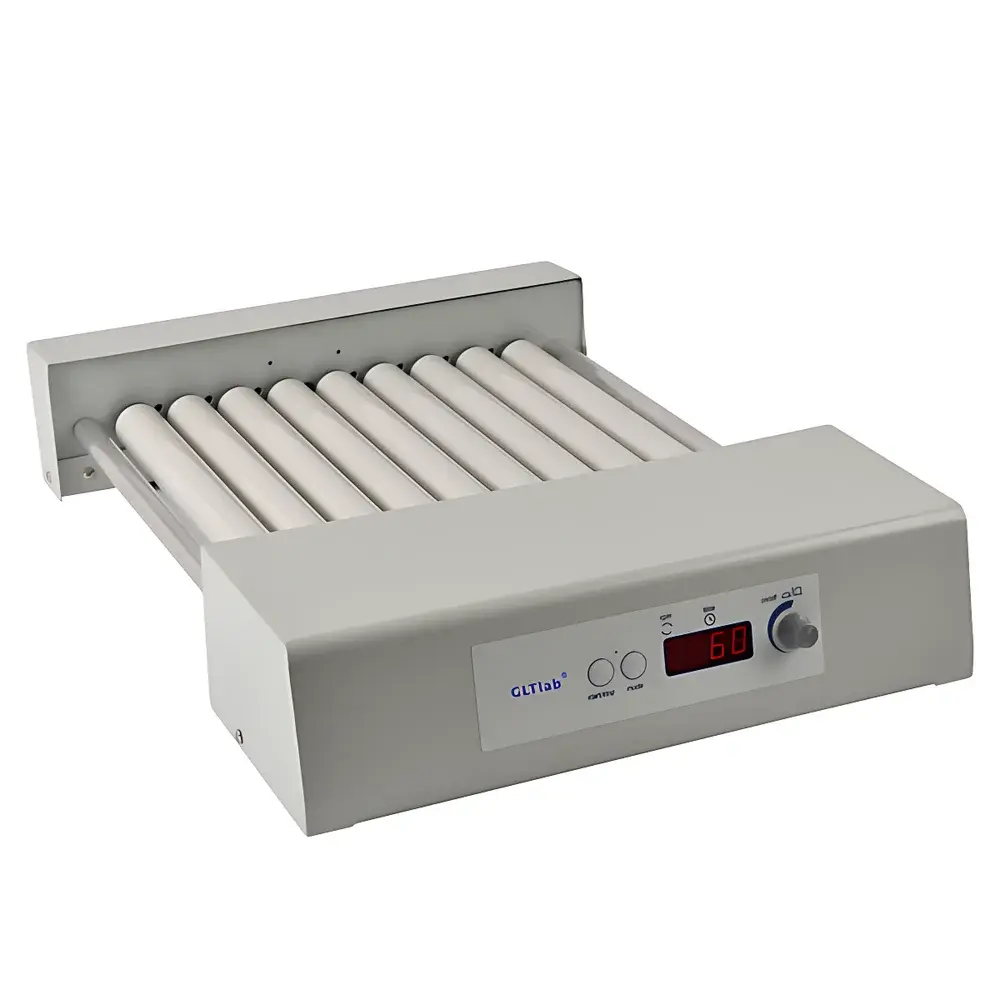
Maplelab LTR1D Digital Orbital Roller Mixer
| Brand | Maplelab |
|---|---|
| Origin | Guangdong, China |
| Manufacturer Type | Authorized Distributor |
| Product Category | Domestic |
| Model | LTR1D |
| Instrument Type | Mixing & Homogenization Equipment |
| Timer Range | Up to 200 hours |
| Oscillation Frequency | 5–300 rpm |
| Temperature Control Range | 0–50 °C |
| Number of Roller Shafts | 9 |
| Load Capacity | 10 kg (tested up to 13 kg with uniform distribution) |
| Sample Vessel Compatibility | 5 mL–10 L (standard configuration supports ≤2 L roller bottles |
| Motion Profile | Dual-mode — continuous 360° rolling + synchronized vertical oscillation (~12–13 mm amplitude per shaft) |
| Safety Features | Motor stall detection, overload shutdown with audible/visual alarm, auto-stop on fault condition |
| Environmental Rating | Operational in incubators (≤60 °C, ≤80% RH) and cold rooms (≥4 °C) |
| Control Interface | Digital display with 1-rpm resolution, programmable timer (9 h / 99 h / 200 h options), real-time speed feedback |
Overview
The Maplelab LTR1D Digital Orbital Roller Mixer is an engineered solution for gentle, reproducible, and scalable sample homogenization across life science laboratories. Unlike conventional orbital shakers or vortex mixers, the LTR1D employs a dual-axis motion principle: each of its nine independently aligned roller shafts rotates continuously at user-defined speeds (5–300 rpm) while simultaneously executing a precisely controlled vertical oscillation (~12–13 mm peak-to-peak displacement). This coordinated 360° rolling + wave-like elevation mimics physiological fluid dynamics—ensuring complete end-to-end mixing without shear-induced cell lysis, phase separation, or air entrapment. The system operates on Couette-type laminar flow principles, where rotational energy is transferred directly to the vessel wall, inducing consistent internal liquid circulation. It is especially suited for applications requiring low-shear handling of sensitive biological matrices—including whole blood, viscous polymer solutions, anaerobic suspensions, cryopreserved cells, and temperature-sensitive reagents.
Key Features
- Dual-motion architecture: Synchronized rotation and vertical oscillation per shaft deliver superior homogeneity versus fixed-angle roller mixers.
- Nine precision-machined roller shafts with adjustable angular offset—enabling optimized torque transfer across diverse vessel geometries (vacutainers, centrifuge tubes, conical flasks, roller bottles up to 2 L).
- Full digital control interface with 1-rpm resolution, real-time speed monitoring, and multi-range timer (9 h / 99 h / 200 h) for unattended long-term protocols.
- Thermally stable platform supporting operation from 0 °C to 50 °C—validated for use inside refrigerated cold rooms (≥4 °C) and humidified incubators (≤60 °C, ≤80% RH).
- Integrated safety logic: automatic motor stall detection, overload cutoff (≥13 kg load threshold), fault logging, and audible/visual alarm activation.
- No adapter required: accommodates vessels from 5 mL microtubes to 10 L containers—vessel positioning is self-centering via gravity-coupled shaft geometry.
Sample Compatibility & Compliance
The LTR1D accepts standard laboratory containers without modification—including evacuated blood collection tubes (BD Vacutainer®, Greiner Bio-One), 15–50 mL conical tubes, glass serum bottles, PETG roller bottles (up to 2 L), and custom-shaped bioreactor vessels. Its motion profile meets ASTM D4067-21 (Standard Practice for Mixing Liquid Samples in Laboratory Containers) for low-shear homogenization validation. While not certified to ISO 13485 or FDA 21 CFR Part 11 out-of-the-box, the device supports GLP/GMP-aligned workflows when integrated with validated lab information management systems (LIMS) and audit-trail-enabled data loggers. All electrical components comply with IEC 61010-1:2010 for laboratory equipment safety.
Software & Data Management
The LTR1D operates as a standalone instrument with embedded firmware—no proprietary software installation required. All operational parameters (speed, duration, start time) are stored in non-volatile memory and persist through power cycles. Optional RS-232 or USB-C serial output enables integration with third-party data acquisition platforms (e.g., LabVIEW, Python-based control scripts) for timestamped event logging. When deployed in regulated environments, users may implement external electronic lab notebooks (ELNs) to capture run metadata, operator ID, and environmental conditions—supporting traceability requirements under ISO/IEC 17025 or CAP accreditation frameworks.
Applications
- Blood banking: Uniform mixing of anticoagulated whole blood prior to component separation—minimizing platelet activation and hemolysis.
- Cell culture: Gentle resuspension of adherent or suspension cells during passaging and cryopreservation recovery.
- Vaccine development: Homogenization of adjuvant-emulsion formulations and antigen suspensions without droplet coalescence.
- Molecular diagnostics: Efficient lysis buffer dispersion in nucleic acid extraction workflows using magnetic bead-based chemistries.
- Cryobiology: Controlled thawing of frozen cell stocks with simultaneous agitation to prevent thermal gradients and ice recrystallization.
- Biopharmaceutical QC: Blending of high-viscosity monoclonal antibody formulations prior to filtration and fill-finish testing.
FAQ
What is the maximum recommended load per roller shaft?
The LTR1D is rated for a total load of 10 kg. For optimal performance and mechanical longevity, distribute weight uniformly across all nine shafts—maximum per-shaft load should not exceed ~1.1 kg. Loads up to 13 kg have been verified under controlled test conditions with balanced vessel placement.
Can the LTR1D be used inside a CO₂ incubator?
Yes—the unit is rated for continuous operation at ambient temperatures up to 60 °C and relative humidity ≤80%. However, direct exposure to CO₂-rich atmospheres (>5%) is not validated; users should confirm material compatibility of housing seals with their specific incubator environment.
Is calibration documentation provided with the instrument?
Factory calibration certificates for speed accuracy (±1 rpm) and timer deviation (<±0.5%) are included. Users may perform periodic verification using NIST-traceable tachometers and stopwatch standards per ISO/IEC 17025 Section 6.5.
Does the LTR1D support remote monitoring or network connectivity?
No native Ethernet/Wi-Fi capability is built-in. Remote status interrogation and parameter adjustment require optional serial-to-Ethernet gateways or PLC-level integration via Modbus RTU over RS-232.
What maintenance is required for long-term reliability?
Annual inspection of roller shaft bearings and drive belt tension is recommended. Lubrication is sealed-for-life; no routine greasing is necessary. Clean external surfaces with 70% isopropanol; avoid chlorine-based disinfectants on polycarbonate housing components.




