
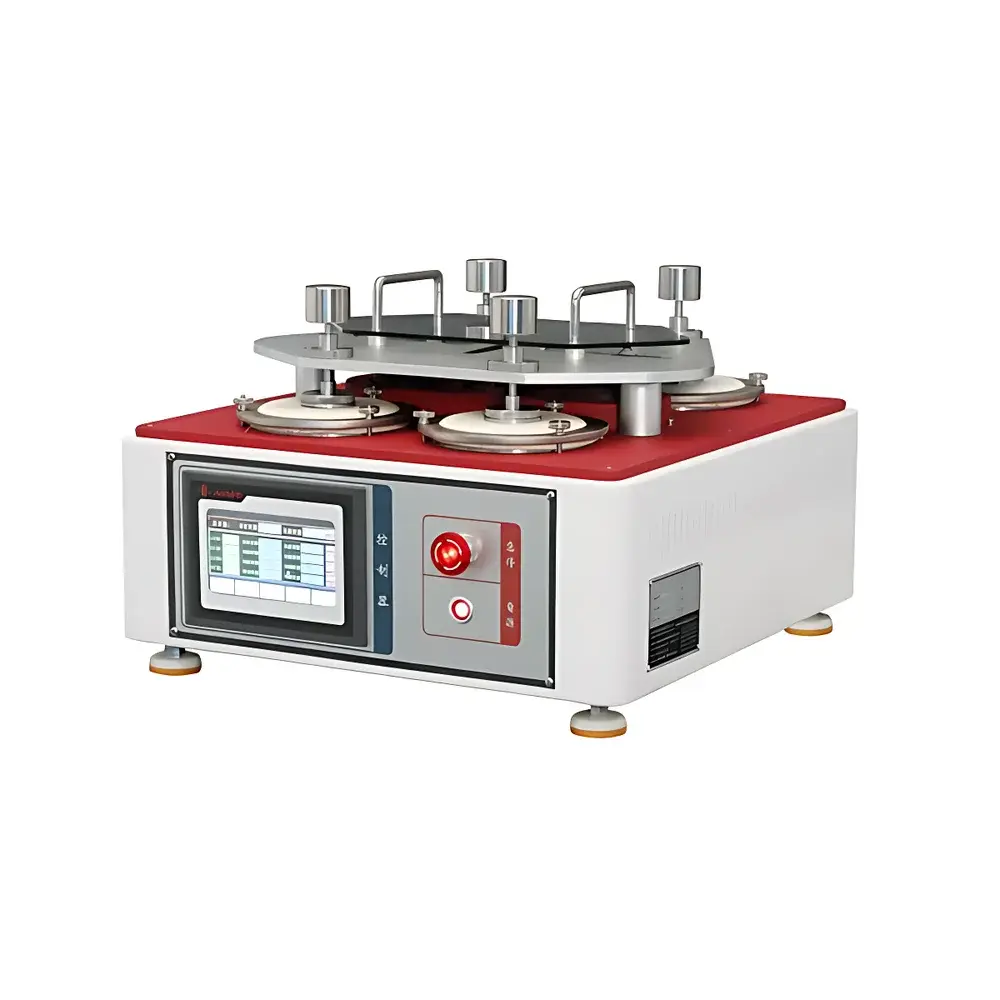
Martndale Abrasion and Pilling Tester HY-752
| Brand | HENGYU |
|---|---|
| Origin | Tianjin, China |
| Model | HY-752 |
| Standards Compliance | BS 3424-24, EN 388, EN 343, EN 530, ISO 20344, ASTM D 4966, SATRA TM 31, ISO 12947 |
| Test Load Options | 9 kPa (595 ± 7 g), 12 kPa (795 ± 7 g) |
| Specimen Holder Surface Diameter | Ø28.65 ± 0.1 mm |
| Cutting Die Diameters | Ø44 mm / Ø38 mm / Ø165 mm / Ø140 mm |
| Pressure Plate Mass | 2.5 ± 0.5 kg |
| Diameter | 120 ± 10 mm |
| Test Stations | 4 / 6 / 9 (independently timed and counted) |
| Dimensions (L×W×H) | 55 × 55 × 35 cm |
| Weight | 90 kg |
| Power Supply | AC 220 V, 50 Hz, 500 W |
| Operating Environment | 20 ± 2 °C, 65 ± 4 % RH |
Overview
The Martindale Abrasion and Pilling Tester HY-752 is an electromechanical textile testing instrument engineered for precise evaluation of surface durability under controlled cyclic rubbing conditions. It operates on the principle of the Martindale method—where a circular fabric specimen is subjected to multidirectional oscillatory motion against an abradant surface (typically wool or standard abrasive cloth) under defined pressure and frequency. This simulates real-world wear mechanisms such as rubbing, flexing, and surface fatigue encountered during garment use, upholstery handling, or protective clothing deployment. Designed in strict alignment with internationally recognized test standards—including ISO 12947 (Parts 1–4), ASTM D4966, EN 388, and BS 3424-24—the HY-752 delivers repeatable, auditable results essential for quality assurance, material development, and regulatory conformance in textile, technical fabric, and personal protective equipment (PPE) manufacturing.
Key Features
- Modular station configuration supporting 4, 6, or 9 independent test positions—each equipped with individual timer control, cycle counter, and audible end-of-test alert.
- Standardized loading system with dual calibrated pressure options: 9 kPa (595 ± 7 g) and 12 kPa (795 ± 7 g), achieved via precision-machined stainless-steel loading components traceable to national metrological standards.
- Specimen holder geometry conforms to ISO 12947-1 requirements: active abrading surface diameter of Ø28.65 ± 0.1 mm, ensuring consistent contact area and load distribution across all samples.
- Interchangeable cutting dies (Ø38 mm, Ø44 mm, Ø140 mm, Ø165 mm) accommodate diverse sample formats—from laboratory swatches to full-scale composite laminates—enabling flexibility in R&D and production-line QC workflows.
- Robust cast-iron frame and vibration-damped base minimize mechanical drift and ensure long-term operational stability under continuous cycling.
- Integrated pressure plate assembly (mass: 2.5 ± 0.5 kg; diameter: 120 ± 10 mm) provides uniform vertical force transmission and eliminates edge-loading artifacts during multi-specimen runs.
Sample Compatibility & Compliance
The HY-752 accommodates woven, knitted, nonwoven, coated, and laminated textiles—including rubber-coated fabrics, flame-retardant composites, and high-performance technical textiles used in occupational safety gear. Its mechanical architecture supports specimens up to 165 mm in diameter and thicknesses compatible with standard mounting clamps (≤5 mm typical). All test configurations comply with mandatory clauses of ISO 12947-2 (abrasion resistance), ISO 12947-3 (pilling assessment), and ISO 12947-4 (visual evaluation criteria). For regulated industries—including medical textiles and CE-marked PPE—the instrument’s repeatability profile meets GLP-aligned validation requirements when operated within specified environmental conditions (20 ± 2 °C, 65 ± 4 % RH) and calibrated per manufacturer-recommended intervals.
Software & Data Management
While the HY-752 operates as a standalone electromechanical tester without embedded digital control, its design supports integration into laboratory data management ecosystems. Cycle counts, elapsed time, and station-specific stop events are logged mechanically and visually via front-panel LED displays. Users may interface external digital timers or programmable logic controllers (PLCs) via dry-contact outputs for automated logging into LIMS or MES platforms. When deployed in GMP or ISO/IEC 17025-accredited laboratories, the instrument’s operation is documented through standardized SOPs, and calibration records—including load verification and motion amplitude checks—are maintained per ISO/IEC 17025 Clause 6.5. Traceability is enhanced by serial-numbered loading components and certified reference abrasives (e.g., worsted wool fabric per ISO 12947-2 Annex A).
Applications
- Quantitative ranking of fabric abrasion resistance for apparel, workwear, and military uniforms.
- Pilling tendency assessment of synthetic blends, cashmere, and microfiber textiles per ISO 12947-3.
- Validation of coating adhesion and surface integrity in rubberized technical fabrics (e.g., rainwear, inflatable structures).
- Comparative testing of nanocoated or plasma-treated textiles to quantify durability improvements.
- Supporting ASTM F1670/F1671 barrier performance evaluations where mechanical stress preconditioning is required prior to liquid penetration testing.
- Pre-compliance screening for EN 388:2016 (mechanical risks in protective gloves) and EN 343:2019 (weather protection garments).
FAQ
What standards does the HY-752 support out of the box?
The instrument is mechanically configured to execute all test parameters specified in ISO 12947-1 to -4, ASTM D4966, EN 388, EN 343, EN 530, BS 3424-24, and SATRA TM31 without modification.
Is calibration certification included with purchase?
A factory calibration report verifying load application accuracy and oscillation frequency is provided. Full ISO/IEC 17025 calibration services are available upon request through authorized metrology partners.
Can the HY-752 be used for non-textile materials?
Yes—provided the material can be mounted as a flat, flexible specimen and withstand lateral oscillatory shear. Applications include thin polymer films, coated papers, and elastomeric sheets, though method adaptation and validation per relevant material-specific standards are required.
What maintenance is recommended for long-term reliability?
Monthly inspection of drive belts, periodic lubrication of cam followers, annual verification of load mass tolerances, and replacement of abradant surfaces after every 50,000 cycles or per visual wear assessment.
Does the instrument meet electrical safety and EMC requirements for EU deployment?
The HY-752 complies with IEC 61000-6-3 (emission) and IEC 61000-6-2 (immunity) and carries CE marking per Machinery Directive 2006/42/EC when supplied with EU-spec power cord and documentation.



