
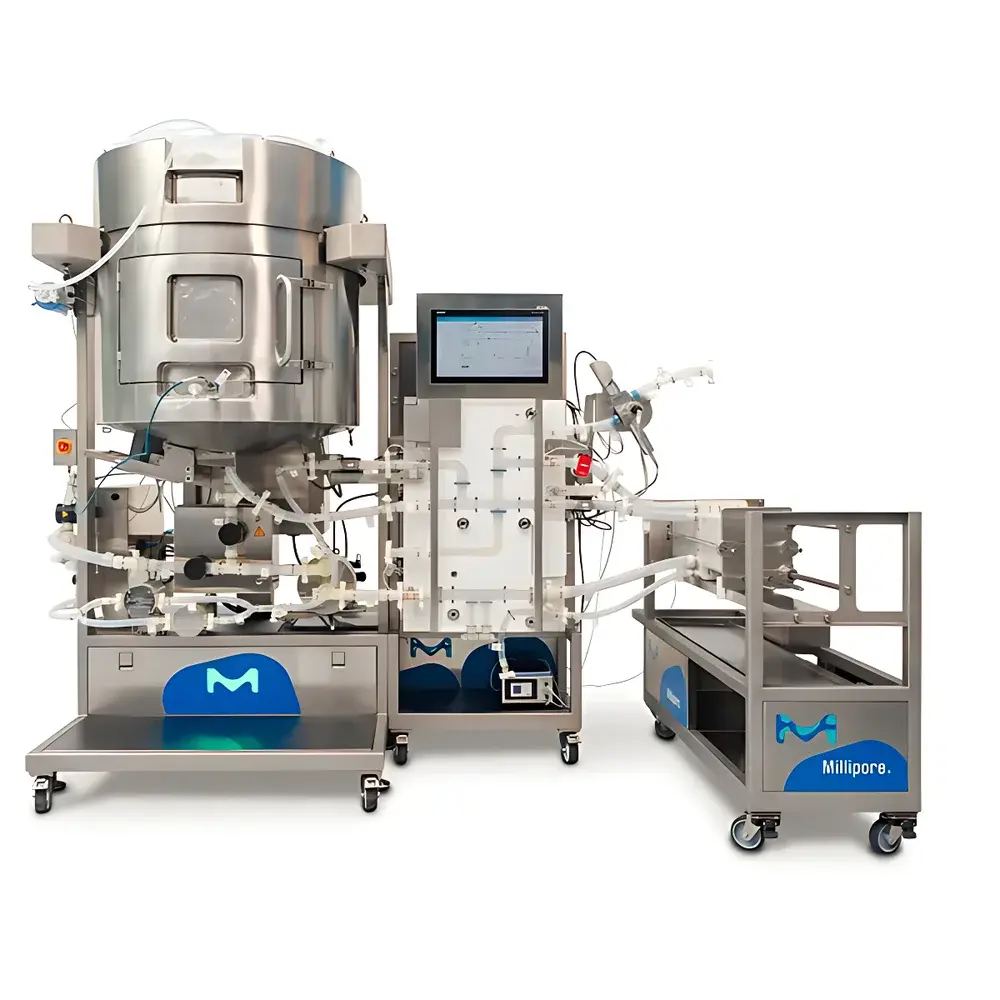
Merck Mobius® TFF 80 Tangential Flow Filtration System
| Brand | Merck |
|---|---|
| Origin | Germany |
| Model | Mobius® TFF 80 System |
| Design | Single-use, fully integrated tangential flow filtration platform |
| Max Membrane Area Compatibility | 20 m² cassette modules |
| Automation Level | Fully automated control software with intuitive HMI interface |
| Intended Use | Industrial-scale bioprocessing for concentration, diafiltration, and buffer exchange of therapeutic proteins, monoclonal antibodies, vaccines, and viral vectors |
Overview
The Merck Mobius® TFF 80 Tangential Flow Filtration System is an engineered single-use platform designed for robust, scalable, and compliant downstream processing in biopharmaceutical manufacturing. Based on the principle of tangential flow filtration—where fluid flows parallel to the membrane surface to minimize fouling and maintain consistent flux—the system enables efficient concentration, diafiltration, and buffer exchange of large-volume biologics streams. Its architecture supports seamless integration into end-to-end single-use process trains, eliminating cleaning-in-place (CIP) and sterilization-in-place (SIP) validation burdens while ensuring product contact surfaces remain Class VI-certified and extractables/leachables-controlled per USP and ISO 10993-18 guidelines. The Mobius® TFF 80 is purpose-built for clinical- and commercial-scale operations, supporting batch sizes from 50 L to >2,000 L with reproducible performance across campaigns.
Key Features
- Single-use, pre-assembled fluid path: All wetted components—including pump tubing, sensors, manifolds, and connectors—are gamma-irradiated, pre-sterilized, and supplied as a validated disposable kit.
- Scalable membrane compatibility: Supports up to 20 m² of industry-standard TFF cassettes (e.g., Pellicon® 3, Viresolve® Pro), enabling flexible process intensification without hardware modification.
- Integrated process control: Equipped with high-accuracy pressure transducers (±0.5% FS), temperature sensors (±0.2 °C), and flow meters (±1% reading), all connected via digital I/O to the embedded PLC.
- Automated operation with audit-trail capability: The Mobius® Control Software complies with FDA 21 CFR Part 11 requirements, providing electronic signatures, user access levels, and immutable data logging for GMP environments.
- Modular design for multi-product flexibility: Quick-connect fittings and standardized cassette holders allow rapid changeover between different molecules or process steps—reducing cross-contamination risk and downtime.
- Real-time monitoring and alarm management: Configurable setpoints for transmembrane pressure (TMP), retentate pressure, permeate flux, and differential pressure trigger actionable alerts and automatic safety shutdowns.
Sample Compatibility & Compliance
The Mobius® TFF 80 handles a broad range of biologics—including monoclonal antibodies (mAbs), fusion proteins, plasmid DNA, lentiviral and AAV vectors, and vaccine antigens—without compromising stability or activity. Its low-shear peristaltic pumping and optimized flow dynamics preserve sensitive macromolecular integrity. The system meets ISO 13485:2016 for medical device quality management and supports compliance with ICH Q5A(R2), Q5D, and Q5E for biological product characterization. All disposable kits undergo rigorous extractables profiling per ELSIE (Extractables and Leachables Safety Information Exchange) standards and are qualified for use under current Good Manufacturing Practice (cGMP) conditions per EU Annex 1 and USP .
Software & Data Management
Mobius® Control Software provides a validated, Windows-based interface for method development, execution, and reporting. It supports creation of SOP-driven workflows with parameter locking, step sequencing, and real-time deviation detection. Process data—including pressure profiles, flow rates, volume processed, and TMP trends—are stored in encrypted SQLite databases with timestamped metadata. Export options include CSV, PDF, and XML formats compatible with LIMS and MES systems. Audit trails record every operator action, parameter change, and system event with tamper-proof timestamps, satisfying GLP/GMP documentation requirements and facilitating regulatory inspections.
Applications
- Final formulation of mAbs and bispecifics via buffer exchange and concentration prior to fill-finish.
- Downstream purification of viral vectors, including clarification support and post-purification polishing.
- Plasmid DNA processing for mRNA vaccine manufacturing, including removal of host cell proteins and RNA fragments.
- Process development scale-up from benchtop (Mobius® TFF 10/20) to clinical manufacturing (TFF 80) using identical membrane chemistry and operational logic.
- Continuous bioprocessing integration via connection to upstream perfusion bioreactors and downstream chromatography skids.
FAQ
What membrane cassettes are compatible with the Mobius® TFF 80 system?
The system supports standard-format polyethersulfone (PES), regenerated cellulose (RC), and modified polyvinylidene fluoride (PVDF) cassettes from Merck and third-party suppliers—up to 20 m² total area.
Can the Mobius® TFF 80 be used for GMP manufacturing?
Yes. It is designed and validated for cGMP-compliant operations, with full documentation packages (DQ/IQ/OQ/PQ), 21 CFR Part 11-compliant software, and extractables/leachables data available upon request.
Is remote monitoring supported?
The system includes Ethernet connectivity and OPC UA support for integration into plant-wide SCADA and automation networks, enabling secure remote oversight and data aggregation.
How is process consistency ensured across multiple batches?
Through automated method execution, closed-loop pressure and flow control, and built-in calibration traceability to NIST standards—ensuring run-to-run reproducibility within ±3% coefficient of variation for key parameters.
Does Merck provide validation support for the Mobius® TFF 80?
Yes. Merck offers vendor-supplied qualification protocols, installation/commissioning services, and technical training aligned with ISPE Baseline Guide Vol. 4 (Biotech) and ASTM E2500-13.



