
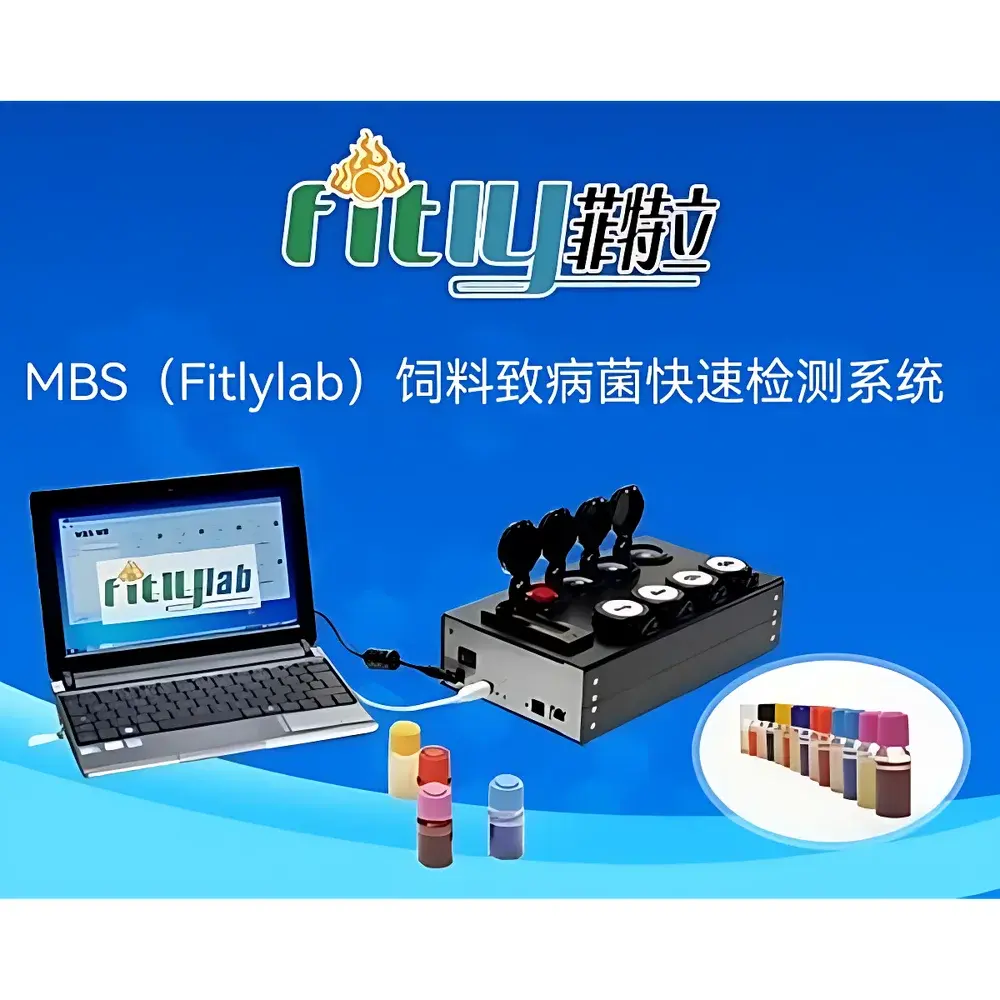
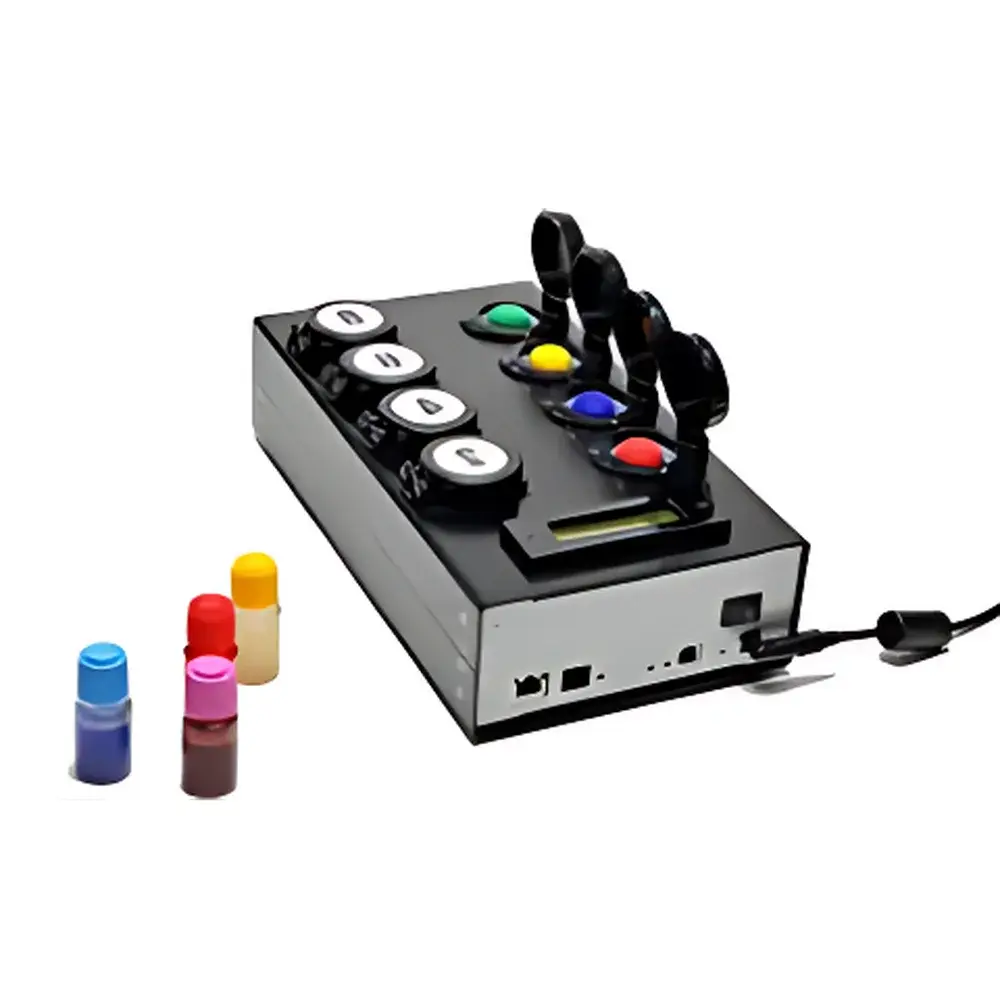
MBS Fitlylab Feed Pathogen Rapid Detection System
| Brand | MBS.SRL |
|---|---|
| Origin | Italy |
| Manufacturer Type | Authorized Distributor |
| Product Category | Imported Instrument |
| Model | MBS (Fitlylab) |
| Detection Method | Chromogenic & Redox-Based Colorimetric Assay |
| Instrument Type | Fully Automated |
| Detection Targets | Total Bacterial Count, *Salmonella* spp., Total Coliforms, *Staphylococcus aureus*, *Escherichia coli*, *Listeria monocytogenes* |
| Sample Types | Compound Feeds (layer/broiler chicken, swine, duck), Animal-Origin Feeds (blood meal, meat-and-bone meal, fish meal, feather meal, whey powder), Plant-Origin Feeds (corn, bran, soybean meal, peanut meal, cottonseed meal) |
| Detection Throughput | 8 independent channels |
| Dimensions | 31.2 cm (L) × 17.5 cm (W) × 9.5 cm (H) |
| Regulatory Compliance | ISO 16140:2003 validated, ISO/IEC 17025:2005 aligned, T/SDAA 025–2021 certified |
Overview
The MBS Fitlylab Feed Pathogen Rapid Detection System is a fully automated, benchtop microbiological analyzer engineered for quantitative and qualitative detection of critical foodborne pathogens and total viable counts in animal feed matrices. It operates on a proprietary redox-based chromogenic detection principle: target microorganisms metabolize specific substrates within the VL detection vial—activating β-glucuronidase, β-galactosidase, or other pathogen-specific enzymes—which catalyze reduction of a chromogenic redox indicator (e.g., tetrazolium salt derivatives). This enzymatic activity alters the oxidation-reduction potential of the medium, inducing a time-resolved color shift detectable across three discrete optical wavelengths (blue, green, red). The MBS-MR instrument continuously monitors spectral absorbance kinetics using triple-wavelength photometry, identifying the inflection point (tinf) in the differential intensity curve as the primary analytical parameter. Since tinf correlates inversely with microbial concentration (log CFU/g), the system delivers precise, calibration-free quantification without culture enrichment or DNA extraction. Designed specifically for complex, low-moisture, particulate feed samples—including high-fat animal meals and fibrous plant meals—the platform eliminates centrifugation, filtration, or pre-enrichment steps for most sample types.
Key Features
- Fully automated 8-channel architecture: each detection well operates independently with programmable temperature control (30–45 °C range) to support simultaneous analysis of diverse pathogens under species-specific incubation conditions.
- Triple-wavelength photometric detection (450 nm, 540 nm, 630 nm): mitigates interference from turbidity, particulates, or pigment carryover common in feed extracts—unlike single-wavelength colorimeters.
- VL detection vials: sterile, sealed, single-use consumables containing pathogen-selective nutrients, inhibitors, and redox indicators; validated per ISO 16140:2003 for equivalence to reference culture methods.
- Direct sample introduction: 1 g solid or 1 mL liquid feed sample added directly to vial; no homogenization, dilution, or neutralization required for >90% of certified matrices.
- CFU-level sensitivity: detection limit of 1 CFU per test vial with ≥99.999% analytical specificity confirmed against 127 non-target strains in interlaboratory validation studies.
- Integrated thermal deactivation: post-assay UV-C irradiation within the vial ensures complete inactivation of residual pathogens prior to disposal—compliant with biosafety level 1 (BSL-1) laboratory requirements.
- Regulatory-ready software: audit-trail enabled, 21 CFR Part 11 compliant data management with timestamped raw absorbance curves, tinf calculation logs, and PDF report generation.
Sample Compatibility & Compliance
The system is validated for use across the full spectrum of commercial feed materials specified in T/SDAA 025–2021, including compound feeds (poultry, swine, aquaculture), animal-derived ingredients (meat-and-bone meal, fish meal, blood meal), and plant-derived components (soybean meal, corn gluten, cottonseed meal). Each matrix undergoes method-specific verification for recovery efficiency (>85%), repeatability (RSD <8%), and robustness against matrix inhibitors (e.g., tannins, mycotoxins, antimicrobial residues). All protocols conform to ISO/IEC 17025:2017 general requirements for competence of testing and calibration laboratories. The integrated software supports GLP-compliant workflow documentation, including electronic signatures, user access controls, and immutable data archiving—enabling seamless integration into GMP-aligned quality control environments.
Software & Data Management
Fitlylab Control Suite (v5.x) provides intuitive, menu-driven operation with multilingual UI (English, Chinese, Spanish). Core functions include: real-time kinetic curve visualization per channel; automatic tinf detection with manual override capability; configurable pass/fail thresholds for qualitative screening; batch reporting with customizable templates (PDF, CSV, Excel); and secure local database storage with optional cloud backup. All data entries are time-stamped, user-identified, and version-controlled. Audit trail functionality records every instrument action—including parameter changes, report exports, and vial lot number entry—meeting FDA 21 CFR Part 11 and EU Annex 11 requirements for electronic records integrity.
Applications
This system serves as a primary screening tool in feed manufacturing QC labs, regulatory inspection agencies, and contract testing facilities. Typical use cases include: rapid release testing of incoming raw materials; in-process monitoring during pelleting or extrusion; finished product verification prior to shipment; environmental swab testing of production surfaces; and outbreak investigation support via same-day pathogen confirmation. Its portability (≤3.2 kg mass) and battery-operated option enable field-deployable analysis at farms, feed mills, or border inspection posts—reducing reliance on centralized reference labs and accelerating time-to-decision by 2–10× versus ISO-standard plate count or PCR-based workflows.
FAQ
What regulatory standards does this system comply with?
It is certified to T/SDAA 025–2021 (China Feed Industry Association), validated per ISO 16140:2003 for method equivalence, and operated in alignment with ISO/IEC 17025:2017 requirements.
Can the system quantify bacteria without enrichment?
Yes—detection is based on metabolic activity in the VL vial; for most feed samples, direct inoculation yields reliable quantification within 6–24 h depending on initial load.
How is data integrity ensured for regulated environments?
The software implements role-based access, electronic signatures, immutable audit trails, and encrypted local storage—fully compliant with 21 CFR Part 11 and EU Annex 11.
Are detection vials reusable?
No—VL vials are single-use, sterilized consumables with integrated UV-C deactivation; post-use disposal follows standard biohazard waste protocols.
Does the system require external calibration standards?
No—quantitative results are derived from intrinsic kinetic parameters (tinf) and do not rely on external calibration curves or reference strains.





