
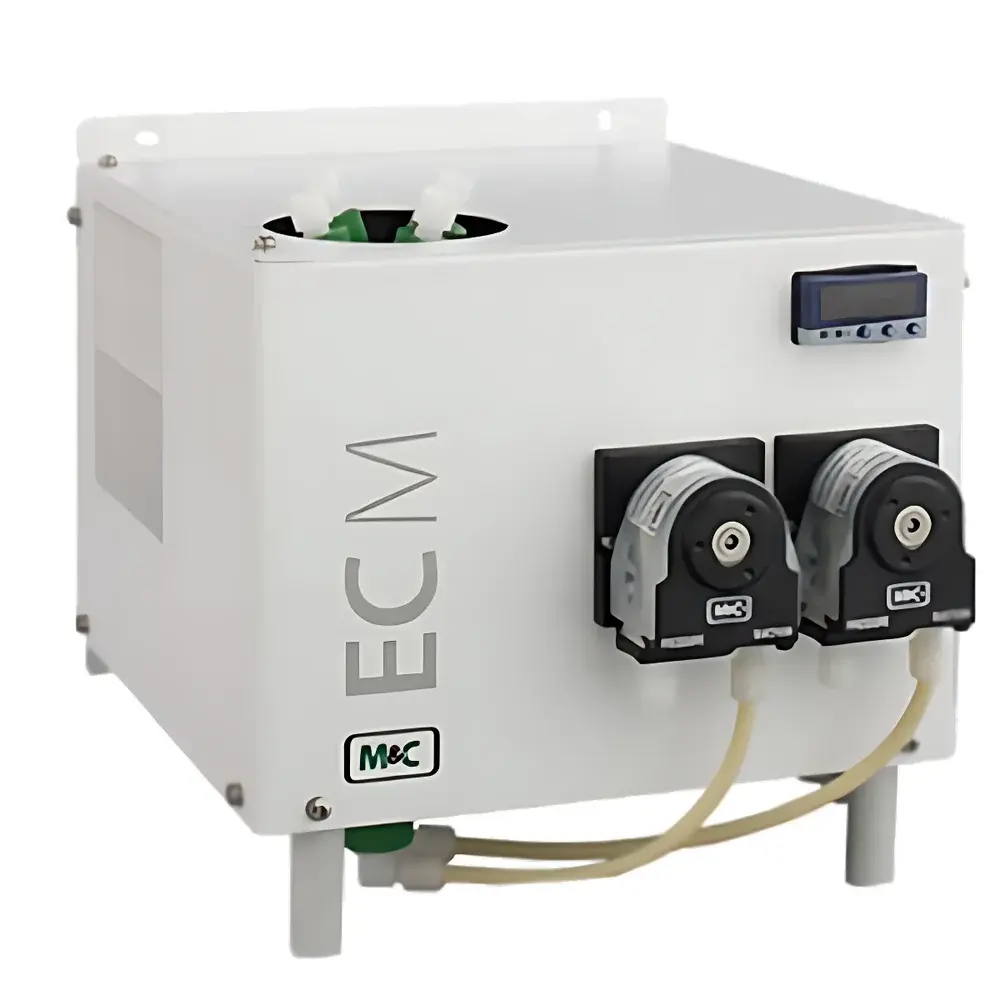
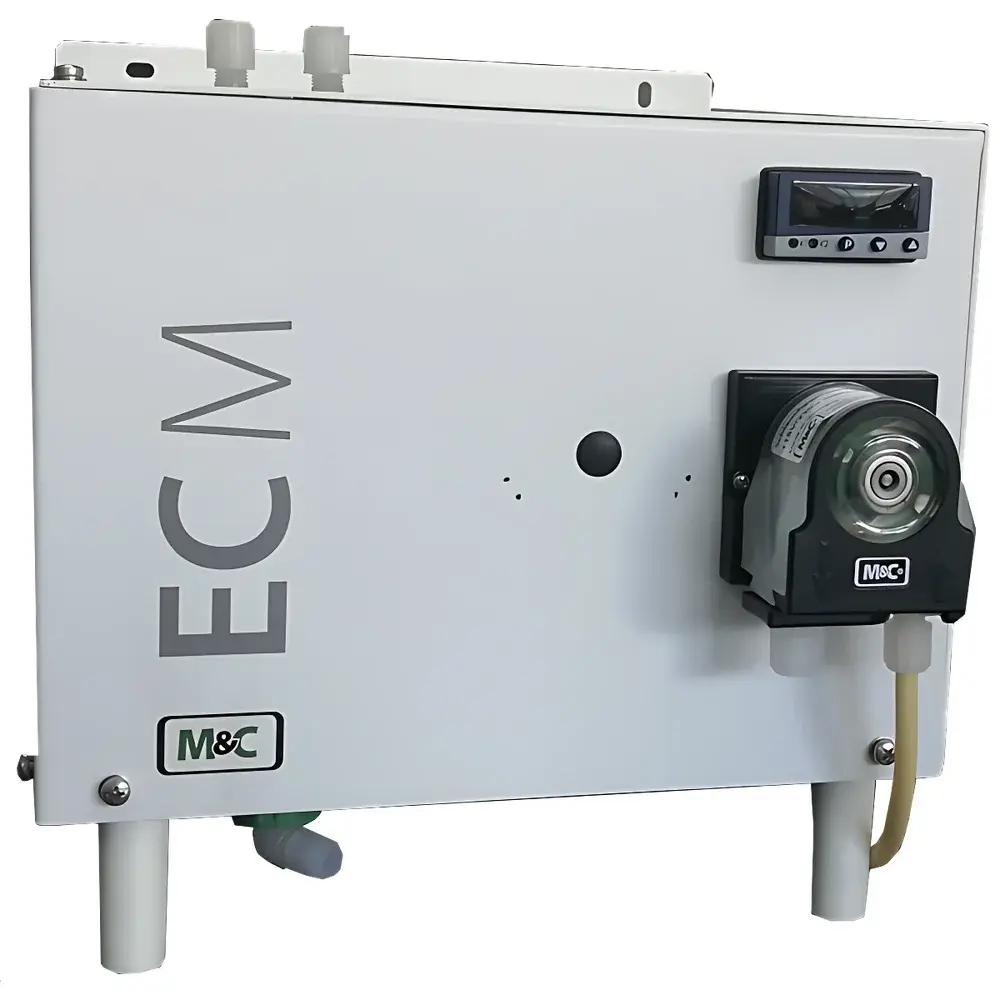
M&C ECM Series Compact Gas Dryer
| Brand | M&C |
|---|---|
| Model | ECM-1 / ECM-2 / ECM-EX2-1 / ECM-EX2-2 |
| Origin | Germany |
| Cooling Principle | Compressor-based refrigerated drying with jet-type heat exchanger |
| Dew Point Range | Adjustable from +2 °C to +7 °C |
| Dew Point Accuracy | ±0.1 °C |
| Heat Exchanger Capacity | ECM-1/ECM-EX2-1: 1 × 250 Nl/h |
| ECM-2/ECM-EX2-2 | 2 × 150 Nl/h |
| Ambient Operating Temperature | Up to 50 °C |
| Certification | ATEX II 2G Ex db IIB T4 Gb, CSA C/US Class I Div 2, FM Class I Div 2, cCSAus |
| Condensate Removal | Peristaltic pump SR25.2 or automatic drain AD |
| Display | Front-panel digital temperature controller with real-time cooling temperature readout and alarm relay output (active at <2 °C or >8 °C) |
| Mounting | Compact rear-panel mounting |
| Housing Material Options | Standard heat exchanger tubes available in borosilicate glass, stainless steel (316L), or PVDF |
| Compliance | Designed for integration into EN 15267-, EPA PS-11-, and ISO 16911-compliant flue gas monitoring systems |
Overview
The M&C ECM Series Compact Gas Dryer is a precision-engineered refrigerated sample gas dryer designed specifically for continuous emission monitoring systems (CEMS) and laboratory-grade flue gas analysis applications. It operates on the principle of compressor-cooled condensation, utilizing a proprietary jet-type heat exchanger to achieve stable, low dew point temperatures in extracted process gases—critical for protecting downstream analyzers (e.g., NDIR, electrochemical, paramagnetic, and FTIR sensors) from moisture-induced drift, corrosion, or blockage. Unlike conventional dryers relying on desiccant or membrane separation, the ECM delivers trace-level moisture control without chemical consumption, pressure drop variability, or adsorption saturation effects. Its core function is to reduce the dew point of hot, humid sample streams—common in stack gas, biogas, or combustion exhaust—to a tightly regulated range (+2 °C to +7 °C)—thereby preventing condensate formation within analyzer cells, sample lines, and calibration manifolds. The system’s thermodynamic stability is ensured by closed-loop compressor control synchronized with real-time thermal feedback from the heat exchanger surface.
Key Features
- Jet-type heat exchanger architecture enabling rapid thermal equilibration and minimal hysteresis across varying flow rates and inlet humidity profiles
- Dew point accuracy of ±0.1 °C over the full adjustable range (+2 °C to +7 °C), verified per ISO 4008 and ASTM D1193 Grade III water specifications
- ATEX II 2G, CSA C/US Class I Div 2, and FM Class I Div 2 certified explosion-proof variants (ECM-EX2-1 and ECM-EX2-2) for Zone 2 hazardous areas
- Three standard heat exchanger tube materials—borosilicate glass (for high-purity, low-adsorption applications), 316L stainless steel (for aggressive acid gas environments), and PVDF (for halogenated or oxidizing streams)
- Integrated digital temperature controller with front-panel LED display, user-setpoint adjustment, and dual-threshold alarm relay (activated below 2 °C or above 8 °C)
- Modular condensate management: configurable with single or dual SR25.2 peristaltic pumps or fully automatic drain (AD) unit for unattended operation up to 72 hours
- Rear-panel mounting design optimized for space-constrained CEMS shelters and analyzer cabinets, with IP54-rated enclosure
Sample Compatibility & Compliance
The ECM series is validated for use with flue gases containing SO₂, NOₓ, CO, CO₂, O₂, HCl, HF, and NH₃ at concentrations typical of coal-fired, waste-to-energy, cement kiln, and industrial boiler emissions. It complies with the mechanical and environmental requirements of EN 15267-3 (Performance Testing of Automated Measuring Systems), EPA Performance Specification 11 (PS-11), and ISO 16911 (Stationary source emissions — Manual and automated determination of velocity and volume flow rate). All models meet electromagnetic compatibility (EMC) per EN 61326-1 and safety standards per EN 61010-1. The cCSAus certification confirms conformity with UL 61010-1 and CAN/CSA-C22.2 No. 61010-1 for laboratory and field-deployed instrumentation in North America.
Software & Data Management
While the ECM operates as a standalone hardware module, its analog temperature output (4–20 mA) and digital alarm relay interface seamlessly integrate into SCADA, DCS, or CEMS data acquisition systems. When deployed in FDA-regulated or GLP/GMP environments, the device supports audit-trail-ready configurations when paired with compliant DAQ platforms (e.g., those adhering to 21 CFR Part 11 requirements for electronic records and signatures). No embedded firmware updates or cloud connectivity are required—ensuring long-term operational integrity and minimizing cybersecurity exposure in critical infrastructure settings.
Applications
- Continuous emission monitoring systems (CEMS) for regulatory compliance reporting under EU IED, US Clean Air Act Title V, and China GB 13223
- Calibration gas conditioning in reference analyzer verification protocols (e.g., EN 14181 QAL2/QAL3)
- Pre-analyzer moisture conditioning for FTIR-based multi-component gas analyzers
- Biogas upgrading process monitoring where H₂S and siloxane removal precedes CH₄ enrichment
- Research-grade combustion studies requiring dew-point-stabilized sampling for stoichiometric ratio validation
FAQ
What is the maximum allowable inlet gas temperature?
The ECM is rated for continuous operation with inlet gas temperatures up to 180 °C when used with optional high-temp pre-cooling stages; standard configuration assumes ≤60 °C inlet.
Can the ECM be used with corrosive gas matrices such as wet HCl or HF?
Yes—select the PVDF or 316L stainless steel heat exchanger variant, and ensure all wetted materials (including tubing and fittings) are chemically compatible per NACE MR0175/ISO 15156 guidelines.
Is dew point calibration traceable to national standards?
Dew point sensors are factory-calibrated against NIST-traceable chilled-mirror hygrometers; certificate of conformance includes uncertainty budget per ISO/IEC 17025.
How often does the SR25.2 peristaltic pump require tubing replacement?
Under continuous operation at 25 °C ambient, standard silicone tubing lasts ≥3 months; fluorosilicone variants extend service life to 6+ months in ozone-rich or chlorinated environments.
Does the ECM support Modbus RTU or Ethernet/IP communication?
No—the ECM is an analog/digital I/O-only device; protocol conversion requires external gateway integration via its 4–20 mA output and relay contacts.
Related Products







