
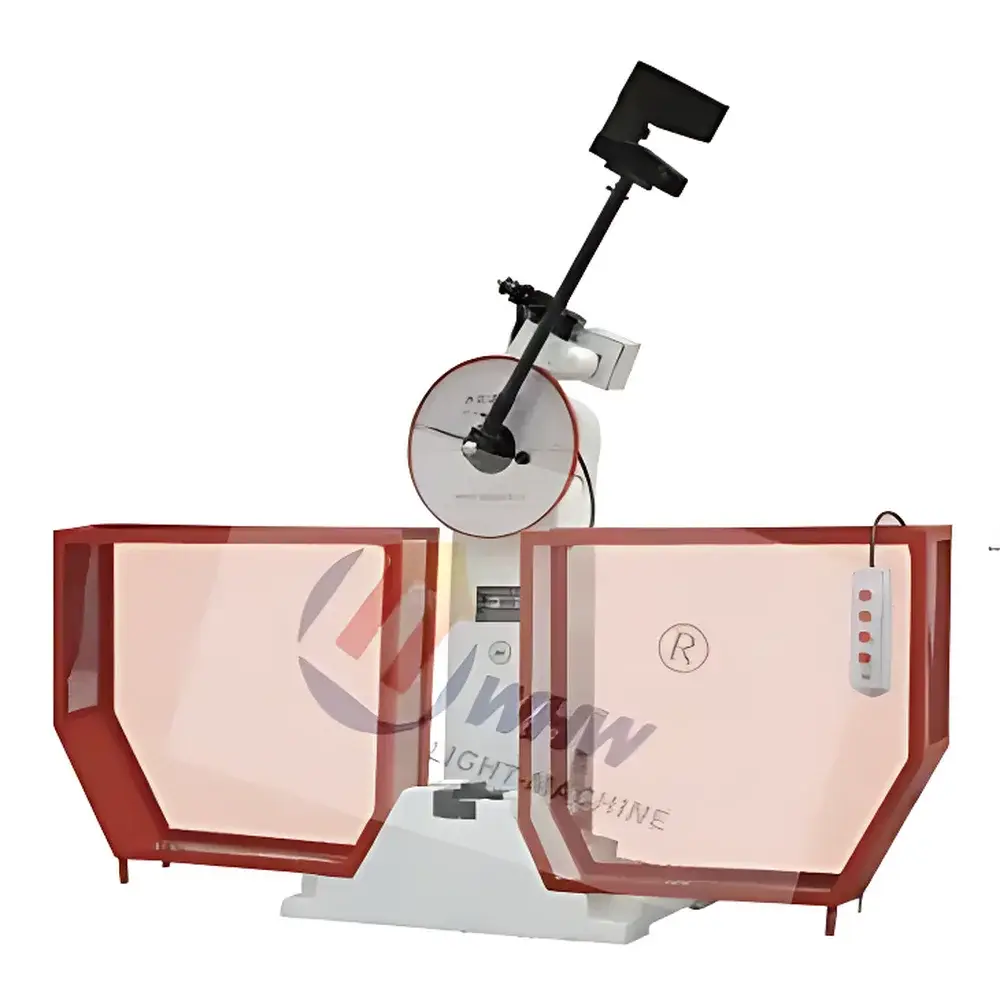
MC009-JB-300B/500B Semi-Automatic Charpy Impact Testing Machine
| Origin | Shanghai, China |
|---|---|
| Manufacturer Type | Authorized Distributor |
| Origin Category | Domestic (PRC) |
| Model | MC009-JB-300B / MC009-JB-500B |
| Quotation | Available Upon Request |
| Impact Energy | 150/300 J (JB-300B) / 250/500 J (JB-500B) |
| Pendulum Pivot-to-Impact Point Distance | 750 mm (JB-300B) / 800 mm (JB-500B) |
| Impact Velocity | 5.2 m/s (JB-300B) / 5.4 m/s (JB-500B) |
| Pre-Lift Angle | 150° |
| Specimen Support Span | 40 mm |
| Anvil Radius | R1–R1.5 mm |
| Striking Edge Radius | R2–R2.5 mm and R8 ± 0.05 mm |
| Specimen Dimensions | 10 × 10 × 55 mm (standard), with optional 7.5, 5, or 2.5 mm thicknesses |
Overview
The MC009-JB-300B and MC009-JB-500B Semi-Automatic Charpy Impact Testing Machines are precision-engineered pendulum-type impact testers designed for evaluating the notch toughness of metallic materials under dynamic loading conditions. Based on the classical Charpy V-notch (CVN) and Charpy U-notch test principles defined in ISO 148-1 and ASTM E23, these instruments quantify absorbed energy during fracture—providing critical data for material qualification, quality control, and structural integrity assessment in high-stress applications. The machines operate on a single-column, cantilevered pendulum architecture with a U-shaped hammer body and calibrated rotational inertia, ensuring high reproducibility across repeated tests. Their semi-automated operation—integrating electromechanical lifting, automatic pendulum release, post-fracture energy recovery, and mechanical dial readout—reduces operator dependency while maintaining full compliance with international calibration and testing standards.
Key Features
- Single-column, rigid frame construction with cantilevered pendulum mounting for minimal vibration transmission and long-term alignment stability.
- Interchangeable striking edges (R2–R2.5 mm for U-notch; R8 ± 0.05 mm for V-notch) secured via precision-threaded fasteners—enabling rapid, tool-assisted replacement without recalibration.
- Standardized 40 mm span anvil support with R1–R1.5 mm chamfered clamping surfaces, conforming to ISO 148-2 and GB/T 229–2007 specimen geometry requirements.
- Integrated dual-safety system: mechanical safety pin engagement during pendulum rest position and full-height wire-mesh guard enclosure compliant with EN ISO 13857 reach-distance criteria.
- Semi-automatic cycle control: motor-driven pendulum lift, solenoid-triggered release, and residual-energy-driven re-lift after fracture—optimized for batch testing in metallurgical QA labs and production floor environments.
- Mechanical analog scale display with dual-range energy indication (e.g., 0–150 J / 0–300 J for JB-300B), offering direct visual readout without software dependency or power interruption risk.
Sample Compatibility & Compliance
These testers accommodate standard Charpy specimens per ISO 148-1, ASTM E23, and GB/T 229–2007: rectangular cross-sections of 10 mm × 10 mm × 55 mm, with optional thickness reductions (7.5 mm, 5 mm, 2.5 mm) for subsize evaluation. Notch geometries include standardized U-notch (5 mm depth, 1 mm root radius) and V-notch (2 mm depth, 0.25 mm root radius). All mechanical components—including pivot bearings, anvil surfaces, and striker edge profiles—are manufactured and verified per GB/T 3803–2002, which specifies metrological validation procedures for pendulum impact machines. Calibration traceability is maintained to national standards (e.g., CNAS-accredited reference laboratories), supporting audit readiness for ISO/IEC 17025, IATF 16949, and AS9100 quality management systems.
Software & Data Management
As analog-dial instruments, the JB-300B and JB-500B models do not incorporate embedded digital controllers or proprietary software. However, they are fully compatible with external documentation workflows: operators may record results manually into LIMS or ELN platforms, or integrate with optional digital transducer kits (e.g., load-cell–based energy sensors and optical encoders) for automated data capture. When used in GLP- or GMP-regulated environments, paper-based test records—including specimen ID, lot number, environmental conditions (temperature per ISO 148-1: ≥20 °C for ferrous alloys), and technician signature—must be retained for minimum 10 years per internal QA policy and regulatory expectations. The absence of electronic records eliminates 21 CFR Part 11 compliance obligations, simplifying validation for legacy-controlled facilities.
Applications
- Quality assurance of hot-rolled and forged steels in automotive and heavy equipment manufacturing.
- Evaluation of low-temperature embrittlement in pipeline-grade X-series steels (per API RP 5L3).
- Verification of heat treatment efficacy (e.g., tempering response in quenched-and-tempered alloy steels).
- Research into fracture mechanics parameters—including ductile-to-brittle transition temperature (DBTT)—via series testing at controlled temperatures (–80 °C to +150 °C using external environmental chambers).
- Supplier qualification audits requiring third-party witnessed Charpy testing per customer-specific PPAP or PQ protocols.
- Failure analysis laboratories performing comparative impact assessment of weld metal, HAZ, and base metal zones.
FAQ
What standards does this machine comply with?
It conforms to GB/T 3803–2002 (verification of pendulum impact testers) and GB/T 229–2007 (Charpy impact test method), and is functionally aligned with ISO 148-1, ASTM E23, and EN 10045-1 for specimen preparation and test execution.
Can it test subsize specimens?
Yes—standard fixtures accept 10 × 10 × 55 mm specimens, and optional adapters support 7.5 mm, 5 mm, and 2.5 mm thicknesses per ASTM E23 Annex A2 and ISO 148-1 Clause 6.3.
Is calibration certification included?
Factory calibration verification is provided; however, end-user periodic verification per GB/T 3803–2002 must be performed annually—or after any maintenance affecting pendulum inertia, pivot friction, or anvil alignment—using certified reference specimens.
What maintenance is required?
Bi-weekly inspection of pivot bearing lubrication, monthly verification of anvil parallelism and striker edge wear (using optical comparator), and quarterly torque check of all fasteners securing the pendulum assembly and specimen supports.
Does it support both Charpy U and V notches?
Yes—the interchangeable striker edges and standardized anvil geometry allow seamless transition between U-notch (GB/T 229) and V-notch (ISO 148, ASTM E23) configurations without hardware modification.



